Review: After Earth (2013)

after-earth-jaden-smith-will-smith

Wow. After the STAR WARS prequels and being subjected to four-and-a-half hours of Hayden Christensen, I didn’t think it was possible for another actor to make him look charismatic by comparison, by Jaden Smith manages it. In AFTER EARTH’S first scene he’s a bored-sounding exposition robot, and his performance only goes downhill from there. The same could be said for the whole film really, going as it does from dreary to worse.

In essence, the film doesn’t have a bad premise for a sci-fi actioner. Mankind has ruined the Earth (aren’t we the worst?) so we settle elsewhere but are predated on by blind fear-sensing aliens. Enter Cypher Raige (Will Smith), a fearless unstoppable action man to save us all. His son Kitai (Jaden Smith) is unable to match his father’s legacy so daddy takes him on the training exercise to end all training exercises. Things go wrong, daddy issues…be a man…they always loved each other unconditionally…yadda yadda.

Let’s pick at the plot strands a bit and see what unravels. We’re shown that the ship the Raiges are stranded in has an emergency beacon, and they appear to manage to use it to fire a distress signal back home. We’re then told they need another beacon located in the bit of spaceship that broke off when they crashed, but not why. It turns out the first beacon didn’t fire after all, but that wasn’t made in any way clear. We’re just asked to go along with it so Kitai will have something to do for the next hour. What it really that necessary to carry a thing specifically evolved to kill you on the same ship purely for training purposes? Why doesn’t Cypher get Kitai to help him with his injuries before he sends him into the wilderness so he can better assist him on his quest?

It’s likely the idea of leaving Cypher with the ship, in communication with Kitai – with him but not with him – was meant to symbolise their arm’s-length relationship. If it was, then it doesn’t really work. Kitai is a rubbish protagonist. As already mentioned, Smith the Younger imbues him with nothing to make him empathetic, or engaging, or interesting (the most notable thing he says is: “My suit’s turned black. I like it, but I think it’s something bad”). He just runs, frowns, shouts, falls over and stumbles through his journey. There are some hilariously lazy quick-fixes for plot problems, usually involving Kitai coming into contact with Earth’s wildlife and either miraculously running away in the right direction or getting a free lift as they carry him off to eat. I really hope this is actually what Jaden wants to do with his life and he’s not just doing it because he’s the son of two successful actors. He might be much better at doing something else. Smith the Elder appears to have had all his usual charm and personality surgically removed to play the glum, hilariously named Cypher. It must have been exhausting to mastermind and co-write such a narcissistic pile, that’s clearly why he’s got to sit down throughout.

The CGI could have done with another pass too. It’s not so bad to bring you completely out of the film, and the Ursa monsters look OK in a ripoff Xenomorph kind of way, but I’ve seen better computer-generated fantasy animals on the small screen. If you’re not going to push for a good script, performances, or interesting concepts, the least you can do is make your action movie look good, surely?

Their ship looks a bit like a manta ray – that’s cool I guess? The best part of the film takes place over about 20 seconds. Father and son on their transport ship, sitting side by side and looking incredibly ill at ease (see accompanying image). Kitai tries to engage his dad in conversation, telling him what he’s been reading lately before Cypher shoots him down and insists they get some shut-eye. Clumsily scripted and performed as a key scene midway through the film is, at least Cypher’s explanation for how he overcomes fear has a certain logic to it. It’s about the only thing that makes any real sense.

The most disappointing thing I found about the film, worse than Smith’s ego, worse than the plotting, characterisation, script or performances, was that it didn’t feel remotely like an M Night Shyamalan film. It could have been directed by anyone. No matter how bad Shyamalan’s films have become over the past decade, at least they were always bad in fascinating and amusing ways. They were never dull. This is just vanilla and miscalculated to the extreme like any other run-of-the-mill minor blockbuster. SSP
Posted in Film, Film Review | Tagged , , , , , , , , , | Leave a comment

Film Confessional: Seventh Son

film_seventh_son_gallery_1600x900_1

I have a confession to make…I rather liked SEVENTH SON. But this isn’t going to be one of those times where I’m going to defend a much-derided work to the ends of the Earth. Seventh Son is pretty bad, there’s no getting around that. But badness can be glorious, endearing, even enjoyable if – counter-intuitively – it’s done right.

Jeff Bridges is at that stage in his career now – he’s an established character actor and former heartthrob, but he’s got his Oscar now and can keep his career ticking over by playing grouches. Julianne Moore too has paid her dues and graciously accepted her awards, and has never been above alternating between prestige pieces and more entertaining, trashy fare. Both do pantomime so well here they should seriously consider moving to the UK.

The script, story, characterisation mostly doesn’t work. The mythology of this world is complete hokum, and characters make quite baffling decisions in their journey through it. I’m reminded of a quote from the late Terry Pratchett that most fantasy “just rearranges furniture in Tolkien’s attic” and that seems to be the case here. I’m not aware of his accurate an adaptation of the books the final film is, but the resulting mixture, full as it is of clashing lifts from European history and every fantasy author under the sun, does little to inspire. It never feels like a complete, self-contained world that makes sense on its own terms, we’re just presented with new rules as a when the filmmakers see to allow for the plot to limp on. It’s not painful to sit through, and it’s all entertaining enough, but you actively have to disengage your brain.

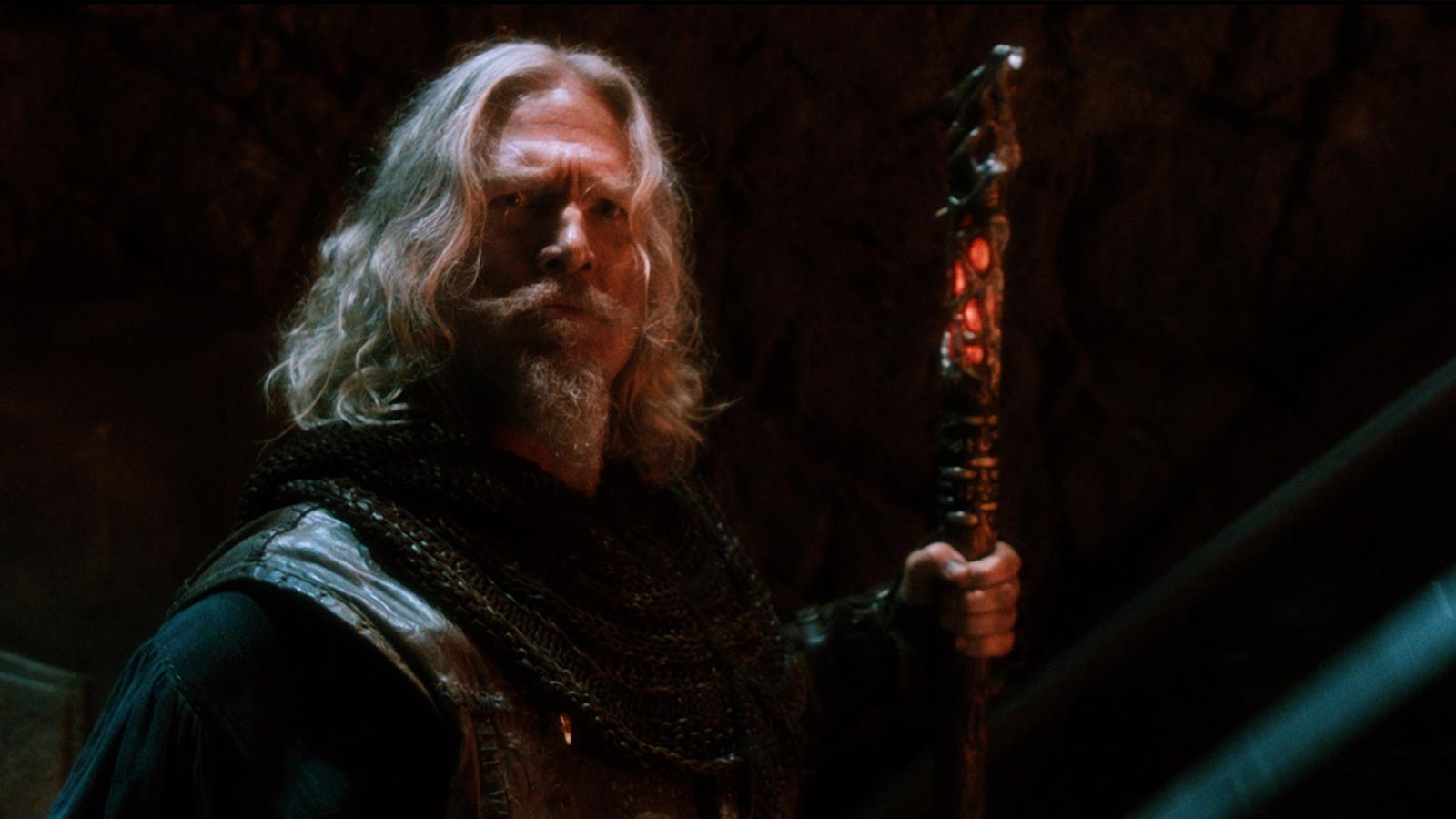
There’s a fun drinking game you can play while watching Seventh Son – take a good swig every time Jeff Bridges sounds like he’s about to choke on his false teeth. You’ll be inebriated in minutes! Apparently he decided to wear them because he thought Master Gregory, living in the Medieval-esque time he does, should have really bad teeth. Then the hair and makeup people slapped a massive beard on his face so you can rarely actually see his teeth. Following this, Bridges seems to have re-dubbed most of his lines with that seriously weird voice he’s chosen so now he sounds a bit like Bane from THE DARK KNIGHT RISES.

The key thing that, for me, prevented the film from collapsing under the weight of its own preposterousness was how earnest all the actors were. Yes, the story and script are stupid, but the performers are fully committed to it, and are clearly having a lot of fun with what they’re being asked to do as well. As already mentioned, Bridges does good grouch, and I’ll admit I laughed a fair bit at his sarky cantankerous comments and how inconsistent his advice to his new apprentice is. Moore practically cackles with glee playing Mother Malkin, and it must have been a pleasant release after doing a string of downbeat dramas over the past few years. Playing Tom the once-and-probably-never-again Prince Caspian Ben Barnes – bless him – is still more wooden than Gregory’s glowy fighting stick.

Genuinely good are the visual effects and creature designs. Witches in this world can shape-shift into big cats, bears, or dragons to better spread death and destruction, and the action highlight of the film involves Mother Malkin’s coven descending on a defenceless town and unleashing the full might of their assorted powers, all very imaginatively realised. It’s a great set piece with a pretty solid Marco Beltrami score to drive it.  I would have liked this scene to have gone on a little longer, and also to have seen a more of what (mild spoiler) Olivia William’s witch-in-hiding could do, though. She must be able to do a bit more than some hand-waving if she was able to snatch Mother Malkin’s protective amulet.

Now and again I’m more than happy to switch off my brain and revel in the badness. Even the most inept ideas have highlights, and Seventh Son’s production design really did impress me. In terms of fantasy actioners, I’d place it firmly in the middle of the pack – it’s better than VAN HELSING (not as tone deaf), but it’s not quite up there with HANSEL & GRETEL: WITCH HUNTERS (it’s missing the darkness and depravity). If you didn’t like it, fair enough, but if you’ve been put off by the reviews so far and fancy a little undemanding fun, I’d say give it a go. SSP

Posted in Film, Film Feature, Film Review | Tagged , , , , , , , , , , , , , | Leave a comment

Review: The Man from U.N.C.L.E. (2015)

Henry-Cavill-Armie-Hammer-Alicia-Vikander-in-The-Man-From-UNCLE-2015-movie

2015 has been a busy year for the spy genre. Between the anarchic KINGSMAN, the thrilling MISSION IMPOSSIBLE, and the much-hyped SPECTRE lurking round the corner,  THE MAN FROM U.N.C.L.E. had it all to prove. Guy Ritchie is in the somewhat unenviable position of bringing out his espionage effort slap-bang in the middle of the pack. He also essentially does exactly the same as he did for SHERLOCK HOLMES – namely giving this story a contemporary twist in tone but maintaining a version of the original story’s period setting. Is it successful? Mostly.

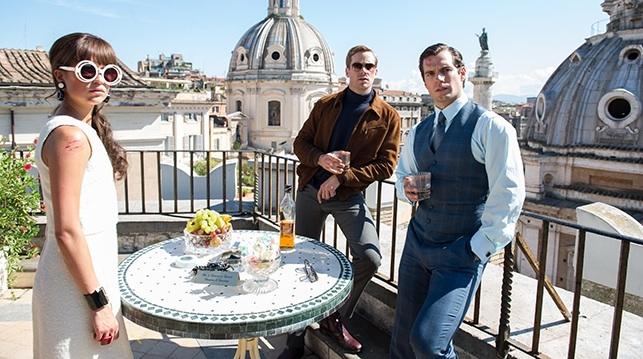
When maverick American spy Napoleon Solo (Henry Cavill) is sent on a mission in East Berlin to extract Gaby Teller (Alicia Vikander), the daughter of a prominent nuclear scientist, little does he suspect that he will soon be forced to ally himself with his Soviet equivalent Illya Kuryakin (Armie Hammer) by his superiors for the sake of world peace. Despite their vastly differing loyalties and ideologies, Solo, Kuryakin and Teller are soon on the trail of a rich and powerful group with plans to heat up the Cold War. 

This kind of film lives or dies on the performances of, and the relationship between, our central protagonists. Thankfully, Cavill and Hammer are superb as Solo and Kuryakin. Cavill could easily have just played Superman in a sharper suit, but he gives Solo a wonderful 60s smoothie cadence, and seems to have fun playing a bit of a jerk as well. Hammer has recovered well from the career stumble that was THE LONE RANGER, and you can easily buy Kuryakin being the ideal Soviet soldier (I mean, just look at him) plus Hammer gives him a quiet intelligence even if he can overplay his psychological trauma. The pair bounce well off each other, and refreshingly still aren’t the best of buddies by the story’s resolution. Alicia Vikander effortlessly saves Gaby from just being the girl along for the ride. Solo and Kuryakin, being the 60s men they are, both try to make her “my woman”, but she gives her agency, attitude, and great comic timing too. I absolutely loved Gaby’s shuffling dance routine as she tries to loosen up Kuryakin in their hotel room after becoming sloshed on vodka. Hugh Grant turns up at the end as well, which is always nice.

The cabal of villains we’re presented with are far less inspiring, and a little dull and indistinct. The best of the bunch is Victoria, and Elizabeth Debicki plays her like a creepy, scheming Grace Kelly. It’s rare too that we have a female villain as tall, if not taller than our heroes, and quite a pleasing sight to see Superman have to look upwards to make eye-contact.

Not every joke lands, particularly concerning Kuryakin’s awkward cover identity, but there are some decent one-liners (Jared Harris theorises that “Inside every Kraut there’s an American trying to get out”), plus a seriously dark accidental offing of one of the baddies, and a standout scene of Solo stopping for a little pick-nick as poor old Kuryakin does all the hard work over his shoulder.

Sometimes I feel Ritchie could tone it down a bit in terms of style. LOCK, STOCK AND TWO SMOCKING BARRELS was made in its dynamic editing, but here Ritchie’s directorial quirks generally seem completely unnecessary. You can’t make a boring  searching a warehouse scene less so by throwing in a shifting split screen. Ritchie also chose rather a hard font to read in yellow for the decent portion of subtitled dialogue. Speaking of subtitles, I think this is the first movie I’ve seen where characters’ dialogue isn’t audible, but we’re still given the subtitles. This choice makes no sense, and it’s not a convention that should catch on. That said, Ritchie and DP John Mathieson compose a gorgeous shot of Solo girding himself for the latest onslaught down a darkened Berlin street, his eyes highlighted by a single, perfect diagonal shaft of light. You take the bad stylistic flourishes with the good.

Like both Ritchie’s Sherlock films, the plot for The Man from U.N.C.L.E. is OK. Just OK. It’s only fit for purpose as long as you don’t over-analyse it. Things that don’t require explanation (like what the Cold War was) are explained. Things that should be explained (like what the hell the bad guys’ end game is) are not. Also, for undercover agents, Solo and Kuryakin spend a little too much time blatantly talking about their mission out in the open for my liking.

If you liked Guy Ritchie’s Sherlock Holmes, you’ll probably like The Man from U.N.C.L.E. well enough, though I can’t testify to what extent it does the original show justice (and considering his age, and unless he’s been doing a lot of back-to-back viewing, neither can Ritchie). You might miss the well-honed wit and superlative thrills of 2015’s other spy films, but it’s got enough charm and charisma of its own to make it worth a look. SSP

Posted in Film, Film Review | Tagged , , , , , , , , , , , , , , , , | 1 Comment

“Enough about me, let’s talk about me…”: When Actors Play Themselves (Sort-of)

Gray-Ghost-4

What’s an actor to do when your star persona becomes a joke? You embrace it of course, and let the audience know that you’re in on the gag. It can be incredibly self-indulgent if mishandled, but if pitched just right it can make a film or TV episode vividly memorable. Here’s a few of my favourite instances when an actor has played themself in a movie or TV series to comic or subversive effect.

btas-beware-the-gray-ghost-02

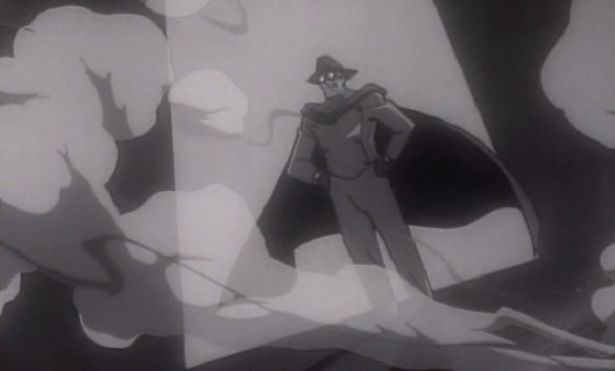
BATMAN: THE ANIMATED SERIES (1992-1995) I loved BATMAN: THE ANIMATED SERIES throughout its run, and still consider it the definitive version of the Dark Knight’s story (yes, including the Nolanverse). It had many highlights, but it was a stroke of genius to get Adam West to play, what else? An actor struggling to get work because of his inescapable association with a single iconic role. It clearly exaggerated West’s woes at the time the show aired, but it does pretty much reflect the state of his career in the years immediately following 1960s BATMAN’s cancellation. It’s West’s poignant performance, the meta-textuality of the plot, in addition to really strong writing that made “Beware the Gray Ghost” one of the finest episodes of The Animated Series’ run.

last-action-hero-arnold-schwarzenegger-maria-shriver

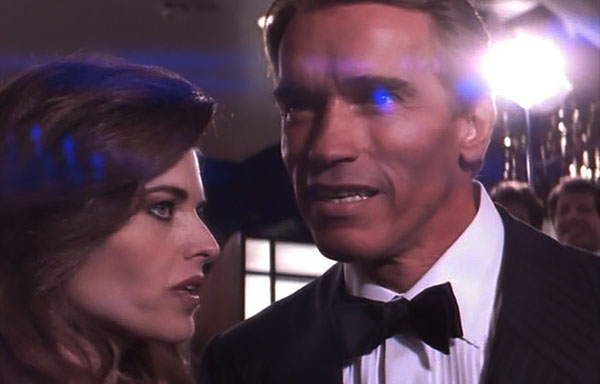
LAST ACTION HERO (1993) Arnold Schwarzenegger spoofs his usual persona for much of this jarring-in-tone family actioner, but as the finale looms he goes one better. Playing the blissfully unaware walking slab of irony that is supercop Jack Slater, Arnie bumps into a familiar face at the premiere of his character’s latest high-octane outing…Arnold Schwarzenegger. So it’s Schwarzenegger playing Slater talking to Schwarzenegger, reality inverts, awesomeness ensues. Thank goodness Arnie has never taken himself all that seriously.

being-malkovich

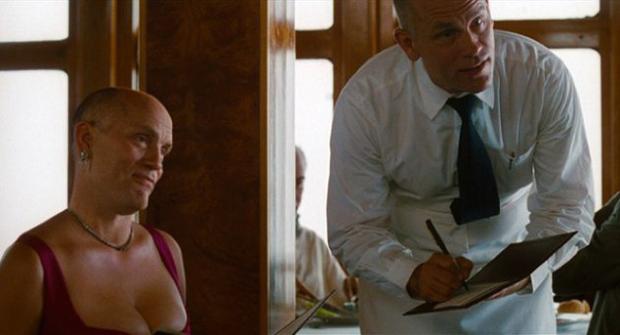
BEING JOHN MALKOVICH (1999) Reality-bending writer Charlie Kaufman’s none-too-trippy idea of using John Malkovich as an unwitting plot device for explaining the concept of free will was master stroke. Malkovich’s willingness to play himself as an actor who is ever recognisable but instantly forgettable was accommodating and completely without ego. You have to be confident in your premise and fully embrace the wackiness to convincingly sell crawling inside your own head. Malkovich Malkovich Malkovich!

patstew lifes-too-short-episode-1-warwick-davis-liam-neeson-review-episode-guide-list

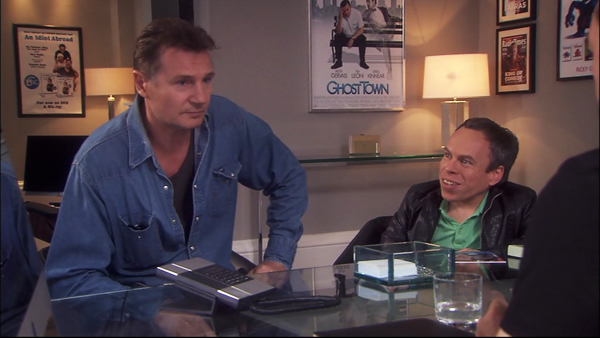
EXTRAS (2005-2007) / LIFE’S TOO SHORT (2011) I’m lumping both of Ricky Gervais’ showbiz-commentary sitcoms together for their much for muchness. Sorry, Gervais superfans. A good number of Hollywood’s finest spoofed themselves on Gervais’ former much-better-than-THE OFFICE sitcom, but Patrick Stewart’s turn was the highlight for me. He’s just as charming as you’d expect, but Gervais and Stephen Merchant write him a bit of an old pervert as well, obsessed by his dream script of playing a man who causes every woman’s clothes to fall off. As for LIFE’S TOO SHORT, the cameo to remember came from the famous on-screen stoic Liam Neeson wanting to break in to comedy with AIDS jokes. I know it’s wrong, but funny is funny.

bruce-drinks-out-of-the-dog-bowl

MY NAME IS BRUCE (2007) “Not sure about the plots, but you’re usually pretty good in them”. So a character describes Bruce Campbell’s career. It pretty much sums up this somewhat self-indulgent parody too. Bruce is great, but the rest…meh? He’s very self-depricating and willing to play an absolute egotistical tool. He’s not really playing himself, but a parody of what a cult icon might be off-screen (a self-obsessed diva) rather than the well-balanced, accommodating human being Campbell actually appears to be from his well-documented interactions with fans.

Sam-Jones

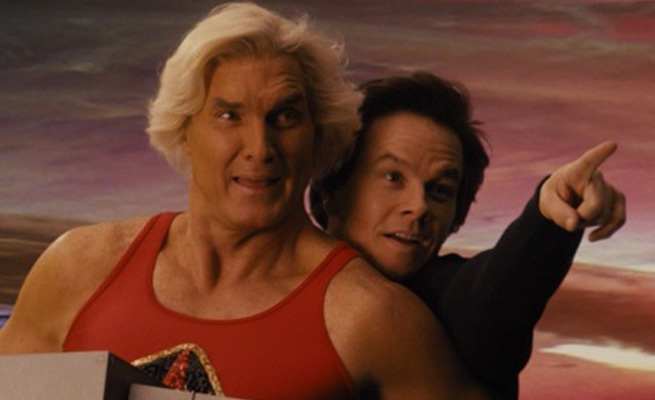
TED (2012) Seth MacFarlane doesn’t really do subtlety. Sam Jones’ memorable appearance as a drug-addled, borderline psychotic version of himself still wearing his Flash Gordon hair is all the better for being about as nuanced as an animated teddy bear fighting a duck. John (Mark Wahlberg) and Ted’s (MacFarlane) encounter with Jones veers from a dream come true (Jones asking them “Do you party?”) to a living nightmare (Ted’s “I’m scared, John” as Jones’ behaviour becomes increasingly illegal and erratic, culminating in him attacking an Asian man with an unfortunately resonant name in the next apartment). FLASH GORDON plays a key part in John and Ted’s relationship, and Jones takes the joshing he gets for his “very loose definition of acting” like a champ.

The_Five(ish)_Doctor_Reboot_3

THE FIVE(ISH) DOCTORS (2013) You might not have seen this one if you live outside of the UK. As a tie-in with DOCTOR WHO’s 50th Anniversary, Fifth Doctor Peter Davison wrote a comedy special starring himself and the other surviving incarnations of the Doctor who were snubbed for a part in the Anniversary episode. Davison, Colin Baker, Sylvester McCoy, Paul McGann, Steven Moffat, Olivia Coleman, John Barrowman among others all played parodies of themselves, but the highlight was undoubtedly McCoy casually name-dropping Peter Jackson and his far more famous Middle-Earth co-stars. I hope none of the previous TARDIS inhabitants really felt this sore at being left out of the festivities, but they came together to produce this light-hearted comic treat precisely because they were.

Edward Norton Birdman

BIRDMAN (2014) While the performance in BIRDMAN that received most attention was Michael Keaton playing a has-been superhero fighting for credibility, he comes across as too grounded and, well, sane in real life for Riggan Thompson to be said to be a version of himelf. Edward Norton, on the other hand, is definitely drawing on experience here in playing Mike Shiner. It’s not so much that he’s actually playing himself but that he’s playing a grotesque version of how he’s perceived in the public consciousness. There are some pretty explicit references to his squabbles with colleagues, and walking out of (or being fired) from major projects for being “difficult”. This, combined with shoutouts to Robert Downey Jr and Jeremy Renner makes it pretty clear that writer-director Alejandro Iñárritu and Norton are specifically taking swipes at the latter’s experience working with Marvel. The bile is barely concealed, but it never becomes obnoxious.

Can you spot any glaring omissions from my selection? What are your favourite examples of actors playing themselves on TV or film? Leave a comment and thanks for reading. SSP

Posted in Film, Film Feature, Television | Tagged , , , , , , , , , , , , , , , , , , , , , , , , , , , , , , , , , , , , , , , | Leave a comment

Review: Mission: Impossible – Rogue Nation (2015)

mission-impossible-rogue-nation-01

The latest outing for Ethan Hunt and the IMF is the most ambitious and technically accomplished to date. There really is very little to ruin your enjoyment of ROGUE NATION overall, and Christopher McQuarrie equips himself admirably as the latest caretaker of the MISSION: IMPOSSIBLE director’s chair.

Following his latest high-stakes mission, it becomes increasingly clear to Agent Ethan Hunt (Tom Cruise) that an unknown and malevolent entity with untold power and influence is behind a series of destabilising attacks across the world. CIA senior Alan Hunley (Alec Baldwin) sees the IMF as outdated, unregulated, and dangerous, and uses Hunt’s apparent paranoia about shadowy forces to disavow his team and drive them underground. Hunt must now reform his team in secret and contend with some deadly individuals with their own agendas to uncover the Syndicate.

Most of us are paying primarily to see Cruise do his thing, and he is still able to perform staggering physical feats for a man past 50. Rebecca Ferguson’s puzzle-box of a rival agent Ilsa Faust makes for a fascinating contrast, and foil, to Ethan Hunt. She wears some ridiculous outfits, and every time you scoff at whether she’ll be able to perform the action in them, then (after occasionally pausing to remove her heels) she does. She’s arguably an even more skilled, more deadly agent than Hunt, and certainly a more nuanced character – just look at the range of emotions that flash by in her eyes when she is informed her mission will not end any time soon. Simon Pegg’s Benji is still good value for money, and Jeremy Renner’s Brandt and Ving Rhames’s Luther make for an entertaining double-act even if the wider plot of the movie passes their characters by. Alec Baldwin plays his 30 ROCK character again, but in a different suit.

Sean Harris is essentially a far less flamboyant version of Javier Bardem’s baddie from SKYFALL, and they share pretty much the same backstory. That’s one thing that still baffles me – five movies in, and the Mission: Impossible franchise is still yet to produce a great villain. Philip Seymour Hoffman probably came closest in MISSION: IMPOSSIBLE III by the virtue of being the most interesting of the bunch. Ah well, maybe next time.

The plot is linear and rarely loses momentum, and pleasingly it doesn’t quite go where you expect it to. We’re provided with just enough tangents, just enough intrigue to keep our eyes glued. I didn’t even mind the shadowy-force-controlling-everything premise so much since they commit to the ridiculousness of it from the start rather than springing it on us as a ham-fisted twist later on (see: CAPTAIN AMERICA: THE WINTER SOLDIER).

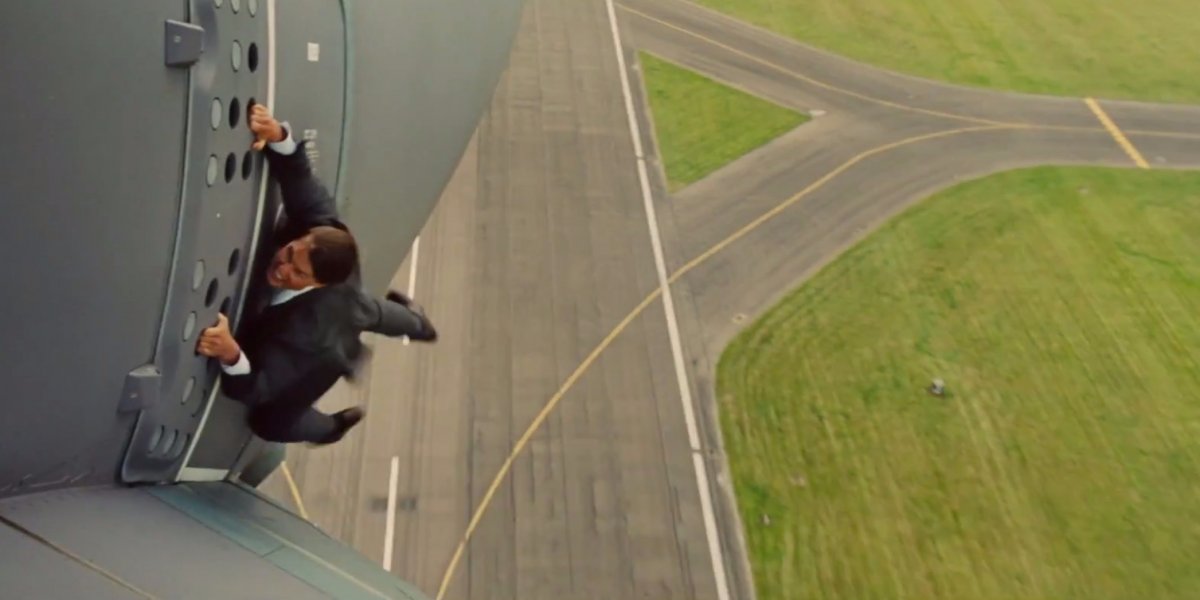
The action is, of course, first-rate, and it’s the second extravaganza of the summer after MAD MAX to thrill through commitment to practical execution. There’s three massive set-pieces, opening with Cruise clinging by his fingernails to the exterior of a plane (giving us an alarming look at his perfect chompers in the wind); a second that progresses from “how many concealed weapons can you smuggle into an opera house?” to Cruise fighting for his life in time to the rhythm of the music; a third requiring him to hold his breath for three minutes in an elaborate underwater switcheroo – all nerve-shredding in their way, and all (mostly) real. My favourite sequence was the rather wonderful (and funny thanks to Pegg’s panicky human Sat Nav routine) car/bike chase through a packed Casablanca. Yes Cruise gets to ride a motorbike again, deal with it. There’s also a pretty nasty fight at the end of the film which, thanks to some meticulous lighting looks just like THE THIRD MAN, but with more stabbing.

Many critics have been hailing this as the best Mission: Impossible yet. I wouldn’t quite go that far. Though Rogue Nation is arguably the most consistently enjoyable of the series, I still prefer GHOST PROTOCOL for mixing up the formula with a little iconoclasm (the masks are, annoyingly, back here). All this globe-trotting and questioning the role of espionage in the modern world is seemingly ripped straight from a certain rival British spy series, but you don’t mind when it brings so much originality to the table in order to drop your jaw elsewhere.

Mission Impossible: Rogue Nation is confident, tactile, and extremely well-crafted, and a refreshingly straightforward thrill-ride to sit through. The mind boggles at what they’ll get Cruise to cling to next time to reaffirm his superhuman credentials, but I look forward to finding out. SSP

Posted in Film, Film Review | Tagged , , , , , , , , , , , , , , , , , , , , | 5 Comments

Review: The Homesman (2014)

homesman2

Tommy Lee Jones’ return to feature directing nine years after THE THREE BURIALS OF MELQUIADES ESTRADA doesn’t quite strike the same perfect balance of tone, characterisation and slow-burning story, but it does reaffirm Jones’ mercurial eye for detail and reemphasise  his interesting take on the dark corners of the human mind and soul.

When independent and sharp-witted frontierswoman Mary Bee Cuddy (Hilary Swank) volunteers to transport three deeply disturbed women to a far away pious community for the sake of their immortal souls, the only company offered is down-on-his luck lowlife George Briggs (Tommy Lee Jones) and even he only joins her for the promise of a reward. How will their journey change this unlikely pair of travelers, and what will they find at its end?

After a strong start THE HOMESMAN is perhaps a little over-reliant on easy stereotyping for the sake of fluid storytelling. I didn’t really like that Mary Bee’s human cargo are neatly pigeon-holed stereotypes of madness. One just stares into the middle distance, one clutches on to a doll and rocks, the other foams at the mouth and lashes out like a feral animal. It’s all just a bit convenient. Aside from this the characters are all pretty well-drawn, and everyone (especially Swank) perform their parts superbly.

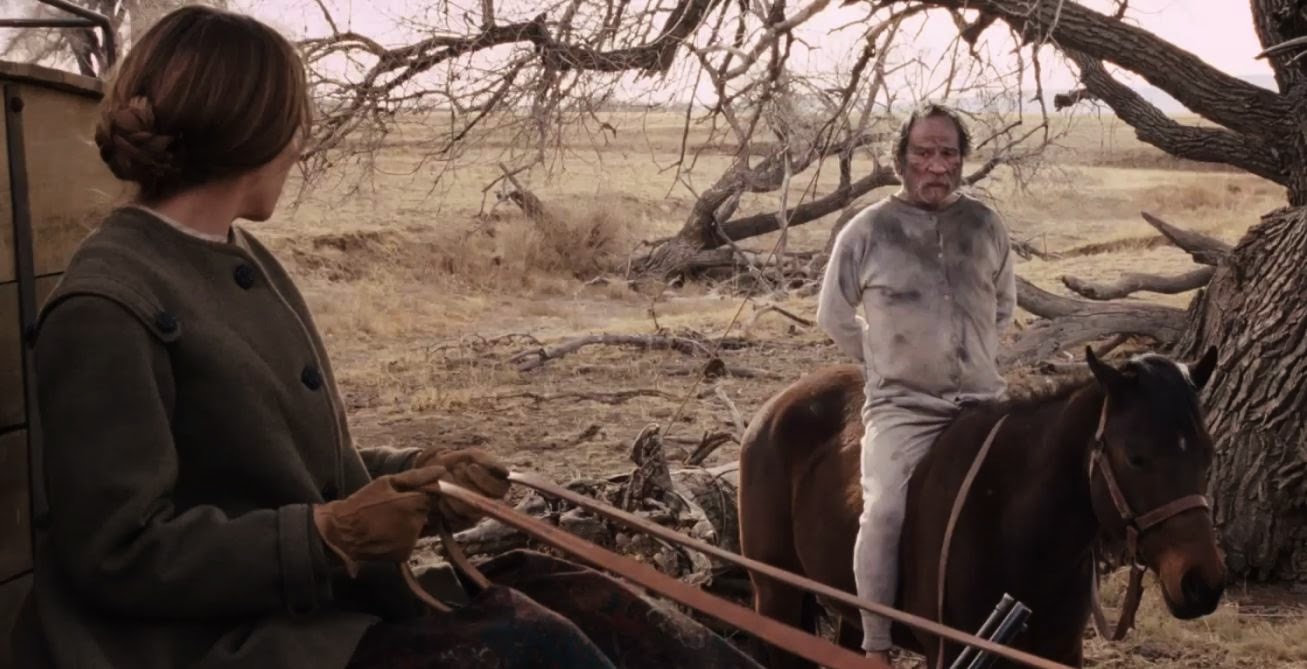
Jones’ representation of the harshness of life on the American Frontier is harrowing. And yet, we are given moments of both gentle humour and very black, almost Coen-y comedy – from George staggering out of his blasted hovel blackened by soot in his long-johns to Mary Bee’s increasingly desperate attempts to woo every man put off by her independence and “plainness” – to break up the bleakness and stop it all feeling too oppressive. The humour of Mary Bee’s rejected proposition always has a darker side, as no matter how intellectually free she is, she could never truly achieve the lifestyle or social status she desired lacking a husband in that time.

It’s likely a testament to the high regard Jones is held in amongst his fellows that he has convinced so many big names to come on board for what are essentially glorified cameos. Tim Blake Nelson as a scruffy scoundrel who has an entertainingly clumsy scuffle with Jones; John Lithgow as a kindly priest; James Spader as a slimy hotelier (with atrocious Irish accent); Meryl Streep as a kindly pastor’s wife. None of them really add a whole lot to the wider story, but they do contribute interesting background shades to film canvas as a whole.

From being pretty grounded and compelling to begin with, the film does become the Tommy Lee Jones show towards the end, with the actor-director providing himself with ample opportunity to prove he can still handle himself and dole out some good old-fashioned revenge. To begin with his character is quite a pathetic example of a man, like a mangy pitiable dog, but he seems to regain his composure and Jones’ usual gait a little too quickly for my money. It’s still the best performance he’s given in a while, and the constantly shifting dynamics of the relationship between George and Miss Cuddy keeps the film involving and very watchable.

It’s a feminist old yarn directed and co-written by a craggy old macho Texan, which might seem an odd formula. While it’s a liberating tale to an extent, it doesn’t shy from the hopelessness of this group of women’s situation, and doesn’t try and tack on an unbelievable resolution either. Jones and his writers know that then as well as now, much work is to be done before we reach true gender equality. He uses humour to hammer his points home, asking us, isn’t it ridiculous how scared Mary Bee’s suitors get when they realise how driven and more intelligent than them she is? George is the only man in the film who considers her an equal, not turning down her offer of marriage because she won’t be an obedient wife, rather just because she is plain-looking. George is a simple man who says it how it is, and is seemingly without prejudice, though that doesn’t make him a nice guy.

The Homesman is a Western that isn’t even really a Western. It’s a stark human drama with a strong voice that just happens to be set on the American Frontier. You don’t begrudge Jones for using a few run-of-the-mill tropes when his film reaches such distinctive heights elsewhere. Just don’t leave it another decade before you direct again, eh Tommy? SSP

Posted in Film, Film Review | Tagged , , , , , , , , , , , , | Leave a comment

Review: Fantastic Four (2015)

ff

“A year ago I had a fantastic version of this. And it would have received great reviews. You’ll probably never see it. That’s reality though.”

– Josh Trank, 6 August 2015

The above was posted by FANTASTIC FOUR director Josh Trank on his Twitter page following the torrent of damning reviews of his follow-up to CHRONICLE three days ago. It was then hastily deleted. This along with horror stories of Trank being locked out of his own editing room adds credence to the theory that 20th Century Fox leaned on Trank and sabotaged the young director’s chances of making the film that he wanted to. We may never know why. Whatever actually occurred behind-the-scenes, the fact remains that Fantastic Four as a final product does not work at all, and sadly it is this movie I must review rather than a hypothetically much better one.

Reed Richards (Miles Teller) has been working on a breakthrough in human teleportation since he was a boy, and is given the chance to realise his dream when Dr Franklin Storm (Reg E Cathey) offers him a scholarship and a team of like-minded young geniuses to work with. Reed, along with childhood friend Ben Grimm (Jamie Bell), Dr Storm’s children Sue and Johnny (Kate Mara and Michael B Jordan) and the only man who might be more brilliant than him, Victor Von Doom (Toby Kebbell) successfully travel to another dimension, but a disastrous attempt to return to their world has unexpected and damaging consequences.

For the first 30 minutes or so, I was with the film. It builds the characters and their motivations well enough, establishing Reed and Ben’s unbreakable bond and shared dreams; the Storm family’s dysfunctionality; and Victor’s disdain for anyone less intelligent than him, which is pretty much everyone. There is a workable rationale for why scientists would want to transport themselves to another dimension and why the Four develop the specific powers they do, though I’m not sure about the Cronenberg-y body horror with this material. Then something breaks.

The second half of the film has nothing. No character, no plot, no emotion, no coherence, no value whatsoever. Whatever Trank intended his film to become, it has been completely and utterly gutted. Entire sequences are missing and the resulting mess is utterly incomprehensible. We leap from the accident to the Four being used as military assets to the default sci-fi-disaster final act without pausing for breath. There’s no contemplation, no room for the actors to experience or convey all this physical and emotional turmoil, unless you count Miles Teller pulling the odd pained expression or mo-capped Jamie Bell doing sad eyes. There was clearly once much more connective tissue, something to make these characters and their actions make sense, but not anymore.

The casting is probably about as good as it could be if you’re committed to the Four and Doom being young adults. I’m still convinced that Mr Fantastic should always be middle-aged, the group’s father figure, and Teller is fine in the role, but is often stuck on exposition duty. Michael B Jordan being one of the most charismatic young actors of his generation playing arguably the most confident superhero of them all is well-cast, as is Bell in his human form playing another poor kid from a rough neighbourhood. Mara sadly has far too little to do throughout, and the usually-excellent Kebbell is essentially just a special effect for the final act, and not a particularly good one at that.

A story dealing with parallel dimensions opens up infinite conceptual and visual possibilities. The dimension our heroes travel to could look like anything, operate with any kind of physical laws. Josh Trank – and this is a criticism I will lay at his feet rather than the studio’s – went for a rocky planet with a few glowy bits. It’s the lowest possible rung on the imagination ladder, especially in a story aiming to explore scientific concepts so complex and far-reaching. Trank doesn’t even shake things up visually when Doom takes over his new domain in earnest. This could have been Doom remoulding an entire planet in his own image, but Trank thought just making a few rocks float and muting the background colour was enough.

Josh Trank has proven he can be an imaginative young filmmaker. Some directors would kill to have such a successful and distinct debut as Chronicle, and I’m not prepared to write him off after a single misstep. I wouldn’t bank on him working with a big film studio again for a while though, and hopefully he’ll rediscover his creative drive back in the independent film circuit. And as for Fox? Well they won’t be making another of these, and I doubt they care all that much if the rights head back home to Marvel as long as they can still milk the X-MEN for all they’re worth. Since it’s so stylistically unremarkable and butchered in the edit, all this latest take on Marvel’s First Family will be remembered for is as a mark of a film studio’s hubris. SSP

Posted in Film, Film Review | Tagged , , , , , , , , , , , , , , , , | 4 Comments

Review: Focus (2015)

HT_focus_smith_robbie_jef_150226_16x9_992

FOCUS annoys me for the same reason that Steven Soderbergh’s OCEAN’S ELEVEN did. I can appreciate that they’re good-looking, reasonably well-acted movies, but they’re just so darn smug about it, think they’re far cleverer that they actually are, and for everything they get right they still make very basic filmmaking errors.

Con man extraordinaire Nicky (Will Smith) takes small-time lifter Jess (Margot Robbie) under his wing and nurtures her considerable skills to allow her to tackle more lucrative targets. But greater reward also comes far greater risk, and Nicky’s latest score might spell more than just some jail time for himself and his sticky-fingered protégé…

Yes, Smith and Robbie have decent chemistry. No, we did not need the 70s porno music accompaniment to their first sex scene. At least Robbie has enough self-awareness to point out when she’s being mistreated though (“Hi, I’m right here!” When one of Nicky’s crew is talking lecherously about her). Robbie is good in general and Jess gets more far more colour as a character as the balance in her relationship with Nicky shifts. Smith, on the other hand, rarely has to disengage autopilot, and when he does show a flicker of emotion it’s usually misjudged or unconvincing. He’s got to the stage in his career that he can’t just get by on having the incredible luck to be born Will Smith – in this film he even has the gall to utter the line “it’s one of the many wonderful things about being me”. Nicky’s team of dubious associates, including Brennan Brown as a dry-witted fence, are fun. Also fun is BD Wong as a nefarious imp of a high-stakes gambler, and Gerald McRaney outclasses the rest of the cast as an enigmatic enforcer.

Date rape jokes should never be OK, in fact let’s cross rape off the whole comic riff menu. Making a Middle Eastern racial slur (based on documented cases legal or not) doesn’t make it any more justified. To be brutally honest, writer-directors Glenn Ficarra and John Requa rarely make a joke in good taste, which wouldn’t be as insulting if they were funnier or wittier, but as they are they just come across as needlessly offensive.

Jess’s character motivation is an easy way out. It’s designed expressly to make stealing OK, and it’s justified as, what else could I do? I’m a dyslexic from a low social class! As aspirations go it’s completely and utterly defeatist, morally it’s overly black-and-white and intellectually it’s patronising. At least have the guts to make your thief steal because she likes it! You might end up with a more memorable and nuanced character then.

The most satisfying scenes are from pretty near the beginning of the film, with Smith and his associates giving Robbie a crash-course in diversionary tactics used by pickpockets, and while they’re not original or particularly creative, they have a nice rhythm and there’s a good crackle between the actors. There’s also a good lead-up to a key moment later on where we see a hit-man taking some amusing health-and-safety precautions for the job ahead.

The worst crime a film claiming to be clever can commit is exhibit extreme stupidity, and one of the key set-pieces in Focus is monumentally stupid. It involves Nicky fixing a bet at a football game in a way that would only work if everyone was in on the fix, and clearly Nicky’s opponent would not play into his hand as he does, even with their near-supernatural explanation for why he does so. It just defies all logic.

Focus isn’t particularly worth your time. Technical competence, the odd amusing diversion and Margot Robbie’s natural movie-star charisma can’t make up for lazy and tasteless writing, a lack of imagination and Will Smith just turning up for the pay cheque. SSP

Posted in Film, Film Review | Tagged , , , , , , , , , , , | 1 Comment

Review: Inside Out (2015)

InsideOut556500e6a2be0-2040.0

INSIDE OUT could be Pixar’s most satisfying ever effort for parents to enjoy alongside their children. For all the vivid colours and goofy characters, we’re also presented with a mini psychoanalytic thesis and big real-world issues that have formidable dramatic heft.

Eleven year-old Riley’s (Kaitlyn Dias) comfortable existence is rocked when her parents decide to uproot and move from Minnesota to California. As her familiar life collapses around her and she struggles to cope with all the changes, inside her head Riley’s Emotions embark on a quest to keep Riley Riley. 

Pete Doctor has always been a great ideas man and a tuned-in satirist. Some of the concepts he and his team of screenwriters have come up with are genius – not only do they set up punchlines, but also add depth to this world of imagination. Take Riley’s Studio Ghibli-esque hovering islands of personality, or the Emotions hitching a ride on the Train of Thought to get back home. On this journey they accidentally mix up boxes of opinions and facts (“Don’t worry, it happens all the time!”); point out déjà vu as a landmark multiple times; and pass by memory workmen busy clearing Riley’s head for new information (“she doesn’t need all these numbers, they’re in her phone!”, “Presidents? Just keep Washington, Lincoln and the fat one!”).

Another of Pixar’s old hands making a return is maestro composer Michael Giacchino. Giacchino has produced some beautiful music before, and his soundtracks always enrich a story, but Inside Out is among his finest scores. It’s somehow intimate and epic, and pretty much sums up the whole film as such.

As always with Pixar films, the gags aimed at the parents are a strange and random mixture, from jokes about psychoanalysis and major art movements to a completely out-of-the-blue CHINATOWN riff. I also imagine couples will get a kick out of seeing the full version of the dinner table scene that featured in the film’s first trailer, where we get to see Mom and Dad’s (Diane Lane and Kyle MacLachlan) emotional workings as they’re trying and failing disastrously to connect with Riley.

The film’s solutions to plot problems are as ingenious and creative as the are surreal. There’s a scene set in a film studio that manufactures dreams that feels (appropriately given Doctor’s involvement) very MONSTERS, INC with all its bored-looking workers doing extraordinary things on autopilot. At one point, to cross a ravine an Emotion uses a ladder made from Riley’s imaginary boyfriends. Pixar have done two mismatched friends on a journey before, but rarely have they had to think this hard to navigate such a complex and bizarre world that runs on its own unique logic, and keep the characters and their motivations consistent within it at the same time.

I see Inside Out as the natural, more sophisticated successor to SNOW WHITE AND THE SEVEN DWARFS. Disney’s eponymous diminutive miners had one dimension only, namely whatever emotional state their name was derived from (to this day I still don’t understand why Doc isn’t Brainy). The Emotions in Inside Out have dominant traits, but are all three-dimensional characters with full personalities as well, and the flawless voice performances (notably Amy Poehler and Phyllis Smith) reinforce what is among the most expressive character animation I’ve ever seen. Another reason why the Seven Dwarfs themselves were merely serviceable rather than great characters was they only had the personality and aspiration dead-end that was Snow White to interact with. The Emotions in Inside Out are fighting to keep Riley, a pre-teen that feels so real you could bump into her in the street, the best version of her herself she can possibly be.

I loved the idea that life begins with the purest emotion of all – joy, but as life is life sooner or later we have to give way to a certain amount of sadness. Sadness isn’t always a bad thing, however, and doesn’t last forever. Riley eventually finds a comfortable bittersweet existence by the close of the film, and that’s ultimately what we as people are aiming for. Inside Out is a beautiful film about achieving emotional harmony that manages to be warm and humorous while also providing enough food for thought to sustain even the most hardened and cynical adult. That’s the only kind of person I can see finding real flaws with Pixar’s latest – those who are unwilling to give in to humanity’s inherent emotionality. Life isn’t perfect, but neither are people. All you can hope for is to level out at some stage and find a balance between joy, fear, disgust, anger, and sadness. SSP

Posted in Film, Film Review | Tagged , , , , , , , , , , , , , | 3 Comments

Review: It Follows (2014/15)

It_Follows_review_-_CANNES_article_story_large

After THE BABADOOK, IT FOLLOWS is the second critical darling horror movie in a year where the premise is far scarier than the final execution. This is pretty frustrating as it feels like another near-miss, but at the same time I feel that It Follows has quite a bit more going for it that its Australian cousin.

Following her first significant sexual encounter, Jay (Maika Monroe) finds her quiet suburban teenage life invaded by an unstoppable something that wants her dead. Her pursuer moves slowly, but It is relentless and can look like anyone. As it becomes increasingly clear that she will never find peace, what lengths will Jay go to in order to exorcise her curse?

It Follows is one of the best-looking films of recent years, horror or otherwise. The pristine, relentless steadicam work, tracking shots, and wide, open vistas throughout support well the themes and plot of the film. Because everything is open, you find yourself constantly scanning the background for It. You’re often consumed by the same paranoia as Jay, constantly on the alert for the next time It appears. I’m quite frankly amazed writer-director David Robert Mitchell has only been at the helm of one other feature before this as his confidence in style and certainty of aesthetic makes the film feel like it is the work of a far more seasoned craftsman.

Rich Vreeland’s score heightens the sinister atmosphere perfectly, sounding chillingly like the musical lovechild of John Carpenter and Vangelis and keeping you constantly on edge.

Performance-wise, Maika Monroe reaffirms her position as one of the most rounded and likeable leading ladies in recent years. Much like with her turn in THE GUEST, Monroe as Jay embraces horror tropes to a point, but feels like a real, normal young woman and reacts as one probably would do to her terrifying predicament. She tells her closest friends about her pursuer almost immediately, and rather than dismiss her until they themselves are knocked off as might happen in the average slasher, they trust Jay and help her as best they can.

Jay’s hipster stereotype of a friend Yara (Olivia Luccardi) annoyed me incessantly, serving no purpose but to read choice prose at thematically convenient moments from her stupid ever-present clamshell Kindle. She represents a forced quirkiness that makes JUNO look subtle in comparison.The rest of the characters work well enough for what they actually have to do in the plot, though perhaps cling a bit closely to conventional horror archetypes.

I liked that it’s left pretty ambiguous what It is beyond a malevolent force. We know how It works, that It hunts the most recent victim of carnal desire, before working its way back along the chain until none remain. We know previous carriers can still see It (a concept that could be made more of), but the force is only concerned with the single, most recent victim. We also have an idea of the things It represents – lust, guilt, STDs, commitment to a sexual relationship too soon. What we don’t know is why It chooses the forms it does, when they change and why, which makes what I think was meant to be a ground-shaking twist later on in the film a little muddy.

After a pretty solid first hour, the film certainly loses something in the final act. The tension mostly leaves the story and it feels like it’s going for a big finish before just petering out. It all becomes a bit SCOOBY DOO as Jay and her clique plan to set a trap for It, and their final confrontation is disappointing. A story like this can’t be tied up with a bow, and the loosely resolved state of the plot works in the end, but you still want an extra punch from somewhere. I would still recommend It Follows as a creepy, if not outright scary, horror with solid performances, well supported by high-impact direction and music. SSP

Posted in Film, Film Review | Tagged , , , , , , , , , , , , , | 4 Comments