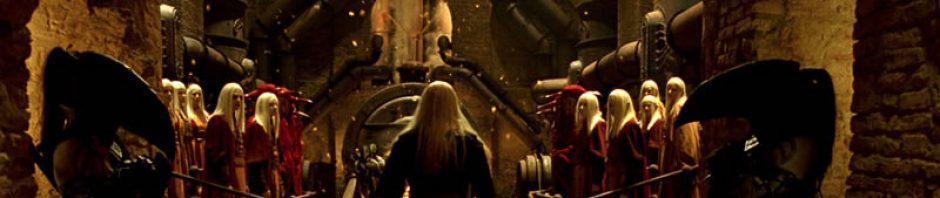
Everyone knows the Scottish Play. Featuring characters and dialogue iconic enough to ingrain itself in culture the world over, you need very little help to make this story memorable. But director Justin Kurzel doesn’t do anything by halves, and has brought everything he can to MACBETH, only his second feature following the fantastic but cripplingly depressing SNOWTOWN. The end result is rather spectacular.
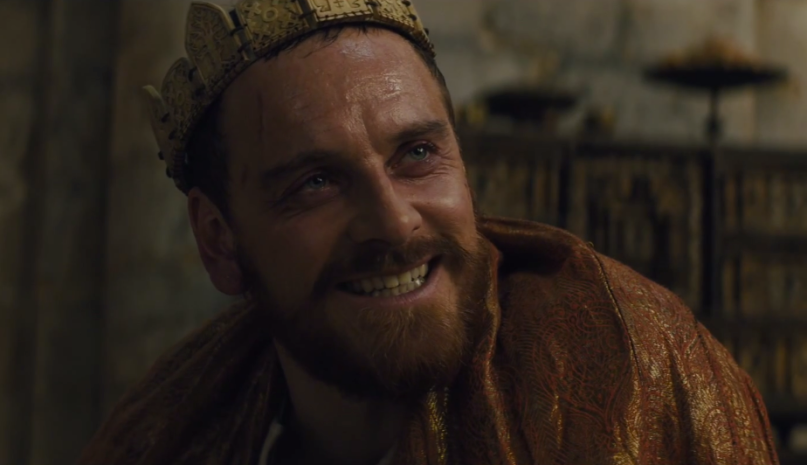
Hail Macbeth! After winning a great victory for his king, Macbeth (Michael Fassbender) is told by a trio a witches that he is destined to rule Scotland. Spurred on by his Lady (Marion Cotillard), Macbeth murders King Duncan (David Thewlis) and claims what was foretold. This act may sate his ambition, but it does not quiet Macbeth’s mind, his paranoia causing him to hallucinate spectres and rule his new kingdom with an iron fist.
Justin Kurzel is an aesthetically accomplished director who uses imposing frost and fog, apocalyptic fire and ash and dazzling shafts of light to vividly illustrate this well-worn story. Macbeth showcases the most desolate yet impressive scenery Scotland has to offer, occasionally enhancing the light or skyline to set the mood. The fog, incredibly, is real though – the crew apparently lost Marion Cotillard in it at one point.
Kurzel also uses time, sound and music (courtesy of Jed Kurzel) to great effect to hammer home Macbeth’s deteriorating mental state, with arty and effectively jarring jump-cuts becoming more frequent as the titular monarch’s mind unravels. The opening battle of the film is brutal but staged elegantly with slow motion and freeze-frames emphasising what war can do to a man.
For all its prettiness and layered themes, the film lives or dies on the performance of the actor playing Macbeth. Thankfully, Fassbender has rarely been better suited to a role, with his permanently haunted eyes and increasingly mentally and emotionally erratic behaviour as his madness takes hold. His gentle amusement with which he plays “Is this a dagger I see before me?” contrasted with the bouncing-off-the-walls mania as he tries to banish the spirit of a dead friend with a banquet hall of onlookers witnessing, terrified. These moments from the play are familiar, but refreshed, given new life. Cotillard is plays down what can be a bit of a pantomime villain role in Lady Macbeth. She’s as nuanced and subtle as Fassbender is flamboyant, and completely inhabits the inner conflict of the character setting her man on a path that, try as she might, she is unable to halt.
Paddy Considine and Sean Harris are as consistently excellent as ever as a pained Banquo and an unhinged Macduff respectively, and David Thewlis rounds out the cast and gives weight to the just King Duncan. The portrayal of the witches here is pretty interesting. There’s three of them as always (Seylan Baxter, Lynn Kennedy and Kayla Fallon) but they’ve been cast younger, and two of them are shown to have children. I like this acknowledgement that Medieval witches weren’t sinister spinsters but ordinary women with families and a specific and useful set of skills. Fear not, Shakespeare purists – though more realistic in their representation, the witches still fulfil their primary purpose in the play of spouting prophecy and foreshadowing characters’ deaths!
I would have found it less distracting if Marion Cotillard used her own Parisian accent rather than attempting Received Pronunciation. If you can’t do a Scottish accent, fair enough, don’t, but why bother with something else that doesn’t sound quite right? I’ll admit I’m not one who finds Shakespearean English easy to follow, but it certainly sounds clearer to me in Scottish accents as the rhythm fits so well.
It’s a lean, no-nonsense and almost pacey adaptation of the Bard’s tragedy. A lesser director might have been tempted to chuck in a second battle towards the end of the film when the heir apparent to the throne of Scotland, Malcolm (the uninspiring Jack Renor) turns up, but Kurzel smartly sidesteps this and just shows the armies forming their battle lines and leaves it to Macbeth deciding all in a much more personal fashion. If I’m really picky, I don’t think a (however brief) opening crawl was needed to contextualise the story. We know it’s set in Scotland, we’re about to see a battle and betrayal so we don’t need to be forewarned. This does result in a great dramatic wipe into our hellish establishing shot.
Justin Kurzel’s Macbeth is aesthetically and aurally distinctive, faithful to the shape of Shakespeare’s text but not opposed to tweaking elements where needed. Even for those not versed in theatre or archaic sentence structure, the uncompromising brutality of the story, the thoughtful and complex performances and the delicious darkness of the characters and their journeys towards inevitable damnation will make this one a real crowd-pleaser. SSP






Review Embargoes: A Catch-22 for All Involved
To embargo or not to embargo? That is the question. Whether gagging journalists’ criticisms pre-release or simply not showing anyone your product before the big day, it’s a major concern for film studios and their flagship blockbuster products, not to mention their audiences.
Let’s not mince words here, an embargo is rarely a sign of something glorious. Josh Trank’s FANTASTIC FOUR had a review embargo, for all the good it did. With Fox bafflingly gutting the movie before abandoning it by the wayside late in the day, their only real hope for a decent return was to dupe enough viewers into the cinema before word spread. The majority of JJ Abrams projects – CLOVERFIELD, STAR TREK, SUPER 8 – consciously do the same and you can put money on him clinging to the same strategy for STAR WARS, whether it’s turned out good or bad. Most horror films aren’t screened for critics prior to release, though this is arguably more to do with the perceived critical disdain for the modern genre as a whole. Marvel, on the other hand, don’t seem to mind if word gets out early, which either indicates unshakable confidence in their product or a certain arrogance. Marvel do have the small matter of most of their films being released in Europe before they are stateside due to Disney’s distribution deals, so you can’t imagine even the world’s most powerful studio could silence or sue every critic across the pond until the home release comes around.
While prominent figures in the industry like Abrams have argued for a “mystery box” approach to film marketing (the admirable aim of preserving the surprise of viewing the film for the first time by revealing as little as possible ore-release), you’ve also got to understand that journalists have a job to do. Yes, they shouldn’t say in their early review that *sigh* SPOILER Darth Vader is Luke Skywalker’s father or that Kevin Spacey is Keyser Soze, or more recently and less relevant that Benedict Cumberbatch is actually Khan, but they should be able to inform their readers/viewers and, since they often see films earlier than most, they should be free to write a detailed and well-argued review prior to public release.
The theory behind review embargoes is to get bums on seats before bad word of mouth spreads, to recoup as much of your failed movie as possible in a short space of time. But surely you’re shooting yourself in the foot if an embargo is nearly always the sign that a film studio has no faith in a movie, that it is unable to survive on its own merits. Just releasing a bad movie, especially one part of an established franchise with a built-in audience would probably still result in breaking even. After all, there are plenty of audience members out there who say, “who cares what the critics think?”
Personally, I try not to read too many reviews of films before I see them simply because I write my own and don’t want my opinion too coloured. As I’m not a professional, I’m seeing movies at the same time as everyone else. The vast majority of viewers have no such restrictions and should actively seek out as many different reviews as possible to make an informed choice of which film to pay to see. If they are unable to access any information beyond studio-sanctioned PR before they’re buying a ticket, how fair is that?
I know we don’t live in an ideal world and dirty marketing tricks are very much part of the Hollywood film business, but film studios really need to stop trying to blind-side their audiences and just make good movies. That way the futile act of having review embargoes will die all by itself. To embargo or not embargo? It’s not a question really. SSP