
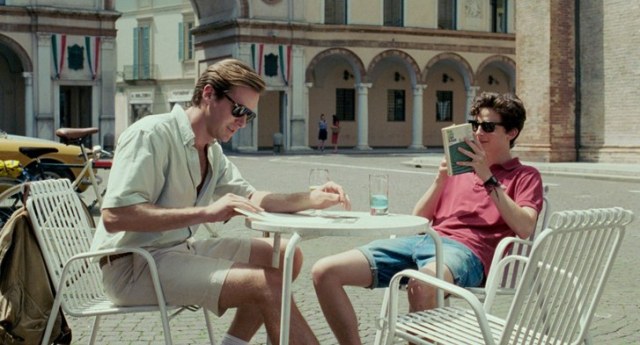
Review: Call Me by Your Name (2017)

Call-Me-By-Your-Name

Study break: Frenesy Film Company/La Cinefracture

I was just starting to think the 90th Academy Award nominations weren’t all that impressive. Then I watched CALL ME BY YOUR NAME, and thank goodness I did. This is one of the most powerful, thoughtful and heartfelt dramas of recent years.

Gifted teenager Elio’s (Timothée Chalamet) long Italian summer with his family is rocked by the arrival of Oliver (Armie Hammer), a mature student on placement with his academic father (Michael Stuhlbarg). Though standoffish to the newcomer at first, the pair’s relationship soon blossoms to a full-blown romance, one that will change at least one of their lives forever.

It took me a while to get used to the pace of this one. I’d describe it as languid or leisurely, completely befitting the Mediterranean setting. It’s a long film, and might feel longer were it not for these characters, but they quickly grow to fascinate you and the passage of time becomes unnoticeable. I adored this strange but natural developing relationship, from apathy to open hostility to grudging friendship and finally passionate physical attraction. Elio and Oliver are both proud, troubled, brilliant men who become the best versions of themselves together, as tragically fleeting as their summer dalliance is. Elio shows off, Oliver dismisses him, and both compete for the affections of the locals and Elio’s family. Their love scenes are tender and real, but tastefully handled. This isn’t just for the sake of studios squeamish about portraying gay sex, either. Both Elio’s intimate scenes with women and with Oliver are handled in the same manner. The more disturbing potential of their age gap is avoided because of one key concept: consent. This is not a one-way relationship.

Distance is used in some really interesting ways by director Luca Guadagnino and DP Sayombhu Mukdeeprom. When Elio comes clean about his feelings for Oliver, they are working their way around opposite sides of a WWI memorial, never mind making eye contact, they can seldom even see each other at this key moment. More often than not the camera pulls back and takes the characters in as part of the landscape, their big beautiful emotions and experiences swallowed up by the even bigger, more beautiful landscape. The sun-drenched Italian countryside couldn’t look more enticing, yet it hides pain and heartbreak in equal measure to passion and elation. Is there a word like “bittersweet” but for a bright summer’s day? That’s what Call Me by Your Name is.

This is the kind of work Armie Hammer excels at. Despite his looks, he is not a Hollywood lead, he is, and always will be, a character actor. You completely get why Elio falls head-over-heels for Oliver, why their meeting matters. Their scenes together positively crackle, but the simple purity of the film’s final flourish is  completely reliant on the skills of one talented actor conveying a storm of repressed emotions. There is nowhere to hide here, and it is here that Timothée Chalamet becomes a star by staring, utterly distraught, past the camera and the stages of grief overwhelm him.

As stunning as Call Me by Your Name’s final shot is, the film’s best scene, indeed the best scene of 2017 comes a little earlier and it is typified by a some wonderful small moments between Chalamet and Stuhlbarg. If you take nothing else away from the film, take this quote about young love: “We rip out so much of ourselves to be cured of things faster that we go bankrupt by the age of 30, and have less to offer each time we start with someone new”. The scene plays out unexpectedly and refreshingly honestly, it accepts that first love may feel like the end of the world when it ends, but it is not the be-all and end-all.

This is a story of first love and sexual awakening that is optimistic but also realistic. As Elio’s story, we see his world glimmer with new possibilities during the good times and get plunged into blackness in the bad. The chemistry at the story’s core makes all this work and the craft, from the locations, filming and sensitive adaptation of the source novel elevates the whole package to something gorgeous enough to hang in a gallery. SSP


Posted in Film, Film Review | Tagged , , , , , , , , | 2 Comments

Review: Three Billboards Outside Ebbing, Missouri (2017)

three-billboards-watching-videoSixteenByNineJumbo1600-v6

Dressed for a dirty job: Fox Searchlight/Film 4

The more I mull over THREE BILLBOARDS OUTSIDE EBBING, MISSOURI, the more its place at the head of the Oscar race baffles me. Martin McDonagh’s first film since SEVEN PSYCHOPATHS boasts admirable performances and fiery dialogue but fundamentally frustrates you as well. This year’s Oscars boast two films that will almost certainly win for their lead performances but which shouldn’t even be in the conversation for the top prize.

Mildred Hayes (Frances McDormand) takes her town’s police department to task for failing to bring her daughter’s killer to justice. Hiring three billboards on the outskirts to publicise their ineptitude (“Raped while dying / And still no arrests / How come, Chief Willoughby?”), she draws the ire of Willoughby (Woody Harrelson), blunt instrument Officer Dixon (Sam Rockwell) and many of the residents of Ebbing, Missouri as well.

McDormand is outstanding, a sweary toughnut matriarch ready for war (just look at how she tears apart the local reverand with a foul, personal monologue). Unfortunately, her character Mildred is utterly abrasive and unlikeable throughout. I know that’s the point, that the terrible defilement and loss of her only daughter has reduced her to a bitter, combative shell of a human being, but it’s a long two hours to spend in her company. Between her and Rockwell’s bigoted live wire as the two showiest roles, you find yourself praying for more time with Woody Harrelson who at least plays a character with light and shade. I wish we were given more time with Mildred’s family unit as a whole – we only get one real flashback that establishes two things: they argued, and they used the C-word very liberally.

I became irritated by the rolling series of coincidences that is the main plot, the on-the-nose dramatic irony in the flashback sequence and whenever McDonagh thinks he’s playing the part of a clever satirist. He’s much better at peppering his barbed dialogue with creative or unexpected swearing, like Mildred’s seemingly innocent billboard inquiry, “I assume it’s ya can’t say nothing defamatory, and ya can’t say, ‘f***’ ‘p***’ or ‘c***’. That right?” The rest is all just a bit contrived, whatever the intention was. I know McDonagh isn’t exactly a subtle creative force, but Three Billboards still features one of the most heavy-handed pieces of symbolism I’ve ever seen, and it’s made all the worse by a character further explaining it to the audience.

While it’s always nice to see Sam Rockwell getting recognition for something, I completely agree that the film’s excusing Dixon’s deplorable actions because he’s dumb and lives with a monster of a mother is pretty repulsive. Harrelson’s Chief Willoughby pulls the old “good deep down” justification for his psychotic subordinate and we’ve no idea what he’s spotted to give Dixon the benefit of the doubt. All points to slightly shoddy writing for Rockwell’s character: if he’s going to be forgiven, redeemed towards the end, then he has to be given more than one dimension.

Equally troubling is that by the end of proceedings, McDonagh seems to be advocating the virtues of vigilantism. I understand the reputation of the Police in the USA has rarely been lower, attitudes, working practices and disciplinary procedures are in dire need of change, but there’s a fair few steps separating the idea of Police reform and the call to arms for citizens sorting it out for themselves, especially when guns as a way to dispense justice comes into the conversation.

My biggest issue with Three Billboards, even beyond the disturbing political subtext and surface-level characterisation, was that I did not feel engaged in this story or characters. I felt passive, unemotional, despite the hard-hitting human story being told. We’re relentlessly pummeled by horribleness for little payoff, and because the story is told in a conventional a-b-c manner instead of playing with time and perspective to gradually reveal the moments that made Mildred who she is, we’re not given enough context or emotional resonance to really understand these characters. Bursts of classical music, the laziest shorthand for “we’re an important film, we’re intellectual, we promise!” really doesn’t help this misjudged, strangely dead-eyed Oscar-contender. SSP

Posted in Film, Film Review | Tagged , , , , , , , | 1 Comment

Review: The Shape of Water (2017)

shape of water

Is your glass half empty or half full?: Fox Searchlight/Double Dare You

THE SHAPE OF WATER promises a lot, and as such you might want to manage your expectations. Don’t worry, it’s good, but with such acclaim lavished on it from the Venice Film Festival onwards you might be expecting another PAN’S LABYRINTH. It isn’t that, but it’s still beautiful and beguiling in its own way.

When an unusual asset arrives at an American government facility during the Cold War, mute cleaner Elisa Esposito (Sally Hawkins) begins an unlikely relationship, blossoming into a full-blown romance between the unlikeliest of lost souls. But can Elisa and her amphibious paramour (Doug Jones) escape their government captors and survive, together?

Here, water equals both sex and death. It’s certainly del Toro’s most overtly sexual film (yes even more so than CRIMSON PEAK, which lest we forget featured Tom Hiddleston’s bum cheeks) but being del Toro’s usual brand of twisted fairy tale, acts of passion beget a balance to be paid in blood, and though the actual body count isn’t high there are consequences to everyone’s actions. The Amphibious Man is seen as a key to the USA getting an edge in the Space Race (something to do with its bilateral respiratory system…or something) and this was very probably intentionally ridiculous. It’s really amusing actually about how quickly the Russian agents in the film lose interest in this particular “asset”. They soon realise that the Americans are desperately clutching at straws and don’t really have anything worth their while.

Sally Hawkins is captivating as Elisa, a bouncy, passionate dreamer who lives and speaks vicariously through film. Tellingly, all the women she idolises on the big screen have very distinctive voices, and they speak on her behalf. Elisa and her new friend are of course (slightly simplistically) made for each other – both are trapped by their physical forms, without speech and only able to communicate through one (OK, two) ways with each other. It’s not subtle, it’s not an especially new or profound take on a relationship, fantasy or not, but it serves this story well enough.

Scene-stealers Octavia Spencer, Richard Jenkins and Michael Stuhlbarg steal their scenes, funnily enough. The trio ground the story, lend humour and heart, and provide a nuanced take on a well-worn archetype, respectively. I’m also pleased to report the film features Michael Shannon at his Michael Shannon-iest. Government “security consultant” Strickland doesn’t quite top Vidal from Pan’s Labyrinth as del Toro’s most chilling villain, but that’s mostly because he uses a cattle prod rather than the blunt end of a bottle to kill people and the latter is somehow scarier. But when it comes to cruel, murderous sociopaths, it’s an apples and oranges situation really.

The Amphibious Man (who looks like a cross between HELLBOY’s Abe Sapien and Thane from MASS EFFECT) doesn’t quite end up being a leader in the del Toro creature pack. The Faun, the Pale Man and the Angel of Death (all also played by Jones) all somehow looked and felt more memorably original. What the Amphibious Man is, though, is a new benchmark in CGI-enhanced man-in-suit performance. Jones’ performance is among his most sophisticated as well, largely because he is being asked to be the least human. This divide between the other-worldly and and real asks you to suspend your disbelief at the central relationship a fair bit, but I guess you should fully expect to do as such in a merman romance.

This could be a dark horse for the Best Picture Oscar what with the established auteur behind it (which the Academy loves), the gorgeously-rendered stylised period setting (which the Academy loves more) and the frequent, indulgent references to the Golden Age of Hollywood (which the Academy loves the most). The Shape of Water doesn’t quite have the magic of Pan’s Labyrith but it has at least as much heart and knowing world-building as Guillermo del Toro’s other work in Hollywood. He still whips back and forth between fantastical wonder and grim reality better than anyone else, but I wasn’t quite swept off my feet by the love story at the heart of this particular tale. If anything, I wanted more of Richard Jenkins clumsily flirting with the pie shop guy. Egg? SSP

Posted in Film, Film Review | Tagged , , , , , , , , , , , , , , | 3 Comments

Review in Brief: A Futile And Stupid Gesture (2018)

Netflix really were straight out of the gate with their 2018 Originals. I hope it’s further evidence of them being enticing for risky, different projects and that we’re not just going to get a deluge of mediocrity. National Lampoon biopic A FUTILE AND STUPID GESTURE gets the Lampoon tone just right, flitting between rowdy hijinks, pretty sharp and unforgiving satire (“the Kids need something to read while getting tear-gassed!”) and the more out-there postmodern stuff, like an alternative, modern Doug Kenney (Martin Mull) talking to camera, mocking the storytelling and the story mocking him right back. It’s a great-looking, MAN ON THE MOON-esque alt-biopic and the cast, particularly Will Forte’s whirlwind Kenney (“You really think Will Forte’s 27?”) and Domhnall Gleeson as the brains and clear head behind National Lampoon Henry Beard (“The oldest man to ever be a teenager”) really make their mark. One for fans and non-fans of ANIMAL HOUSE alike. But mostly, it’s for the fans. SSP

Posted in Film, Film Review | Tagged , , , , , , , , | Leave a comment

Review in Brief: Good Time (2017)

For those of you still in denial: Robert Pattinson is a really good actor, given the right material. GOOD TIME, the tale of a robbery gone wrong and good and bad brotherly influence, comes from the ridiculously talented Safdie Brothers Josh (writer-director) and Benny (director-star/beating heart of the film). They have aesthetic flair with imposing aerial shots, sickly neons and deep shadows, they clearly push their actors to go that extra mile with some of the most pained exchanges of heated dialogue I’ve seen in a long time, and they really have something to say about our world and its shortcomings. Admittedly the middle section of the film where Pattinson’s Connie hides out at someone’s house then goes looking for a fellow outlaw’s valuable acid stash doesn’t compel quite as much as the rest of the film. But the final scene, so pure, so simple and affecting, absolutely floored me. SSP

Posted in Film, Film Review | Tagged , , , , | 1 Comment

Review: Black Panther (2018)

black-panther-trailer

Hear me roar: Marvel/Disney

As thrilled and enthralled as I was by BLACK PANTHER, I can’t imagine what it must be like to watch this if you’re black.

Newly-crowned Kind T’Challa (Chadwick Boseman) returns home to secretive high-tech African nation of Wakanda to rule. He must unite the tribes and maintain order using the royal birthright alter-ego of the Black Pather, not to mention deciding on how his isolationist country should interact with the world. Everthing becomes much more complicated when vengeful radical Erik Killmonger (Michael B Jordan) returns to Wakanda and challenges T’Challa for the crown…

Refreshingly, T’Challa doesn’t subscribe to the old “lone hero thing”. He knows he needs, and he asks for, help. Always having a team to back him up has a lot to do with him being royalty (even back when kings led the charge into battle they were surrounded by loyal bodyguards) but it also speaks volumes of his personality, and how he sees his family and friends. To T’Challa, those he values are indispensable assets.

And what assets these loved ones are! Letitia Wright’s impish gadget gal Shuri (T’Challa’s sister, who must surely be destined for a scene where she emasculates Tony Stark through tech talk) and Danai Guira’s deadly spear-wielder Okoye (imagine how formidable you have to be to be asked to protect a bulletproof warrior-king). Both are undeniable highlights of the film, and Marvel better be busy writing them into anything and everything they can. Chadwick Boseman is strong in the lead even if his accent occasionally veers into uncharted territory and yes, everyone who has proclaimed Michael B Jordan’s Killmonger as the most interesting and compelling villain in a Marvel film are correct. His arc, his aims and motivations carry the entire film and fearlessly skewers and subverts realities of race in our contemporary world.

This is less a superhero movie than a fantastical spy thriller. As for the spy/espionage stuff, the gadgets are better than Bond, the politics more self-aware and the tech displays more original and exciting than in most sci-fis. We see traditional tribal cloaks become energy shields, holograms that disintegrate into sand clouds and a range of remotely-piloted vehicles (Shuri has a moment of panic when taking sudden control of a car in South Korea and wondering, “Which side of the road do they drive on?”).

Black Panther’s action scenes are something else, a whole new scale and level of vital energy for Marvel. I didn’t stop grinning for the entire Busan sequence from the (AVENGERS-topping) long-take casino fight to the deliriously fun gadget-driven car chase that follows it. Later on we have a pitched battle on the plains that wouldn’t look out of place in LORD OF THE RINGS or GAME OF THRONES.

I was not familiar with the concept of Afro-futurism at all, but it’s a fascinating aesthetic, presupposing an untouched African nation as a vibrant cultural collage focussed through a science fiction lens. Director Ryan Coogler revels in the look and feel of this world, with soaring camerawork capturing both vast tableaus (the awe-inspiring first flight into Wakanda) and every little detail of characters’ traditional African dress (taking in the distinctness of each region’s tribe as they gather to observe a bout of ritual combat). Colourful tribal dance performances are played completely straight and without much comment, and as such it just sweeps you up (from an outsider’s perspective) as a striking, vibrant celebration of a wealth of African cultures.

Black Panther represents Marvel’s boldest move yet in many ways. It’s one of the darkest and most violent of the studio’s offerings so far, but it’s also one of the most fun and full of life. While the spectacle on offer will surely mean it’ll end up as one of the blockbuster highlights of 2018, it’s an important marker in wider film history as well. The modern superhero movie cycle may not have happened at all without BLADE in 1998, now another black hero is taking the genre into its next phase with wit, bravery and a whole lot of power behind its punches. It’s fantastical but grounded, escapist but about the here and now. Here’s hoping our return to Wakanda isn’t in the too distant future and that Coogler gets to make whatever the hell he wants next. SSP

Posted in Film, Film Review | Tagged , , , , , , , , , , , , , , , | 7 Comments

Review in Brief: American Made (2017)

In AMERICAN MADE, Tom Cruise turns in his most beguiling performance in years, and much like Leonardo DiCaprio did in THE WOLF OF WALL STREET, he does it by playing a complete and utter bastard. In an exaggerated take on pilot-turned-smuggler Barry Seal’s exploits in Central and South America in the 1970s and 80s, Cruise, director Doug Liman and writer Gary Spinelli produce a zippy, stylish and extremely entertaining comedy-thriller. Seal gets by a lot on luck, avoids death and arrest numerous times and somehow (and unwisely) manages to juggle working for the CIA and the Medellín Cartel. Events have been moved around and compressed, characters combined and dramatic license wholeheartedly embraced, but that’s the norm for biopics. Cruise doesn’t get to run and jump as much as he usually does, but he gets to fly and play off some well-cast supporting players like Domhnall Gleeson (CIA handler “Schaffer”), Alejandro Edda (Medellín’s Jorge Ochoa). Sometimes true stories only need a little Hollywood-ising. SSP

Posted in Film, Film Review | Tagged , , , , , , | Leave a comment

Valentine’s Day Review: Hellboy II: The Golden Army (2008)

HB2

Blue is definitely their colour: Universal Pictures/Dark Horse Entertainment

Spoilers ahead for HELLBOY II.

HELLBOY II: THE GOLDEN ARMY is one of my absolute favourites: a beautiful, unique and kick-ass fantasy superhero movie that builds and expands on the solid foundation of its predecessor and ends up, in style and tone, halfway between Guillermo del Toro’s Hollywood output and his artier, richer Spanish-language projects. During my latest re-watch I got to thinking what a lovely alternative Valentine’s Day movie this could be, because it is, in the end, all about love…and kicking ass. Just in time, eh?

Mankind’s demon protector Hellboy (Ron Perlman) and the no-longer-secret Bureau for Paranormal Research and Defence face Prince Nuada (Luke Goss), a vengeful elf renegade who will stop at nothing to reclaim the Earth for his kind. The end of the world may be the least of Red’s worries, with his relationship with Liz (Selma Blair) strained and about to get far more complicated…

We know del Toro marshals wonderful production design teams (the animatronics and creature designs in this are stunning), that he electrifies fantasy spectacle and breathes life into monstrous characters in a unique way. You can’t help but be drawn in by how this universe is realised by del Toro’s, a universe inspired by the whole run of Mike Mignola’s Hellboy comics rather than a particular storyline. Such pleasing details can be found throughout, like how the elves bleed sap and turn to amber when they die, how the faerie folk live and reluctantly grow amongst the rusted pipes, struts and supports of the human world above.

But what makes me really love Hellboy II, weirdly, is the unexpectedly affecting goofy rom-com element. Amphibious Abe Sapien’s (Doug Jones) faltering awkward new relationship with Princess Nuala (Anna Walton), Hellboy’s more established relationship with pyrokinetic girlfriend Liz hitting new roadblocks. The choice of “Can’t smile without you” as the movie’s theme song really was a stroke of genius, resulting in HB and Abe getting sloshed on Mexican beer and mulling over their love lives (“I can’t smile, or cry. I think…I have no tear ducts”, “I would die and do the dishes!”). This scene always makes me think of a friend I don’t speak to anymore; we shared many a moment like this.

Love is everyone’s mortal weakness here. Hellboy can’t fight Nuada to the best of his ability for fear of harming the Princess (the old supernatural bond between twins thing) and is seriously crippled by Liz’s sudden appearance at his duel, ghost-in-a-diving-suit Krauss (Seth Macfarlane/John Alexander/James Dodd) lost his body forever trying to save his fiancé (offscreen), and Abe essentially releases Nuada’s unstoppable Golden Army by keeping the final piece of the all-powerful eleven crown as a bargaining chip for the safety of his elf beaux. Added to this Nuada himself, his twin sister being the one chink in his armour and his ultimate downfall.

Both Nuala and Nuada say “I love you” in their way when they die. Nuala does it in a more explicit fashion, making a final empathic connection with Abe. For Nuada, it’s more a grudging acknowledgment of Hellboy’s impossible position trapped between two worlds, just as he was. He feels for him and hopes he can make it work out (“We die and the world will be poorer for it”).

Happy Valentine’s Day everybody. If you’re with someone, watch a film together. If you’re on your own, watch a film, and consider Hellboy II in both situations, the best of alt-romantic movies and tragically unresolved relationship stories. I really wanted to find out what kind of endearingly weird parents Hellboy and Liz would have made, ah well… SSP

Posted in Film, Film Review | Tagged , , , , , , , , , , , , | 1 Comment

Review in Brief: The Cloverfield Paradox (2018)

THE CLOVERFIELD PARADOX is bad, but not bad enough to be interesting. It’s weird, but not weird enough to be memorable. A few neat visuals and tech demonstrations aside, it mostly amounts to 100 minutes of bad exposition, unanswered questions and ideas from about three different screenplays. Once again, as seems to be the Cloverfield model, the franchise this has become part of seems to have been reverse-engineered after the fact. You find yourself clamouring for more of the fun stuff where objects and people end up inside things they shouldn’t (doubtless why the experiment that drives the plot has to take place well away from civilisation) but instead we’re left slogging it with first-draft characters trying to recreate the experiment that plonked them into another dimension in the off chance it might reverse itself because…science? We really were spoiled by 10 CLOVERFIELD LANE weren’t we? SSP

Posted in Film, Film Review | Tagged , , , | 2 Comments

Review: Darkest Hour (2017)

darkest-hour-trailer-1

Gunning for the Oshkar: Perfect World Pictures/Working Title Films

DARKEST HOUR left me cold. Yes, Gary Oldman will probably win the Oscar for portraying Winston Churchill. Yes, he probably should. And yet, something about the presentation of the film around him left me feeling pretty empty and disconnected.

May 1940, political outcast and fine orator Winston Churchill (Gary Oldman) takes over the mantle of Prime Minister of Great Britain from the ailing Neville Chamberlain (Ronald Pickup). Over the initial months of his premiership, he faces political infighting, a lack of faith from his monarch George VI (Ben Mendelsohn) and the potentially harrowing loss of hundreds of thousands of soldiers stranded and surrounded in Dunkirk…

Churchill was a big personality to say the least. With Oldman’s performance and seamless prosthetics being so big, isn’t it pretty redundant, even reductive, to have big stylistic flourishes throughout the film as well? Here’s a good drinking game: take a swig every time there’s a dramatically imposing crane shot or desaturation and high-contrast film noirish lighting in the same scene, it won’t take long to get as sozzled as the man with the ever-present cigar. Revealing Churchill for the first time in total darkness with the strike of a match from his bed was a stroke of genuis, but elsewhere you just want director Joe Wright to tone it down a bit and let the story and the man speak for themselves.

The best scenes are not the speeches or the war room strategising (AKA the money shots for the awards reels), they are the simple exchanges between Churchill and King George (a refreshingly dialed-back Mendelsohn is the next-best thing in this) the two most powerful men in the country trying to work each other out and if not agree, then not entirely disagree. Their first meeting is made awkward by Churchill requesting they reschedule their weekly meetings to fit around his nap time, in subsequent scenes the King and the PM’s relationship is made sourer by Winston’s increasingly erratic behaviour until his monarch seems to take pity on him when he at his lowest ebb.

Darkest Hour has a fair bit of crossover with THE CROWN, and it’s not just because Pip Torrens is in both. Though this story takes place nearly a decade before Elizabeth II ascended the throne and Churchill won his second premiership, a lot of the same figures are involved in the key events. John Lithgow plays a more tragic and frail Churchill in the Netflix series, but you can understand the appeal of focussing on the man at the height of his powers for the big screen.

I think Wright was going for something akin to Spielberg’s LINCOLN, something grand but focussed, something to throw light on political plotting behind the seminal moments in a dark era of history. Despite the force of Oldman’s performance, you never really get into what is making Churchill tick, even less so the motivations of his conniving political opponents. Though it was completely made up, I thought the scene where Churchill rides the Underground and speaks to ordinary Londoners did its job rather well, unlike other scenes designed to show his humanity which fall a bit flat. Let’s not even get started on the real Churchill’s darker side, his prejudices and unfeeling acts made throughout his career, all deftly skipped over for the film. The worst we hear about the old dog here is that he was mean to his secretary (Lily James) after too many morning brandies.

You already know this story (especially if you’re British, doubly so if you saw DUNKIRK a few months back), and you’re not going to learn anything new about this wartime icon from Darkest Hour. It stops just short of being a hagiography, but over-styling and characters frequently standing around explaining the plot might sink Joe Wright’s latest were it not for the man in the jowls. SSP

Posted in Film, Film Review | Tagged , , , , , , , , , , , , , | 2 Comments