Review: Annihilation (2018)

annihilation-movie-screencaps-.png

Into the unknown…: DNA Films/Paramount Pictures/Scott Rudin Productions

Fear not, viewers outside North America, despite reaching us through Netflix ANNIHILATION is not another straight-to-streaming stinker. In fact, Alex Garland’s second film as director is a thought-provoking, odd and uniquely beautiful beast.

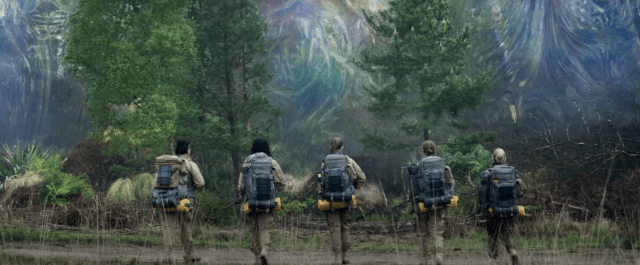
A military-science expedition into a quarantined area of wilderness causes each member of the expeditionary team to question their sanity, perception and the very laws that hold the universe together. Academic and former soldier Lena (Natalie Portman) volunteers for the mission following the sudden reappearance of her missing husband Kane (Oscar Isaac) in a critical state of health, but everyone has their reasons for heading into the “Shimmer”.

Early on there’s a striking shot of Lena and Kane reconnecting after a long time apart, their hands meeting seen through a glass of water. The image of their fingers touching bleeds, refracts and distorts. This becomes a motif as the film progresses, often with characters being separated by some barrier or another, creating distance in their relationships and forcing us to question our, and the characters’ perception of what is going on.

It’s great to see an all-female team of scientists and security types (explained as being able to offer a different take on the mission than all the solely male teams who have failed by disappearing or dying horribly ). You usually just get the token woman (Vasquez in ALIENS) or the fretting wife back home and it’s very refreshing here to redress the balance. There’s a lot of effort to differentiate the team and flesh them all out with unique backstories and motivations, and the characters work in broad strokes, though the genius in the group (Tessa Thompson) is of course meek and wears glasses. Thankfully the rounded performances make up for any shortcomings in character writing.  I want to hear Jennifer Jason Leigh provide handy exposition in more things, because you forget how commanding a presence she can be (“Soldier-scientist – you can fight and you can learn”).

Everything in this world is refracted in some way. This is an alien invasion (sort-of – something extraterrestrial may crash to Earth) movie all about change, not destruction. Despite the gun-toting on the poster, this is not an action film. Mutated creatures attack, but the team usually have to think their way out of whatever pickle they find themselves in. Much like ARRIVAL, this story is driven much more by theme than plot, and what happens in the beginning, the middle and especially the end is left deliberately ambiguous. Be on the look out for visual cues that rhyme but don’t necessarily say a lot about what is or isn’t actually happening.

There’s an odd, sinister beauty to a lot of this, from the oily, pearlescent barrier of the Shimmer to the fauna gone a bit wrong that live within it. The image of wildflowers that have grown into human shapes and stand watch like sombre guardians and the innocuous crystal trees scattered over a beach landscape will stay with me.

The film  has one of the most captivating, perplexing finales I’ve seen since…probably Garland’s last feature. This isn’t another EX MACHINA, but a different thinky sci-fi that takes its big ideas away from the confines of a chamber piece and out into the wild. Personally, I really enjoyed the confines of Ex Machina, but the expanded playground and thematic headspace of Annihilation works pretty well too. Don’t look for answers here, because you won’t get any. Unless Garland or someone else adapts one of Jeff VanderMeer’s sequels, then we might get some. Just enjoy the weirdness, and the debates about what it all means that follows. SSP
Posted in Film, Film Review | Tagged , , , , , , , , , , , | Leave a comment

Review: Game Night (2018)

game-night-633x356

Wanna play a game?: Access Entertainment/Aggregate Films

GAME NIGHT is an unexpected delight. Something that could just be raucous and crude in the hands of the guys behind the VACATION remake from a couple of years back ends up being not only a really sharp comedy but a seriously polished action film as well. DC time-travel extravaganza FLASHPOINT might not turn out so bad if John Francis Daley and Jonathan Goldstein stick with it.

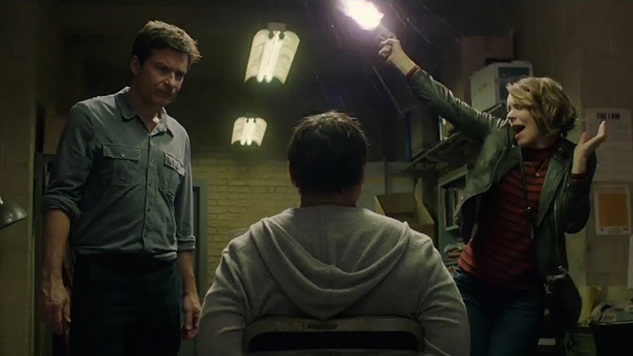
Max (Jason Bateman) and Annie (Rachel McAdams) found each other through their love to win. At the latest of their game nights with their friends, Max’s alpha older brother Brooks (Kyle Chandler) arranges for something a little more special: a simulated kidnapping. But when real criminals come after Brooks in revenge for dodgy deals gone wrong, Max, Annie and their fellow players will need more than a competitive spirit to get through the night.

I don’t think I’ve ever seen an action-comedy (outside of comic adaptations) where the action is this good. The choreography and blocking of the fights and chases throughout the film is slick and creative as our players get way, and then way more, over their heads. One of the film’s standout sequences is an ambitious long-take of the characters being chased around a mansion tossing a Faberge Egg to each other, and it may well be even better executed than the casino fight in BLACK PANTHER.

There were shots in this I’ve never seen before (the shot turning in time with a lock, a crane shot weaving side-to-side in time with a swerving vehicle) and there’s a general gloss and precision to the whole enterprise. There must be a BEETLEJUICE influence here with the shots of model neighbourhoods from afar blending into real locations in closeup each time we move to a new location, and this playfulness makes for a nice contrast with all the violence.

The gags come thick and fast and the cast, epecially McAdams (Annie is sweary, bouncy, a bit scary), Billy Magnussen (Ryan is beaming, excitable, scarily stupid) and Jesse Plemons (Officer Gary is robotic, prone to melting into shadows, scariest) all sell the hell out of their characters. The group are split off into their respective pairings for much of the story and play off each other in some really entertaining ways. The scene of McAdams forced to do DIY surgery on an injured Bateman in an alley using an online tutorial on a phone that keeps going to sleep is something to behold, a comic set piece that’ll take some beating.

Not everyone is equally well served (Sharon Horgan is mostly reduced to grimacing at Magnussen) and Bateman doesn’t exactly have to stretch himself, but it must be difficult to divvy up memorable moments between such a varied ensemble. There isn’t really a weak link in the cast, unless like me you’re allergic to Danny Houston (thankfully he’s only in it for a scene).

I can’t think of many comedies (action-leaning or otherwise) where I’m considering buying the soundtrack. Clint Mansell’s 80s synthy momentum-builder is seriously effective and memorable. They’re clearly aiming for a franchise, with strong branding from the animated opening credits onward, added to the distinctive look and sound of the film. They’re certainly sequel-baiting at the end (mild spoiler: Kyle Chandler doesn’t learn his lesson) and with this group of characters, I’d quite happily go for at least one more of these. I just hope they can keep it fresh and give every performer chance to shine. SSP

Posted in Film, Film Review | Tagged , , , , , , , , , , , , , , , , | 1 Comment

Review in Brief: Colossal (2016/17)

When I first heard about COLOSSAL – premise: giant monster is mysteriously linked to drunk Anne Hathaway – I thought, yes, that does sound like just my kind of movie. And you know what? It is! Hathaway and Jason Sudekis are at the top of their game, both playing way outside their comfort zone and going to some seriously dark places as the film boldly tackles some challenging issues, from addictive personalities to unhealthy abusive relationships. The other film it reminded me the most of was THE SKELETON TWINS; both films have an undulating tone and comedians playing it straight and are about how you can run but you can’t hide from your own and others’ self-destructive behaviour, you can only hope your coping mechanisms work. Colossal goes for a more fantastical slant, but for a movie with 200 foot monsters scrapping as they tower over Seoul’s skyline, it’s very grounded and very emotionally resonant. SSP

Posted in Film, Film Review | Tagged , , , , , | Leave a comment

Review in Brief: Jigsaw (2017)

While JIGSAW isn’t a bad movie, not even particularly low down in the wider SAW franchise (for the record it goes I, III, VI then Jigsaw) but it’s hard to love. Expect pleasing references to the earlier movies, new traps (my favourite for its simplicity is a big sandpit that immobilises you to have an assortment of sharp and heavy things drop in your head TOM AND JERRY-style) and a pretty easy mystery to solve. If you’ve seen even a handful of these movies surely by now you know the formula for guessing who Jigsaw’s (Tobin Bell, still having a blast) latest accomplice is: it’s not the really obvious suspect, it’s the slightly less obvious one. The Spierig Brothers are so much better than this material (watch PREDESTINATION) but they keep things polished and sure-footed even if few moments or characters are particularly memorable. SSP

Posted in Film, Film Review | Tagged , , , , , , | Leave a comment

Review in Brief: Their Finest (2016/17)

Yes, it’s probably destined to be a perennial Sunday afternoon favourite along with all the other cosy feelgood historical fare, but THEIR FINEST has a fair bit of bite to it as well. It has what SUFFRAGETTE (dignified as it was) was missing: some palpable anger. Never mind the insult delivered to Catrin (Gemma Arterton), “obviously they can’t pay you as much as the chaps”, but women screenwriters didn’t even receive a writing credit for the considerable valuable work they contributed to the war effort. The film industry may still have a way to go to achieve true equality, but at least we’ll never go back to the days of anonymous “script girls”. Yes, Their Finest doesn’t quite stick the landing as either a particularly convincing romance or as an act of significant historical reassessment, but it’s got a bit of attitude and it’s very watchable with good turns from Arterton and Bill Nighy. SSP

Posted in Film, Film Review | Tagged , , , , , | Leave a comment

Review in Brief: The Vault (2017)

THE VAULT isn’t a very good…anything. Marketed as a horror-thriller (haunted bank vaults: why isn’t that a genre go-to?) but it just doesn’t work because it’s not scary and it’s not exciting. I think they might have been going for bank robbers doing a bad thing for the right reasons, a Robin Hood-type thing, but the character motivations and storytelling are so muddled that nothing really sticks. Taryn Manning and Francesca Eastwood are both fine as the sibling bank robbers, but James Franco makes no impact despite his character being pretty key to the plot and everyone else in the movie is just a cardboard cutout. It’s just a waste of the talents of everyone involved, lacking surprise, suspense, good lighting and general interest in what’s going on. Use your time better elsewhere if you can because this one really isn’t worth it. SSP

Posted in Film, Film Review | Tagged , , , , , | Leave a comment

Review: Lady Bird (2017)

lady-bird-web-3-1200x600-c-default

Retail therapy: Scott Rudin Productions/Entertainment 360

While we’re up to our eyeballs in father-son stories on film, even pretty frequently seeing father-daughter and mother-son stories (both examples involving sons tend to be dysfunctional, because aren’t we just the worst?), there are relatively few really good mother-daughter films. Then along comes LADY BIRD.

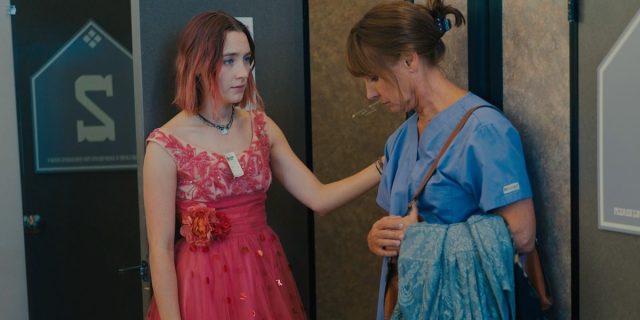
Christine “Lady Bird” McPherson (Saoirse Ronan) is at a difficult time in her life. Her Catholic school life is coming to an end, she wants a boyfriend, she wants to go to a college that will nurture her artistic inclinations and she’d love it if her mum (Laurie Metcalf) would get off her back for once. Since none of this (by Lady Bird’s estimations) will happen while she is stuck in Sacramento, “the Midwest of California”, she sees it as just the right time for her to leave the nest.

It’s so refreshing to see Saoirse Ronan, a young actor who I’m sure has bad hair and greasy skin days like the rest of us, allowed to have acne and lank hair, because that’s what real teens look like! The teenage characters speak how real teenagers do as well; they’re bright but not ridiculously verbose as someone like Diablo Cody might write them. Lady Bird’s defense of her mathematics skills not being a strength (“that we know of…yet”) and her uncomfortably “not flirting” with the cool kid in the band (Timothée Chalamet) rings far truer than all the forced (if charming) quirk of JUNO.

Major props to Laurie Metcalf for playing a challenging personality (the family “bad cop”) so sympathetically. Lady Bird’s mother is a formidable woman really struggling to understand her difficult daughter. In one of the film’s major moments, as she leaves Lady Bird at the airport for her journey to college she has a mini-meltdown that traverses an impressive emotional obstacle course in a very short space of time, and she still just about pulls herself together before she sees her husband (Tracy Letts) again.

The best scenes are the constantly shifting, passionate, petty arguments between Lady Bird and her mother. God bless her, but Lady Bird can be more than a little insufferable. She is the kind of kid who makes a scene over eggs at breakfast and would rather throw herself out of a moving vehicle than continue an awkward conversation, after all. A key point has Lady Bird asking her mother, of her potential, “What if this is the best version?” Tellingly, her mother struggles to alleviate her doubts. Still, at least she doesn’t lie to her!

The film unusually portrays a pretty positive Catholic education. Supportive and passionate teachers (Lois Smith and Stephen Henderson among others), ample opportunities for extra-curricular growth, not being expelled for graffitiing “just married to Jesus” on a nun’s car… Even if Lady Bird feels lost, it looks like a good school, a school with a sense of humour apparently, which sends the Irish kids home to sober up after they got drunk on locker-stockpiled minis on St Patrick’s Day.

The McPhersons have a really interesting, unusual family dynamic, with adopted children, surrogate children and ungrateful biological children. This isn’t overtly explained, but seeing the family unit sitting down for breakfast and the dynamics between them gradually flesh out throughout the film is enough.

Lady Bird draws liberally from Gerwig’s experiences, and the timelines certainly match up, but Gerwig has been keen to distance the film from the biopic label. Lady Bird’s story is perhaps a bit too neatly tied up by the end, it maybe could end a scene earlier for a more ambigious final note, but there’s very little else to criticise of the film as a whole.

Gerwig’s naturalistic delivery in her acting has carried over to her writing and direction. It’s a really good-looking, sharp, confident debut and her authorial imprint is already clear. We have graphically strong transition scenes, low-key character beats and jolts of joyous, more extrovert, endearingly goofy energy. Lady Bird is a thing of understated, honest beauty and a sign of great things to come from Gerwig. SSP

Posted in Film, Film Review | Tagged , , , , , , , , , , , | 1 Comment

Review in Brief: Mute (2018)

I’m so pleased Duncan Jones got this one out of his system. It’s just a shame MUTE doesn’t feel fresher or more complete. Speechless protagonist Leo (Alexander Skarsgard, cast for his big sad eyes) is Amish . Except for when he isn’t. Yes, Leo sits with his back to the TV, but he also has family photos (which promote vanity) and uses desk lamps and modern plumbing (both of which are conveniences of modern life). I know some visual similarities to last year’s BLADE RUNNER 2049 were likely coincidental, but there’s also an exotic dancer in gold bodypaint and a clear plastic poncho that unwisely invites comparisons to Ridley Scott’s original, as does his less smoggy future city (if there’s one city that’ll stay shiny and well-run even if the rest of the world goes to hell, it’s Berlin). I’ll say one thing for Mute: the relationship between Paul Rudd and Justin Theroux’s incredibly dark characters is fascinating, but one thing working isn’t enough. SSP

Posted in Film, Film Review | Tagged , , , , , , , , | 3 Comments

Review: Call Me by Your Name (2017)

Call-Me-By-Your-Name

Study break: Frenesy Film Company/La Cinefracture

I was just starting to think the 90th Academy Award nominations weren’t all that impressive. Then I watched CALL ME BY YOUR NAME, and thank goodness I did. This is one of the most powerful, thoughtful and heartfelt dramas of recent years.

Gifted teenager Elio’s (Timothée Chalamet) long Italian summer with his family is rocked by the arrival of Oliver (Armie Hammer), a mature student on placement with his academic father (Michael Stuhlbarg). Though standoffish to the newcomer at first, the pair’s relationship soon blossoms to a full-blown romance, one that will change at least one of their lives forever.

It took me a while to get used to the pace of this one. I’d describe it as languid or leisurely, completely befitting the Mediterranean setting. It’s a long film, and might feel longer were it not for these characters, but they quickly grow to fascinate you and the passage of time becomes unnoticeable. I adored this strange but natural developing relationship, from apathy to open hostility to grudging friendship and finally passionate physical attraction. Elio and Oliver are both proud, troubled, brilliant men who become the best versions of themselves together, as tragically fleeting as their summer dalliance is. Elio shows off, Oliver dismisses him, and both compete for the affections of the locals and Elio’s family. Their love scenes are tender and real, but tastefully handled. This isn’t just for the sake of studios squeamish about portraying gay sex, either. Both Elio’s intimate scenes with women and with Oliver are handled in the same manner. The more disturbing potential of their age gap is avoided because of one key concept: consent. This is not a one-way relationship.

Distance is used in some really interesting ways by director Luca Guadagnino and DP Sayombhu Mukdeeprom. When Elio comes clean about his feelings for Oliver, they are working their way around opposite sides of a WWI memorial, never mind making eye contact, they can seldom even see each other at this key moment. More often than not the camera pulls back and takes the characters in as part of the landscape, their big beautiful emotions and experiences swallowed up by the even bigger, more beautiful landscape. The sun-drenched Italian countryside couldn’t look more enticing, yet it hides pain and heartbreak in equal measure to passion and elation. Is there a word like “bittersweet” but for a bright summer’s day? That’s what Call Me by Your Name is.

This is the kind of work Armie Hammer excels at. Despite his looks, he is not a Hollywood lead, he is, and always will be, a character actor. You completely get why Elio falls head-over-heels for Oliver, why their meeting matters. Their scenes together positively crackle, but the simple purity of the film’s final flourish is  completely reliant on the skills of one talented actor conveying a storm of repressed emotions. There is nowhere to hide here, and it is here that Timothée Chalamet becomes a star by staring, utterly distraught, past the camera and the stages of grief overwhelm him.

As stunning as Call Me by Your Name’s final shot is, the film’s best scene, indeed the best scene of 2017 comes a little earlier and it is typified by a some wonderful small moments between Chalamet and Stuhlbarg. If you take nothing else away from the film, take this quote about young love: “We rip out so much of ourselves to be cured of things faster that we go bankrupt by the age of 30, and have less to offer each time we start with someone new”. The scene plays out unexpectedly and refreshingly honestly, it accepts that first love may feel like the end of the world when it ends, but it is not the be-all and end-all.

This is a story of first love and sexual awakening that is optimistic but also realistic. As Elio’s story, we see his world glimmer with new possibilities during the good times and get plunged into blackness in the bad. The chemistry at the story’s core makes all this work and the craft, from the locations, filming and sensitive adaptation of the source novel elevates the whole package to something gorgeous enough to hang in a gallery. SSP


Posted in Film, Film Review | Tagged , , , , , , , , | 2 Comments

Review: Three Billboards Outside Ebbing, Missouri (2017)

three-billboards-watching-videoSixteenByNineJumbo1600-v6

Dressed for a dirty job: Fox Searchlight/Film 4

The more I mull over THREE BILLBOARDS OUTSIDE EBBING, MISSOURI, the more its place at the head of the Oscar race baffles me. Martin McDonagh’s first film since SEVEN PSYCHOPATHS boasts admirable performances and fiery dialogue but fundamentally frustrates you as well. This year’s Oscars boast two films that will almost certainly win for their lead performances but which shouldn’t even be in the conversation for the top prize.

Mildred Hayes (Frances McDormand) takes her town’s police department to task for failing to bring her daughter’s killer to justice. Hiring three billboards on the outskirts to publicise their ineptitude (“Raped while dying / And still no arrests / How come, Chief Willoughby?”), she draws the ire of Willoughby (Woody Harrelson), blunt instrument Officer Dixon (Sam Rockwell) and many of the residents of Ebbing, Missouri as well.

McDormand is outstanding, a sweary toughnut matriarch ready for war (just look at how she tears apart the local reverand with a foul, personal monologue). Unfortunately, her character Mildred is utterly abrasive and unlikeable throughout. I know that’s the point, that the terrible defilement and loss of her only daughter has reduced her to a bitter, combative shell of a human being, but it’s a long two hours to spend in her company. Between her and Rockwell’s bigoted live wire as the two showiest roles, you find yourself praying for more time with Woody Harrelson who at least plays a character with light and shade. I wish we were given more time with Mildred’s family unit as a whole – we only get one real flashback that establishes two things: they argued, and they used the C-word very liberally.

I became irritated by the rolling series of coincidences that is the main plot, the on-the-nose dramatic irony in the flashback sequence and whenever McDonagh thinks he’s playing the part of a clever satirist. He’s much better at peppering his barbed dialogue with creative or unexpected swearing, like Mildred’s seemingly innocent billboard inquiry, “I assume it’s ya can’t say nothing defamatory, and ya can’t say, ‘f***’ ‘p***’ or ‘c***’. That right?” The rest is all just a bit contrived, whatever the intention was. I know McDonagh isn’t exactly a subtle creative force, but Three Billboards still features one of the most heavy-handed pieces of symbolism I’ve ever seen, and it’s made all the worse by a character further explaining it to the audience.

While it’s always nice to see Sam Rockwell getting recognition for something, I completely agree that the film’s excusing Dixon’s deplorable actions because he’s dumb and lives with a monster of a mother is pretty repulsive. Harrelson’s Chief Willoughby pulls the old “good deep down” justification for his psychotic subordinate and we’ve no idea what he’s spotted to give Dixon the benefit of the doubt. All points to slightly shoddy writing for Rockwell’s character: if he’s going to be forgiven, redeemed towards the end, then he has to be given more than one dimension.

Equally troubling is that by the end of proceedings, McDonagh seems to be advocating the virtues of vigilantism. I understand the reputation of the Police in the USA has rarely been lower, attitudes, working practices and disciplinary procedures are in dire need of change, but there’s a fair few steps separating the idea of Police reform and the call to arms for citizens sorting it out for themselves, especially when guns as a way to dispense justice comes into the conversation.

My biggest issue with Three Billboards, even beyond the disturbing political subtext and surface-level characterisation, was that I did not feel engaged in this story or characters. I felt passive, unemotional, despite the hard-hitting human story being told. We’re relentlessly pummeled by horribleness for little payoff, and because the story is told in a conventional a-b-c manner instead of playing with time and perspective to gradually reveal the moments that made Mildred who she is, we’re not given enough context or emotional resonance to really understand these characters. Bursts of classical music, the laziest shorthand for “we’re an important film, we’re intellectual, we promise!” really doesn’t help this misjudged, strangely dead-eyed Oscar-contender. SSP

Posted in Film, Film Review | Tagged , , , , , , , | 1 Comment