For every Alex Garland who successfully shifts their focus you get a David Koepp who does not. Taylor Sheridan has added an extra step to the writer-to-director process, by acting first. He’s clearly talented, having penned two of the best screenplays of the past decade back-to-back. WIND RIVER is Sheridan’s least successful effort, possibly because he shouldn’t try and do everything. It’s far from inept, with a decent level of craft in the way the inhospitable but beautiful winter Wyoming is shot and it has a message worth talking about, but for whatever reason it lacks weight for such potentially punchy material. Wind River’s characters aren’t as fully-formed as those in HELL OR HIGH WATER, not as fascinatingly contradictory as SICARIO‘s. Aside from a late, contextualising flashback, performances rarely get to rise above the surface-level, any grounding in atrocities people can commit to each other given the opportunity is lost in pretty standard. SSP
Review in Brief: Wind River (2017)
80s Review: The Shining (1980)

This is why I don’t like hotel corridors: Warner Bros/Hawk Films
Most people’s first thought of Stanley Kubrick’s THE SHINING will be one of three images: the ghost girls, the woman in the bath and Jack Nicholson axing his way through the bathroom door. Few western horrors, except for perhaps THE EXORCIST are as iconic, are such an integral part of the pop culture furniture. And to think, Stephen King didn’t like it!
When aspiring author Jack Torrance (Jack Nicholson) accepts the position of overwinter caretaker of the isolated Overlook hotel in Colorado, he could hardly guess the horrors he is about to subject his family to. For the Overlook carries a burden within its walls, a history of murder, madness and malice, and Jack’s young son Danny (Danny Lloyd) has unique gifts, the kind that make him very appealing to the hotel’s unquiet dead…
Stephen King might not have liked it as an adaptation, particularly the reading of his lead becoming an antagonist, but Jack starting out on the edge (are you really going to trust Nicholson claiming that “nobody’s saner than me” with that grin?) before he arrived at the Overlook, supernatural events only exacerbating his preexisting mental health issues, really works. The hotel may be the home of a corrupting, black-and-white evil formed out of the atrocities committed within its walls, but it can only shape and mould what is already in the human heart, mind and soul; we are very susceptible to all kinds of influences as a species.
The acting is all very “big”, with Nicholson delivering what is essentially a proto-Joker and Shelley Duvall rarely allowed to be anything other than a nervous wreck. No, she shouldn’t have been put through the physical and emotional turmoil Kubrick insisted on, but it did result in the reality of her fragile nature. You tend to forget how good Danny Lloyd’s performance was, one of the all-time great child actor performances that has multiple levels to it.
This might be unsurprising to hear about a Kubrick film, but The Shining is staggering on a technical level. Everything bar the front of the Overlook at the beginning was purpose-built at Elstree Studios and that Steadicam (used to great effect in corridors) was in its infancy. That invention was so new, in fact, that its originator Garrett Brown was still operating it himself (doing split shifts with ROCKY II over the Atlantic). It’s the stillness of the camera that gets you, the rigidity. Nothing is obscuring your view and you’re not being allowed to look away even if you want to.
The sets are meticulous bordering on obsessive, because no one building boasted all the features Kubrick wanted we get a Frankenstein mix of all of the best, and worst, grandest and chintziest hotels you’ve ever stayed in. Never mind butting heads with his actors over incessant retakes, you have to feel for Kubrick’s long-suffering production design team that had to produce such an ingenious and versatile labyrinth of corridors and rooms to his exacting standards.
For all the blood and cross-cutting to horrific haunted house imagery, what makes The Shining such an effective horror is how it manipulates mundane images and sounds. Long corridors are made scary, and to this day I feel uneasy in hotels in case I turn a corner and see the Grady girls waiting for me at the other end of a corridor. The whir and the clatter of Danny’s trike as it goes from floorboard to carpet, floorboard to carpet is made scary. Being on your own in a large building with all the lights on is made scary. The soundtrack not playing ball, rarely clueing you in in when the next scare is coming until it’s there is scary.
The Shining arguably changes what King was trying to achieve with his story, but I’d take Kubrick’s version any day of the week. This take has humanity starting out a bit wrong, malevolent spirits only taking our worse natures further than they would go naturally. Humans are scarier than ghosts or psychic powers, an idea which carries more weight and leaves a lasting impression beyond the shocking visuals and uneasy tension-building. As a different Joker to Nicholson’s put it, “madness is like gravity: all it takes is a little…push!”. SSP
90s Review: The Silence of the Lambs (1991)

Analyse this: Orion/Strong Heart/Demme Production
THE SILENCE OF THE LAMBS has been a firm favourite of mine for a long time, one of those I’d always stop for if it was playing on TV late at night, and try as I might, be helplessly drawn in all over again.
To catch a meticulous and depraved serial killer, the FBI must use the mind of another meticulous and depraved serial killer. When trainee Agent Clarice Starling (Jodie Foster) enters the Baltimore State Hospital for the Criminally Insane to interview Dr Hannibal “The Cannibal” Lecter (Anthony Hopkins) a game of wits begins…
Point of view is really interesting in Lambs. It’s not really a murder-mystery because we know who the killer is almost from the start. It’s really about how the protagonist catches up and whether they will manage it in time. This is a very Thomas Harris way of telling a story.
Clarice is set up to be underestimated from the start, with the 5’2″ Foster hemmed in on all sides by big men in the FBI lift. She has to work twice as hard to be noticed, to be respected and valued, but she’s likely learned to use these expectations of her based on her sex and stature to catch people off-guard. She puts up with a lot of belittling and more blatant sexism, from FBI colleagues including Scott Glenn’s Crawford (sympathetic, supportive, but still uses her), Anthony Heald’s puffed-up Dr Chilton (superior, lecherous), Frankie Faison’s hospital orderly Barney (kindly but patronising), but she also gets to play her hand, using guile and fortitude to keep at least a step ahead of everyone she encounters. Unless she is caught off guard by sociopaths that is, whether a keenly honed tool like Lecter or a blunt object like Bill.
Quite rightly, the film is best-known, best-loved because of its bravura set pieces, not action or visual spectacle, but conversations, Clarice and Dr Lecter mentally sparring, each trying to deconstruct the other. These scenes may only be a few minutes a piece, but Foster and Hopkins make them dazzle, giving Harris’ words, adapted almost verbatim, even more bite. From Lecter’s iconic, low-key reveal to the barrier that constantly divides them as their sessions get really intimate in the details, these sequences are masterful examples of economic yet deep dives into character.
Jonathan Demme isn’t a showy filmmaker here, letting performance and our imaginations do most of the work. By the time Ridley Scott brought HANNIBAL to the screen with sickly style but lacking power, it became really obvious that less is more. Dr Chilton showing an (unseen to the audience) Polaroid to Starling with the comment, “He did this to her…the doctors managed to reset her jaw, more-or-less” is far more chilling than actually seeing the incident (Scott of course actually showed it to us to shrug-worthy effect in the sequel).
“It rubs the lotion on its skin or else it gets the hose again”. I get that Buffalo Bill (Ted Levine) can be seen as an offensive stereotype, that his prominence in pop culture along with several other examples from the 90s probably did the public perception of the trans community lasting damage. The book does a better job of distancing him from the group he is often seen to represent: “It’s taken years – we’re not through yet – showing the public that transsexuals aren’t crazy, they aren’t perverts”. I’d be inclined to see him as one isolated, disturbed individual (Lecter even theorises that “Billy is not a real transsexual”) but since the film unwisely dropped this subplot from the book, some nuance is lost. When trans characters are so seldom seen in mainstream films and when they are seen they appear like this, well, it’s problematic.
There’s something behind Hopkins’ eyes that is utterly terrifying. We empathise with Clarice and her struggles, we even feel a modicum of pity for Buffalo Bill, but we are never asked to feel anything but fear towards Lecter. As Harris came to realise when he wrote him, he represents the line to never cross. He remains beguiling and fascinating but an enigma from his introduction, his escape and beyond. In the foreword to the new edition of RED DRAGON in 2000, Harris admits that Lecter still frightens him, that the character holds some strange supernatural power over his creative process. He writes that “I found, and find, the scrutiny of Dr Lecter uncomfortable, intrusive” and that “I did not know that Dr Lecter would return”.
I love the misdirection at play throughout. I’m sure it wasn’t the first movie to do it, and we’ve seen it plenty of times since, but the cross-cut between Crawford’s heavily armed team knocking and Buffalo Bill opening the door to Starling alone on his doorstep gets me every time. This trick of storytelling is even foreshadowed earlier with Clarice’s flashbacks to her worst childhood memory, changes in time and location not signposted but blended into the same scene and Clarice’s perception of the present and how she got there.
For all Hopkins’ showy twenty minutes or so of screentime, it’s not Lecter alone we remember about The Silence of the Lambs, but his dynamic with Clarice. That’s one of the (many) reasons why the follow-up wasn’t as compelling; Lecter is only interesting when interacting with a worthy opponent and he’s in the spotlight far too long. It’s Foster’s movie through-and-through and Foster’s performance makes this slick thriller special. SSP
Review in Brief: Churchill (2017)
Trading showiness for human connection, CHURCHILL is far superior to DARKEST HOUR. The dialogue might range from poetic bluster (“My job is not to fight, not to die…I must exist”) to rather cumbersome exposition (“We’ve only a three day window before the tides change, making its possible to land our craft”) but Brian Cox’s portrayal of Churchill really manages to tap raw emotion rather than be a caricature. He may have been the icon, the rallying cry, of the British nation (despite being half American), but Churchill was not a well man by 1944, nor was he infallible, with the allied high command, chiefly Eisenhower (John Slattery) considering him a liabilty, a relic from another time, another type of warfare. Here, Winston Churchill’s angry blustering is shown to mask his insecurity, vulnerability and fear of at the very real prospect of losing everything. It tends to feel a bit TV Movie, but it gets under the skin of “The Greatest Britain”. SSP
Review: Jurassic World: Fallen Kingdom (2018)
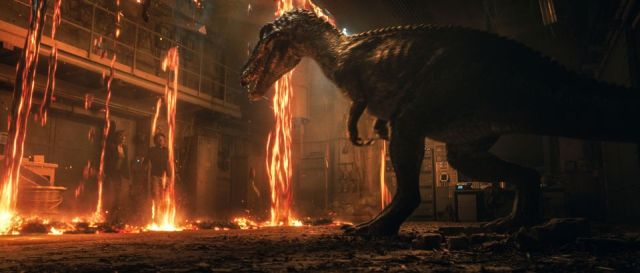
Lava actually: Amblin Entertainment/Legendary Entertainment
Well, it’s certainly a lot more fun than the last one. JURASSIC PARK is my favourite childhood film and remains very close to the top of my list today. The sequels have never been up to much, and each time we go around again the wonder is diminished, the spark of creativity dimmed. This went especially for JURASSIC WORLD, which tried to both appeal to nostalgia and mix up the formula, achieving neither. FALLEN KINGDOM, for better or worse, knows exactly what it is.
After the PR disaster of dinosaurs running, flying and swimming amok in Jurassic World, the theme park is mothballed and the scaly attractions prepared for auction to the highest shady bidder. Enter former park executive Claire Dearing (Bryce Dallas Howard), now working for an animal welfare charity and tracker Owen Grady (Chris Pratt) whose only obstacles to saving the dinosaurs are those with too much money and no morals and the small matter of a volcanic eruption already in progress…
They really want you to know that they are aware of “Shoegate”. There are several quite pointed closeups of the sensible boots Howard is wearing. Sadly, more appropriate footwear for running for your life isn’t the same as character growth. At least Howard seems to be trying and isn’t on autopilot again (lookin’ at you, Mr Pratt). I still don’t buy Owen and Claire’s relationship, though a scene where they both have to get very up close and personal with an unconscious T-Rex in a shipping container to draw blood for…plot reasons is an unexpectedly great character moment for the both of them, and Pratt and Howard seem to be having a lot of fun playing this moment. The supporting cast are fine, with Daniella Pineda’s paleo-veterinarian Zia being a welcome addition and Ralph Spall having fun as a slimy suit impotently leading a collective of cruel mercenaries (including Ted Levine, collecting trophies again Buffalo Bill-style).
The fact that they really lean into the film’s silliness, the premise’s inherent nature as B-movie material (when Spielberg isn’t involved or involved in an inferior re-hash) does Fallen Kingdom a lot of credit. Yes, you could pick apart the logic some of the plot points if you were so inclined, but you’ll have a lot more fun if you just go with it. Ideas with their roots in Michael Crichton’s pages are taken to the nth degree and get some serious payoff, even if they don’t stick the landing executing every concept. Plus, if there’s an opportunity to show a Velociraptor being exploded through a window then I want to see it. Simple pleasures.
Something that also helps give it a distinctive flavour is hiring a director with a recognisable style. The film’s Gothic horror-tinged final act, all shadows and secrets, is an undoubted highlight. JA Bayona really pushes the vampiric side of the new Indoraptor. In a key scene we see it crawling vertically down the outside of a building to claw at a bedroom window, which couldn’t be more Dracula if it tried. It’s probably the new films’ highest-impact theme: any animal raised in isolation, whether artificial or not, will come out wrong when it leaves captivity. Auctioning off dinos as prestige pets or for sport is chillingly believable as well, far more so than sending them overseas as scaly soldiers (please don’t bring that idea back in the third film, Trevorrow…).
If they’re going to keep this series going, it’s got to evolve and offer up something different each time. These new movies can’t just be, “Remember this? Well here it is again!”. The film is crammed full of dino-cameos (Brits will be pleased to hear that the very belated appearance of our snappy native carnivore Baryonyx is worth the wait) and the camera captures these real-feeling creatures in some striking new ways, whether from above pacing restlessly in their warren of cages, causing mayhem as their world (outside) collides with ours (inside), or one particularly dignified and moving death-by-nature. We’re certainly not short on memorable visuals, but a few sharp or even vaguely memorable lines of dialogue to go with them wouldn’t go amiss.
I reckon Jurassic World: Fallen Kingdom is going to be my 2018 ALIEN: COVENANT equivalent in that I quite enjoyed it, even its more divisive tangents, but I seem to be in the minority. It’s not that I can’t see value in the criticisms; the characters are still uninteresting, the storytelling standard and wonder mostly lacking. But this is easily the scariest and most tense Jurassic film since the first, it adds a fair few new ingredients to the stew and with Bayona’s stylistic flare and unabashed ease with serving up trashy entertainment we get some vivid set pieces too. It’s certainly not high art, but it makes an impression. SSP
Review: Solo: A Star Wars Story (2018)

Who’s scruffy looking?: Luscasfilm/Disney
SOLO is the most OK Star Wars movie I’ve ever watched. The first Star Wars spin-off ROGUE ONE didn’t knock it out of the park, but at least it felt complete, what was intended, and it balanced the nostalgia factor with enough that was new. Solo is a film of peaks and troughs, Kessel Runs and pieces of junk exposition. They get the casting spot-on, but not a whole lot else meets your expectations.
Long before he became the Rebel Alliance’s favourite scoundrel, Han Solo (Alden Ehrenreich) escapes his life in the slums by joining the Imperial Academy and is recruited by Tobias Beckett’s (Woody Harrelson) gang of smugglers to undertake a daring heist, meeting future friend Chewbacca (Joonas Suotamo) and frenemy Lando Calrissian (Donald Glover) en route.
There was a bit of an outcry during the film’s troubled development when it was revealed by original Solo directors Phil Lord and Chris Miller that “Han Solo” might not be the character’s real name. Rest assured, he is really called Han.
While he is better at portraying Harrison Ford’s smirk and attitude than his voice (and he needs a chin prosthetic to look even vaguely like him), Ehrenreich makes a pretty good young Han and most importantly makes the BFFs-at-first sight relationship with Chewie hit home. Glover nails Billy Dee Williams’ Lando Drawl and crafts a compelling rivalry between him and his “ol’ buddy”. Harrelson does his usual thing (can/should Star Wars characters have the surname “Beckett”?) and Phoebe Waller-Bridge like Alan Tudyk before her in Rogue One, crafts one of the most interesting and contradictory non-human characters, “droid rights” campaigning droid L3-37. Less convincing are Emilia Clarke and Paul Bettany, the former only defined in terms of her relationship to the men around her and the latter who needs much more than scars and inappropriate smiling to be scary.
The film’s first act feels very TV pilot-y, throwing characters, conflict and ideas at you at a staggering rate while never giving the impression that the whole story has been worked out yet. Network TV can do this: they have time to try things out and the opportunity to ditch things that don’t work before they stick. A two hour film? Not so much. It gains confidence in the first big set piece, a train heist lifted straight from the broadcast pilot of FIREFLY, “The Train Job” and spruced up with better effects and more exciting staging. The long-awaited Kessel Run is a killer sequence with STAR TREK reboot-level stupid physics and even more jeopardy than you might expect, not just to beat the parsec record for getting through the nebula, but to do it before the Falcon’s highly volatile cargo explodes or the ship, which is falling apart around our heroes, gets too many holes to keep the outer space, erm, out.
There’s some serious AMAZING SPIDER-MAN 2 syndrome in evidence here. Tell. The. Story. You’re. Telling. I’m so sick of teasers for future instalments that might never manifest, when the plot stops dead to allow for a “this will matter later” moment. They keep referencing Jabba the Hutt and the other bounty hunters and seemingly building towards Han’s defining moments, but the aforementioned Kessel Run and freeing Chewie aside, nobody seems in a hurry to get there. Solo’s story is a bit of a messy grab-bag of genre tropes and story beats, at various points playing dress-up as ALADDIN, SPARTACUS and THE MAGNIFICENT SEVEN among others.
There are surprises for sure, some of them without much point beyond solidifying the current iteration of the wider mythology. I certainly wouldn’t object to seeing Ehrenreich in the role again in some capacity, though whether this is in a direct sequel or a spinoff focussing on a different character remains to be seen. The original directors jumping (or pushed from) ship and replaced by Ron Howard midway through production implies a more incoherent final product, but really Solo just ended up being frustratingly inconsistent. It may look and sound good and have some talented actors fronting it, but it’s not daring or memorable enough to make me consider revisiting any time soon. SSP
50 Years On: 2001: A Space Odyssey (1968)
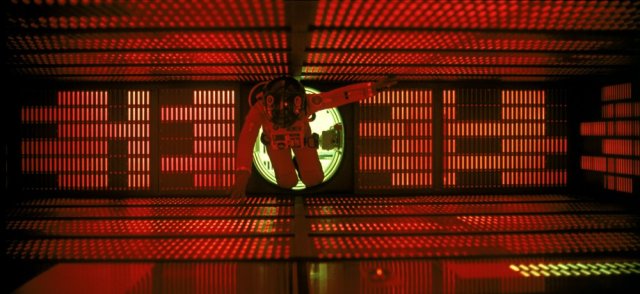
I’m afraid…of symbolic red: MGM/Stanley Kubrick Productions
There are films every cinephile should see on the big screen. 2001: A SPACE ODYSSEY is near the top of that list. Last weekend I finally managed to tick this moviegoing experience off and thought it would be a great opportunity to look at how well it’s aged 50 years after its initial release.
From the dawn of man, to their journey to the stars and beyond, this is the story of humankind looking for answers, with only an increasingly aware AI and an unknowable black obelisk as our guide…
Five decades later and 2001’s influence still holds sway over cinematic sci-fi. For at least the following two decades, very few visions of the future – from STAR WARS to ALIEN and, er, EVENT HORIZON – didn’t owe something to Stanley Kubrick and Arthur C Clarke. The future isn’t sleek and aesthetically pleasing, it’s pale grey, chunky and functional. It’s also tactile, this world created with models, sets, matte paintings and clever little in-camera tricks (the walking up the walls bit still astounds) and you get the feeling Kubrick would have done it this way even if better technology had been available.
Like a lot of the best sci-fi, the world we are presented with is outlandish yet plausible – are Hilton Space Stations really any less strange an idea than Virgin Galactic? We’ve come to terms with the fact that if any of us get the opportunity to go into space it’ll be a long haul, a massive commitment. Hints at necessary technological advancements, from super-grippy shoes for cabin crew to move around in low gravity, meals in liquid cartridge and paste forms and the essential complicates space toilet are all grounded in a 60s-looking-to-the-future logic. More chillingly, leaps forward in AI technology makes the prospect of computers, if not turning on us then killing us through a programming glitch (think driverless cars) all the more real. When our end comes, it won’t be an an apocalypse of terminators marching over a hellscape, but it might be HAL telling us “I’m afraid I can’t do that”.
Re-watching 2001, I found myself quite unexpectedly thinking of BABY DRIVER. Don’t worry, I haven’t lost it (though by sheer coincidence a certain disgraced actor in Edgar Wright’s heist musical also played a HAL-alike in MOON). Like Baby Driver, 2001’s scenes are edited, and action within long-takes progresses, so perfectly in time with the classical score that Kubrick must have at least had the specific pieces of Strauss music he wanted to use in mind during filming.
The pacing of 2001 could be charitably described as “leisurely”. Less charitably, the film is “ponderous”. It is an epic which takes the time to ingratiate you in a new world. And surely telling the story of the entirety of human existence should be lengthy? At the same time, while I know slow movements and long sequences in space help sell the experience of entering a vacuum, I really don’t think Kubrick needed to keep every similar scene the length they are.
2001 still fuels passionate discussion today amongst sci-fi fans; its most famous imagery and elusive conclusion remain iconic and rightly so. Kubrick and Clarke stubbornly avoid proving anything close to an answer to what the ending actually means (oh, to be a fly on the wall as they hashed this one out together…). Personally, I think it represents evolution by time loop. From the dawn of man, the Obelisk has been guiding the evolution of our species, deciding when the right time is for us to take a leap forward. After he goes through the star gate, Dave (Keir Dullea, definitely cast for the reflective quality of his big eyes) enters the loop and every time he comes back around he is an improved, higher form until he finally transcends his mortal form as the Star Child. Of course, that’s just my theory. SSP
Review in Brief: Coco (2017)
I promised myself I wasn’t going to cry at COCO, Pixar’s latest. I need to stop making promises I can’t keep. Even the reason behind the film’s title brought on a little lip wobble. The studio really does produce emotionally mature animation, and with this coming hot on the heels (by Pixar standards) of INSIDE OUT, the cartoons seem to be growing up in real-time with their avid fans. Coco carries a real poignancy very appropriate to the Dia de los muertos; losing a loved one, while upsetting is not the end, and they never really leave us while we still mark their passing and remember the joy they brought us. The real heartbreak comes from those without anyone left to remember them, those forgotten or ignored by their surviving family for a variety of typically silly (in the grand scheme of things) family reasons. The animation is vibrant and imaginative and it’s wonderfully performed by the actors, singers and musicians, an appropriately festival-like experience with a thoughtfully sombre undercurrent. SSP
Review: The Lure (2015)

Not quite “Part of Your World”: WFDiF/Platige Image
Mermaid horror-musical THE LURE is something else. Mostly because it’s a mermaid horror-musical, and I, like many others I’m sure, never thought I’d ever watch, let alone want or need, such a thing. It’s also apparently the first proper musical to come out of Poland, a fact which for some reason surprised me.
There are rules to being a mermaid, and rules to being a human, and the two states of being are rarely harmonious. When mermaid sisters Silver (Marta Mazurek) and Gold ((Michalina Olszanska) come ashore, they become novelty singers at a club, but soon realise they each want something very different from the human world.
I was pretty much sold on the opening of the mermaids’ first song: “Help us come ashore / there is nothing to fear / we won’t eat you my dear”. The dark, bestial and dangerous mermaids of European myths and folklore are always more interesting than those wearing shells and chilling on rocks. As a musical The Lure doesn’t fit neatly into either “spontaneously breaking into song” (SINGIN’ IN THE RAIN) or “performance confined to stage” (CABARET) variety, but does a bit of both, with the numbers being enjoyed by the punters in the club and allowing characters to express their inner turmoil when on their own with their thoughts.
There are some gloriously camp musical numbers, mostly set to electro pop floor-fillers. The club Silver and Gold sing and dance at is grotty, its patrons and management grottier still, but none of them seem to have qualms about throwing themselves around the dance floor when the mood arises. This is a very different reality to our own, one where mermaids walking on land isn’t all that strange compared to the other sights at the cabaret. In fact that is the thing that brings you out of this film’s weird, wonderful and more than a bit grotesque world the most: nobody seems to think the existence of mermaids and other folkloric creatures is out of the ordinary, in fact it barely provokes a shrug.
This film does for mermaids what LET THE RIGHT ONE IN did for vampires, but with a bit of BEYOND THE VALLEY OF THE DOLLS thrown in for good measure. More Beyond the Valley of the Dolls should be thrown in for good measure in movies: the world would be a much livelier, stranger-in-tone place.
It’s a symbolic (well, more iconoclastic) coming-of-age story that morphs into a pretty painfully rendered trans narrative by the end, at least that’s how I read it. Whereas Gold’s drives are simple – protecting her sister and eating any human that poses a threat – Silver’s main drive throughout the second half of the film is essentially to become a “real” woman with functioning sex organs, so she goes for surgery. This results in easily the most disturbing musical number I’ve ever seen, with Silver singing about her innermost desires from an iced slab as surgeons remove both her tail and the human bottom half of the “donor”. It’s a pretty bold and unusual take on Hans Christian Andersen, and a sequence that will make or break the film for many, if the air hostess striptease, boogying leches in bad suits and punching mermaids in the nose didn’t do that for you already.
We’re looking at some weird and wonderful times ahead if filmmakers like THE LOVE WITCH‘s Anna Biller and The Lure’s Agnieszka Smoczynska carry on getting to make exactly the kinds of films they want to. They won’t be for everyone, but they certainly stand out from the crowd and stay with you for the bad and the good. SSP
Review: Deadpool 2 (2018)

Mooning the fourth wall: Twentieth Century Fox/Marvel Entertainment
Two years ago, despite thoroughly enjoying his cinematic debut, I said it was a shame that they dialled back on this portrayal of Deadpool’s schizophrenia. Thinking back I realise if you really go for mental illness angle in a comic book movie you end up with SUPER, which while interesting is a harrowing, difficult watch. I’m not surprised Wade has been given a heart and (slightly) more control to turn this franchise into a crowd-pleaser.
Wisecracking immortal mercenary Wade Wilson/Deadpool (Ryan Reynolds) is in a bad place, and it’s not because he hasn’t gotten over now looking like a testicle with teeth. To find a new purpose to his endless surplus of life he protects a gifted but dangerous child (Julian Dennison) from time-traveling assassin Cable (Josh Brolin) and forms his very own super-team to avoid actually having to sign up with the goody-goody X-Men.
DEADPOOL 2 is a pretty hard movie to review well, even more so than the first really because the novelty has worn off somewhat. I laughed nearly constantly (except for the sad bits because I’m not a sicko) but I don’t want to ruin all the best jokes by regurgitating them here. The issue is that the film is at least 75% jokes. It’s all very meta in a juvenile sort of way, with DP referencing/insulting other actors’ careers and who their character remind him of (chiefly Brolin) or turning to camera to acknowledge when the film is getting a bit predictable, which it sometimes is.
My favourite joke from the first film is given a great punchline here, and without spoiling too much let’s just say Wade gets to right some great wrongs by the end of the film. In addition to plenty of X-Men franchise lampooning (and grudging praise for LOGAN) there’s a disturbingly funny BASIC INSTINCT reference, childish humour goes dark when film industry abuse is referenced (“All these pictures of old white men…I should have brought a rape whistle”) and when Wade’s healing powers are briefly suspended (“now I have the power of unbridled cancer!”).
The things this man can do with a knife block… You can definitely tell ATOMIC BLONDE’s David Leitch is behind the camera this time with a lot of the action amped up with (bone) snap, crackle and pop. I kind-of miss the scrappiness of the first film’s fights, the moderate budget prompting creativity, but the sequel doesn’t go all-out on the spectacle either, for every standard superhero bust-up there’s an entertaining subversion to balance it.
How great is it to see Julian Dennison getting to be in big Hollywood movies? New additions Cable and Domino (Zazie Beetz) are both class acts, their performers clearly relishing their roles almost as much as Reynolds. It is a shame that Negasonic Teenage Warhead (Brianna Hildebrand) isn’t given enough to do to steal the show again, though shiny straight arrow Colossus (Stefan Kapicic) is still good value for money. The Deadpool series is continuing its programme of rehabilitating X-Men wronged by previous movies and there are obscure references for fans to spot throughout and a surprise or two in store for viewers of all stripes.
While the Merc with the Mouth’s views are usually pretty progressive for a killer who enjoys pissing people off, the film around him does resort to shortcuts in character portrayal that are, frankly, beneath the filmmakers. Unless I missed it, Pool doesn’t reference Trump coming to power since his last outing either, which seems like a wasted opportunity at an open goal. The odd disappointment in storytelling and misjudged portrayal aside, Deadpool 2 is a hugely entertaining follow-up and the ideal stage for Ryan Reynolds to do what he does best (and what he does is really funny). SSP

 SSP Thinks Film