
ELLE is like the darkest soap opera you’ve ever seen. You get all the extra-marital affairs and mummy and daddy issues you might expect from nightly soft drama telly of the like of EAST ENDERS, but it also subjects us to a brutal rape scene multiple times a-la Gaspar Noé and takes us on an odyssey of moral repugnance in the style of Lars Von Trier. It’s a story all about taking ownership of a horrible event through action, of coming to terms with, and getting past being a victim. Paul Verhoeven has never being shy of presenting controversial views of the world, but thankfully he doesn’t fetishise the rape itself, but does present us with a unique (problematic?) perspective of events with perhaps a bit too much unnecessary spectacle. The group of characters we follow are all pretty awful people, but fascinating in their way, entertaining and hilarious to be around and thoroughly believable in their passive-aggressive bickering. Isabelle Huppert juggles so many contradictory and difficult elements in her performance that she is worth watching Elle for alone. SSP
Review in Brief: Elle (2016)
Review: Get Out (2017)
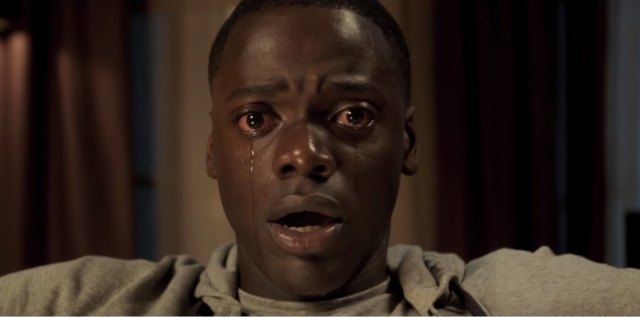
Do you see what I see?: Blumhouse Productions/Monkeypaw Productions
You might have an idea of the general direction GET OUT is heading in, but few will guess how far down this deep and murky thematic rabbit hole writer-director Jordan Peele will take us. This is a horror film for our time, about our time.
Chris (Daniel Kaluuya) is in a happy relationship with Rose (Allison Williams) and thinks nothing of spending a weekend with her parents on their rural estate. But very quickly it becomes clear that the awkwardness of Rose not telling her parents that her new boyfriend is black is the least of Chris’s worries…
Get Out an effective little suspense/horror movie but it’s also a cutting thesis on being black in America today. As a white viewer with a moral compass, you’re taken from extreme almost CURB YOUR ENTHUSIASM-esque awkwardness to complete abject horror and everything in-between, and I would imagine the experience would be even more hard-hitting for black viewers. You’ll be biting your hand to stifle cries of discomfort at Rose’s extended family’s attempts to clumsily woo Chris, and you continue to gnaw through your fist as Chris’s situation becomes a waking nightmare and creeping dread and sinister revelations give way to torture and revenge violence. For every person who commits blatant and violent acts of extreme prejudice you have someone who aims to please, to prove their non-judgemental nature by pandering (unconsciously or not) and thereby proving that they do care about race, because their conversation track is changing to accommodate it. It is in depicting these different faces of ingrained racism that Get Out shows its strongest hand.
Daniel Kaluuya – still mostly unknown in the USA unless you remember him from SICARIO, considerably more recognisable if you watch TV in the UK – is a star in the making. It takes some talent to play the uncomfortable tangle of emotions Chris is struggling with and to still play it low-key. Catherine Keener and Bradley Whitford do creepy well and Allison Williams, well, just watch the film.
It’s telling that a TSA agent (Lil Rel Howery) is presented as a hero in this story over the police, such is the toxic public perception of law enforcers and race relations. Because after all he’s been through, why on Earth would Chris call the cops for help? When this Rod does appeal to his uniformed fellows’ sense of duty to help him search for Chris, he is laughed out of the office. Our stomachs drop at the sight and sound of a siren towards the end of the film, a noise that should inspire hope but has become a dread sign for so many.
Many will be more on board with the slow build-up of the film, the sinister-but-you’re-not-sure-why underbelly of a certain portion of society. Others will be put off by the ending, where things get weirder and far more extreme in terms of imagery and ideas. I liked pretty much all of it, especially the weirder stuff. The story gets a bit scrappy (but still bold) in the final stretch, and some of the characters are too broad and cartoony for the tone of the wider piece, but these are pretty much my only criticisms.
While I don’t think you can tar everybody with the same brush, it seems increasingly clear that racism in all forms is a deeply-rooted problem in American society, even if has become almost Freudian in some circles. If some viewers struggle to process, understand or (bafflingly) fail to sympathise with news coverage of American race-driven police brutality and racism of all stripes, it could be down to film and television to tell this story in a way that connects through entertainment. Just as the last couple of years has year has given us projects as far-ranging as STRAIGHT OUTTA COMPTON and ZOOTOPIA to discuss these hot-button issues, Get Out will likely end up as one of the most significant films of 2017 and the decade. Peele has produced a biting, brutal thriller-chiller that couldn’t feel more chillingly relevant. SSP
Review in Brief: Sing (2016)
SING is a pleasant surprise. It may be a clichéd underdog/competition story retold with singing animals, but it’s got a lot of pep and ends up being the most soulful and best-realised animations Illumination have produced so far. The characters are appealing archetypes: the overworked stay-at-home pig mum (Reese Witherspoon) liberated only by her her passion for singing, the prickly (get it? Because she’s a porcupine) rock chick (Scarlett Johansson) stuck as a supporting player despite prodigious talent and the sensitive and talented gorilla son of a gangster (Taron Egerton) who never wanted to be a hard man. As a jukebox musical, the song selection is crowd-pleasing and the singing is great, with Egerton wowing in particular belting out Elton John. There’s a bit too much forced jeopardy in the final stretch, and you’re not going to win any prizes for guessing every single story beat, but more like this and fewer minions from Illumination would be welcome, as would lots more from director Garth Jennings. SSP
Review: Boy (2010)

Family at war: Whenua Films/Unison Films
Handled delicately, grief makes for a great film. Boiling Taika Waititi’s films down to their core themes, if EAGLE VS. SHARK was about battling depression and HUNT FOR THE WILDERPEOPLE was about finding a place to truly belong, then BOY is certainly about coping with grief.
Boy (James Rolleston) seems perfectly happy with his rural life making his own entertainment, keeping an eye on his younger brother and idolising Michael Jackson. That all changes on the day when his tearaway dad Alamein (Taika Waititi) turns up on his doorstep asking to be part of his life again. But are Alamein’s intentions pure? Judging by his reputation it seems unlikely.
Boy seems to be Taika Waititi’s most personal film to date. You have to think he drew from his own life experience, a Maori cultural perspective of growing up in a small town in New Zealand in the 1980s. What a stoke of luck to have found James Rollerston to play such a winning lead after he only fell into the role early in production. As Boy, he radiates likeability as speaks direct to camera on his unique world view and uniquely New Zealand turn of phrase. He also radiates raw pain in a manner of an actor beyond his years as Boy’s world slowly crumbles around him. Waititi casting himself as Boy’s mostly absent dad might be considered narcissistic if the writer-director wasn’t prepared to play Alamein as such a disappointment. You completely buy that this old punk would appear to be the coolest guy around to his impressionable young sons, but when you get past the posturing, the bargain basement wisdom and the natural charisma, there really isn’t a whole lot to him but his selfish drive and using his family as a means to an end.
Waititi is never afraid to acknowledge that a lot of our time on Earth is a pretty miserable experience. All we can really do is treasure the few bright spots and hope for the best. Boy’s hero worship of his absent dad is a coping mechanism, along with his obsession with Michael Jackson and playing war on the beach. While much of his life is fun and games, endless daydreaming and long summers, he also has to act as a very real guardian to his younger brother. Boy is both younger and more grown up than his years.
The final flourish of the film shouldn’t really be ruined, but I’m too excited about it not to. Just skip ahead a paragraph if you want to go into this quirky curiosity completely cold. So, basically, after all the plot threads are resolved and the character arcs reach their natural conclusion, the whole cast break into doing the “Thriller” dance crossed with a Hakka. It almost goes without saying that this is an out-of-leftfield stroke of genius, but the film is playful with its presentation throughout with film spoofs and animation all springing from Boy’s mind over-compensating for his continual disappointment.
Taika Waititi is easily up there with my favourite directors of all time. His work is playful and extremely funny but not in the least bit maudlin. With Boy, Waititi wears his heart on his sleeve and highlights a seldom explored cultural perspective to make his most mature and profound film to date. With his imagination and his mastery of balancing a variety of tones, I can’t wait to see what he does with THOR: RAGNAROK later this year. SSP
Review in Brief: Kong: Skull Island (2017)
KONG: SKULL ISLAND is what it is, and what it is is a big, dumb monster brawl. The just-post-Vietnam War setting is just window dressing to the standard, laboured story setup. While the creatures are impressively realised, clearly nobody has given this ecosystem beyond cursory thought: some beasties are big, others aren’t, trees and mountains don’t seem any more verdant or towering to support the ecosystem. But switch your brain to low power mode and when things get going it’s a lot more fun, with gruesome demises of flunkies (plenty available as the helicopters they arrive on seem to breed between scenes) and brutal ape-on-lizard-thing combat. You’d be fully justified to ask for characters with more than one defining trait apiece and a more memorable script, the best line being from a soldier worrying about riding in a makeshift boat: “This thing looks like it’s made out of pure tetanus”. At least this occasionally cracks a smile, unlike GODZILLA. SSP
Review: Dunkirk (2017)
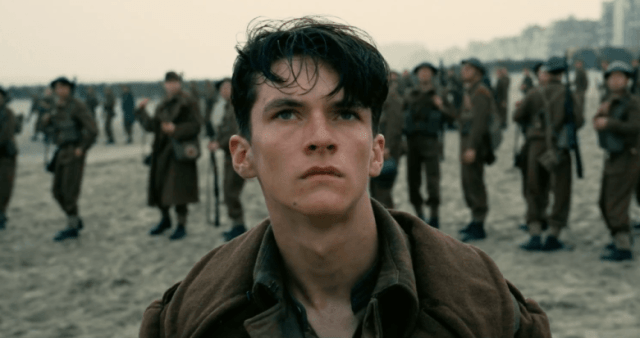
“We shall never surrender…”: Warner Bros/Syncopy
The French coastline, May 1940. With the Allied army surrounded and with the sea blocking their escape, a massive civilian effort gets underway to evacuate as many servicemen as possible as the fight continues on the beaches, on the seas and in the air above. The experiences of a soldier (Fionn Whitehead), a civilian sailor (Mark Rylance) and a pilot (Tom Hardy) are just three stories among thousands trying to flee, liberate, or survive Dunkirk.
In a masterstroke, Nolan uses three time different dilations to tell three interconnected stories. One week on the beach, one day on the sea, one hour in the air. I watched this with a couple of people who found this jarring until the moment when the timelines crossed, but I thought it worked extremely well. To represent the different experiences of Dunkirk and involvement in various stages of, or the entire battle required something special in the edit.
Hans Zimmer and the sound department do sterling work on the soundtrack to ratchet up the tension with a staggeringly complex soundscape. The storytelling is elemental, built around earth, air and water, but Zimmer also works in a key sound effect into his score for each environment; a ticking watch/sea mine for the beach, an industrial engine chug for the sea and the telltale whir of an engine for the sky. These sounds weave in and out, pitch up and down with the story, even crossing over and merging at the point the characters’ paths cross.
You’re thrown headfirst into the chaos, with soldiers dying messily and without ceremony, explosions throwing up great clumps of sand and waves lapping over your field of vision. The aerial sequences are eye-popping and tactile (you get that when you use real planes) and for someone who isn’t great at flying, made my stomach plunge. As an experience, Dunkirk is going to be hard to top, especially if you’ve seen it in IMAX with the image and wall of sound all-encompassing. You feel like you’ve been through an ordeal, that you can still taste the salt water and feel the sand caught in your nails and teeth. Much like DEEPWATER HORIZON (a lesser film, but similar in tension) it benefits from a tight runtime, remaining gripping rather than becoming an uncomfortable slog.
There are images in Dunkirk that won’t leave me for a while. Columns of soldiers seemingly queuing in an orderly fashion on an endless beech awaiting rescue. The gruesome but strangely beautiful sight of a line of corpses becoming shrouded by sea foam. The simple and unglamorous humanity of a soldier trying to find a moment in and amongst running for his life to relieve himself.
Admittedly a few moments in the final, somewhat forced few minutes made me want to do my best Graham Chapman impression and say, “Now stop that, it’s just getting silly”. It just seems a bit off in tone and style to the rest of this grounded, matter-of-fact film. Maybe Nolan got caught up in the moment and thought the film was missing some emotional beats from the finale.
In Churchill’s eyes, Dunkirk was a military disaster, and true enough it was a defeat for the allies. But in human terms, it was one of the finest hours for the British people, and that is what Nolan’s film commemorates. This is not a story of historically significant Great Men, but ordinary people, both brave civilians bringing our boys home and worn down servicemen, many of whom would have been branded cowards by their superiors despite the relentless enemy onslaught they faced, somehow managed to get through this. Dunkirk is an impeccably-crafted tribute to these men, to this moment and between restrained, raw performances from the ensemble and a tight focus on small stories within the main event ends up being Nolan’s most captivating and emotionally resonating film to date. SSP
Review in Brief: Prevenge (2016/17)
We’ve had plenty of schizophrenic serial killer movies, but PREVENGE must be the first where the voice telling the perpetrator to kill is her unborn child. Our antihero is utterly miserable in her pregnancy, so turns to killing and maiming, but only those who have wronged her…and witnesses. Writer-director-star Alice Lowe doesn’t shy away from the fact that it’s not just pig-headed ignorant men who ostracise mothers-to-be; women can be far crueler (the parting advice from an job interview is “Sort out your own business before you interfere with everyone else’s”). It won’t be to everyone’s taste, especially if you tend to struggle with unflinching depictions of the darker aspects of humanity (though I don’t know whether we’re really meant to be on Ruth’s side). Lowe/Ruth is right, nature is “a bit of a c*nt”, but drastic changes in our bodies clearly can inspire immense creativity in artists. Immense, twisted creativity. SSP
Review in Brief: The Autopsy of Jane Doe (2016)
There are surprisingly few horror movies set in morgues. Plenty with morgue scenes, but a scarcity that really make the most of that cold dread atmosphere for an extended duration. What they do with a few key simple sounds and our natural human discomfort around death is creepy, the lighting and camera angles that cause subtle changes on Jane Doe’s face as her autopsy progresses are even creepier. From a slow and subtle build we eventually get a full-on scare-fest the effect of which would be ruined if I were to describe it in more detail. Better to go in cold and you’ll leave with a racing heart and a not entirely unpleasant lingering feeling of unease. I wasn’t a great fan of André Øvredal’s previous effort TROLL HUNTER, but here his talent for world-building with limited resources and consistently scaring the pants off his audience is without doubt. SSP
Review in Brief: Elvis & Nixon (2016)
ELVIS & NIXON is an intriguingly simple title and unfortunately, a pretty disappointing final product. In the depiction of this remarkable partly true, partly hypothetical series of real-world events, Kevin Spacey makes for a good Nixon. He’s slimy and calculating but because he’s such a gifted mimic he stops short of being a caricature. The same unfortunately cannot be said of Michael Shannon, who can do Elvis’ lackadaisical drawl, but physically could be replaced by any other actor in general film to be a more physically convincing King (Alex Petyfer playing Elvis’ confidant in particular looks noticeably more like Presley next to Shannon, which is unfortunate because they share most of their scenes). Shannon just about justifies his casting with the wounded way he plays a line about a stillborn brother, “They out him in a box”, but elsewhere he is disappointing. The whole thing is very TV movie: completely watchable, but nothing screaming must-see, nothing striking stylistically or even offering up all that many reasons to care full-stop. The central dialogue scene between two of the most influential men in the world is great, but that only makes up about fifteen minutes worth of the film and is not quite worth the wait. Would it be that much of an ask to make some of the side characters more interesting or to give the time period more socio-historical context and conflict? SSP
Review: War for the Planet of the Apes (2017)

No monkey business: Chernin Entertainment/20th Century Fox
As the simian flu virus continues to ravage what little remains of human society, Caesar (Andy Serkis) and his tribe of intelligent apes continue to carve out their own place in the world. When a ruthless Colonel (Woody Harrelson) raids Caesar’s camp and takes the ape’s nearest and dearest from him, Caesar is forced into increasingly rash action to defend his species.
Shall we just take a moment to appreciate how versatile a director Matt Reeves is? From intimate extended scenes of apes hanging out and chatting in sign language to a version of the Battle of Helm’s Deep…but with apes and the finale of ZERO DARK THIRTY…but with apes, there seems very little he can’t do. While nothing is quite as striking as the last film’s initial silent stretch or Koba’s tank hijacking, you can still look forward to fireworks, intensity and original imagery throughout.
I loved that the war of the title isn’t what you expect. After all, only humanity is stupid enough to still propagate warfare after the world as we know it has come to an end. The Colonel and his encounters with Caesar are pleasingly difficult to predict as well and thankfully the story doesn’t come down to man good, apes bad, but as always with this series it’s, man complicated, apes less so.
Serkis clearly used Clint Eastwood as his reference point for Caesar in this film. While he’s the most gifted with spoken language among his kind, he’s still economic in his speech by human standards and he’s got a great withering glare and he becomes a Bill Munny from UNFORGIVEN-esque vengeful loner as the plot progresses. It’s this need for revenge, that very human desire, that causes Caesar to make mistakes and to put his kind in further jeopardy, whatever his original intentions were. Harrelson’s Colonel is built up a lot so you expect some grand revelation about his identity, but again he isn’t what you expect and his justification for his actions may well be pretty ordinary and all the scarier for that. The strange parker-wearing hermit Bad Ape (Steve Zahn) is the real breakout in this film. It’s always Caesar’s story and Serkis’ playground, but in this new character something endearing, incongruous and thoughtfully funny is created.
Apes’ apishness is used wittily as a plot point on several occasions. The majority of ape interactions are still signed and subtitled (what other blockbuster wouldn’t have found an excuse for more verbose apes by now?). Reeves has faith in his audience being engrossed enough in this world and compelled by the simian characters for these scenes to flow like a standard scene of dialogue. We also get a display of distressed ape hitherto never seen in a film since it was possible to create photorealistic primates. It’s a pleasant moment of light relief in an otherwise gloomy film, and I won’t ruin it by describing it exactly – you’ll know it when you see it.
Nova and Cornelius, Alpha & Omega. Reeves is an Apes superfan, and peppers the new film with references to what has come before and/or is still to come. You could read these as earlier versions of the same characters, which would make the original film’s sophisticated ape society only a couple of decades away (unlikely) or you can read them a cyclical nods to the series history, much as the new Caesar is a tribute to the original from the end of ESCAPE FROM THE PLANET OF THE APES.
Speaking of referencing what has come before, I love Michael Giacchino’s work on the score here. Jerry Goldsmith’s distinct unsettling high-pitched refrains are used sparingly at key moments and Giacchino’s music in general conjures the appropriate moody atmosphere and palpable tension, in addition to proving his aptitude for revitalising and remixing soundtracks we know, much like Reeves does with his movies.
There is no need to carry on this story any further. It has been told. War for the Planet of the Apes resolves organically and satisfyingly. We know where this particular tale is heading and all the characters involved at this point have reached their natural end point. It’s vibrant and thoughtful and expansive in a pristinely rendered film world. The line between the real and the motion-captured characters has never been so blurred and summer blockbusters have seldom been this rich a viewing experience. SSP


