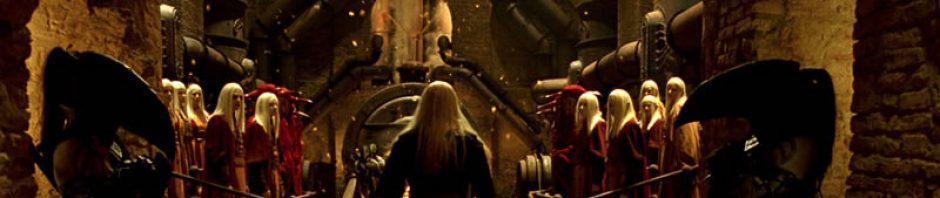
Don’t compare OUTLAW KING to BRAVEHEART, compare it to IRONCLAD. This is brutal, dirty history, and there’s not a kilt in sight. Chris Pine is a softly spoken and dignified Robert the Bruce, Florence Pugh is a fiery counterpoint to their relationship and Aaron Taylor-Johnson is unrecognisable to the extent that I didn’t realise he played Bruce’s deadliest warrior until the credits. They get the key historical details right (locations, styles of warfare, ceremonies and rituals) though perhaps tone some down for the sake of watchability (for instance, there’s no way the witnesses in the king’s bedchamber would allow consummation to not take place on his wedding night). I’m not sure a lot of the film will stay with me, but it’s all very watchable and a much more worthy marker of a key passage of Scottish history. Now if you’ll excuse me, I’m off to read about if black ops knights were really a thing… SSP
Review in Brief: Outlaw King (2018)
Review: Private Life (2018)
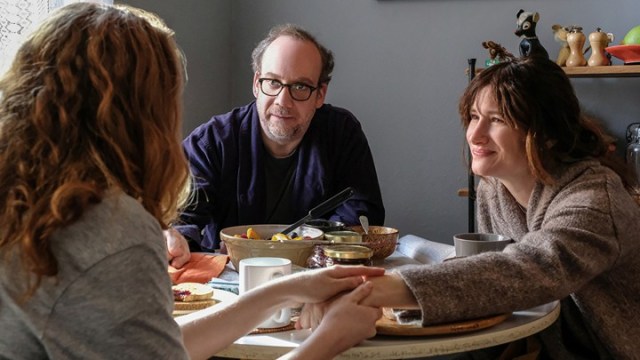
Not everyday breakfast conversation: Netflix/Likely Story
This review contains spoilers for PRIVATE LIFE.
Netflix are having a pretty stellar year of original content. I mean, the bad stuff is still pretty bad, but the good stuff is really good and often takes you by surprise. I didn’t really know what to expect from PRIVATE LIFE beyond Paul Giamatti and Kathryn Hahn being reliably great. They are that, but this also turned out to be one of those delightful film surprises of 2018. I’m going to remember this emotional rollercoaster for a long time, and I think you will too.
After trying unsuccessfully for a baby for several years, writers Rachel (Kathryn Hahn) and Richard (Paul Giamatti) decide to undergo IVF treatment. As their relationship bears this added strain, their niece Sadie (Kayli Carter) takes a break from college and comes to stay.
Everyone feels so real here. Rachel and Richard are a couple who love each other deeply but who can’t help blurting out embarrassing secrets at inappropriate moments, can’t resist taking little digs or saying exactly the wrong thing at the very worst time (Sadie shares this family trait of not thinking before speaking). They look like us, they act like us, when they’re around the house they don’t wear pants (in both in the American and British sense).
Rachel and Richard are trapped. They have been through so much, hit so many hurdles and they still have to keep spending and hoping to get anything out of this. They have to get pregnant before the money or their time runs out or else they will have wasted both. This must be the story and the struggle for so many expectant couples. The film was inspired by the real struggles of writer-director Tamara Jenkins undertaking fertility treatments and this adds that essential level of grounding and authenticity.
Hahn is the emotional core of the film throughout, but Giamatti gets perhaps the standout moment when the normally pragmatic Richard finally breaks and considers throwing in the towel, exclaiming “I just want my life back…I’m just some guy who injects hormones into your ass every night!”. Elsewhere, the new gold standard is set for awkward escalating movie dinner scenes. That’s particularly impressive as let’s be honest, all movie dinner scenes are awkward and escalating, that’s why you put a dinner scene in your movie, not so your characters can eat and make merry but to try them.
Discussions of morality are by no means shirked. Rachel and Richard’s relationship dynamic with Sadie is odd to say the least, as when she offers to be their egg donor she is essentially acting as both a co-parent and daughter to them. The film doesn’t make judgements about what they are asking her to do, or the somewhat dishonest way they keep their bases covered elsewhere, but it acknowledges that there is a lot to unpack in this situation.
The message, the truth of what real couples undergoing IVF treatment must go through, is mercifully balanced by some endearing comic imagery, from Rich looking more confused than aroused at his “motivational” porn in the sample-giving room to Rachel’s first IVF procedure coming with the added awkwardness of her (very nice) doctor insisting on playing prog rock throughout. The biggest laugh comes from Rachel looking over the “EBay for ova” and practically recoiling at the idea that her potential egg donor is proud of getting “a full scholarship for golf”.
If it wasn’t for BLACKKKLANSMAN absolutely killing it, Private Life would have the most memorable, powerful final moments of any film of 2018. Think CALL ME BY YOUR NAME but much more dialed back and optimistic. Private Life is painfully honest, bittersweet and I only slightly hesitate to say, important. So what are you waiting for? Boot it up – it’s not a downer, I promise. You’ll laugh, you’ll cry and your heart will be all filled up. SSP
Review: Wildlife (2018)

Can we at least have the radio on?: June Pictures/Nine Stories Productions
I’m not yet 30 but WILDLIFE makes me feel old. Paul Dano was the stroppy teenager in LITTLE MISS SUNSHINE, now he’s directing movies. The ever-youthful looking Carey Mulligan and Jake Gyllenhaal are now old enough to be playing the parents of a teenager. Why is time in such a hurry?
In sleepy Montana suburbs in the 1950s, young Joe’s (Ed Oxenbould) comfortable home life is shaken when his father Jerry (Jake Gyllenhaal) loses his job out of the blue. Jerry’s coping strategy is to go off and fight raging forest fires and his mother Jean (Carey Mulligan) makes some equally questionable decisions while her husband is away, leaving Joe to support himself and cope alone.
Wildlife really is a teenager’s-eye-view of domestic life falling apart. All eyes are on Joe, so the camera often lingers on his reaction to the questionable actions of others happening offscreen, and it is testament to Oxenbould’s already finely-honed skills that you can always read what is going through Joe’s confused head. Acting performers Gyllenhaal and especially Mulligan off the screen is no mean feat. The trio have a grounded and believable family chemistry and the dynamic of the household is knocked completely off balance the moment one of them is out of the picture.
You could flip a coin to decide who is the least suitable parent as both make such rash and stupid decisions seemingly as much out of spite for each other as to save the family from its immediate difficulties. And of course they blame each other for everything that inevitably goes wrong, but Joe would be quite right (but too mature and well-adjusted to) ask them to consider what they are doing to him. His parents are both completely self-centred and far less mature than their teenage son. Jerry does what he does out of obscenely overcompensating for his wounded pride, Jean seems to be trying to reclaim her (really not that distant) youth and reassert the authority she already held in their household. You really struggle to get in their headspace to understand any of their decisions; they are completely irrational and without a thought for what really matters.
Joe is one of the most pragmatic teen characters I think I’ve ever seen on screen. When our time with this family finally draws to a close, only one of them is really coping with their lives undergoing such massive changes over a short period of time, and by rights it shouldn’t be him. He doesn’t have time to act his age, go through all the usual teenage experiences and work out who he is because he is left to parent himself. As soon as his mother becomes more interested her social life than her son, he goes straight out for groceries and starts to look for an after school job to support himself, and you suspect, stay out of her way.
The film is full of particularly relevant and resonant imagery echoing the devastating wildfires that have ravaged California this year (a particularly unhappy accident as the film was well into production by the time the disaster hit). Fathers leaving for the fires with their families staring after them, like soldiers going to war the decade before. You do wonder which among them had the experience necessary to make a difference and how many, like Jerry, were looking for any means of escape.
This is an incredibly sure-handed directorial debut from Dano. He tells the kind of story that he is so often cast in, but with his, and writing partner Zoe Kazan’s own take on the material. It’s intimate and emotionally raw, about coping and not coping with real mistakes. I hope Dano keeps up his work in front of the camera as well as behind it, but if the former needs to take a back seat to the latter, Wildlife is a calling card that makes you take notice. SSP
Review: The Endless (2017/18)
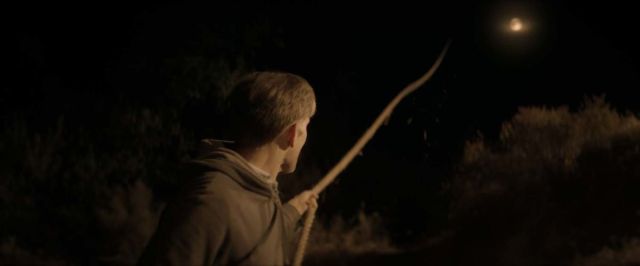
With all your might: Snowfort Pictures/Pfaff & Pfaff Productions
About half a decade ago, indie nobodies Justin Benson and Aaron Moorhead hit the festival circuit with their first feature film RESOLUTION, and it did rather well. Critically. The problem was nobody saw this weird near-plotless sci-fi when it was released into the wild. Basically it was about a guy forcing his friend to go cold turkey while voyeuristic video tapes with possible cult connections keep turning up out of thin air. Now the good folks at Arrow Films have packaged Resolution together with the home release of Benson and Moorhead’s follow-up THE ENDLESS, and trust me you want to see both. It’s not essential for your understanding but the former sets up the latter and the latter enriches the former.
Not many escape fanatical death cults, fewer still go back to them voluntarily once they do. After living a normal life for many years, brothers Aaron (Aaron Moorhead) and Justin (Justin Benson) are drawn back to the strange entity-worshipping commune that made them to find very little has changed – not the people, not the place and certainly not the thing pulling the strings and lurking just beyond our field of vision…
The central mystery, which is kept intentionally vague is what is It and more importantly what does It want? As it’s so succinctly put by the cult leader (Tate Ellington) at one point, “It shows us what It sees. There’s a powerful elegance to that”. I don’t think I’ve ever seen a powerful external threat use our innate trust of what we see with our own eyes as a weapon before. It’s a really sinister idea that lingers in the back of your mind. Even more scary is the society that has built itself a comfortable little life around It. The cult has no leaders (yeah, sure…) they drink beer, play music and make merry, but something you can’t quite put your finger on is always off.
Benson and Moorhead are stupidly talented. Co-directors and stars with Benson writing and Moorhead as cinematographer. I don’t even know how you’d keep track of the job at hand if you’re spinning so many hats, wearing so many plates…wait, what was my point again?
This is one of the most thought-provoking and surprising sci-fis in years. Both films, but especially The Endless are all about perception and time (particularly temporal distortions and time loops). It’s not got a massive budget, but what they have they use really well, with striking aerial photography to emphasise the brothers’ insignificance, isolation, and later, hopelessness and very sparing use of special effects elsewhere. As was proven in THE FORBIDDEN PLANET, having a mostly invisible monster can save you a lot of headaches on a technical level and leave it to the audience’s imagination to fill in the gaps. This film world somehow always feels bigger and with more moving parts than we actually see on screen.
I really don’t want to go into any more plot specifics as this is one that’s best seen without preconceptions. I won’t say absolutely everything they try to do works but it’s never not interesting. It’s meticulously crafted, endlessly inventive and discussing what it’s really all about could fuel many a social gathering over a jug of craft beer.
The standard move for any successful indie genre filmmaker seems to be to bigger studio projects but I don’t know whether Benson and Moorhead would be able to retain their distinctive voice if they followed suit. I’m not saying if they hopped aboard with Marvel, for instance, it wouldn’t yield anything worth watching, but it would be a battle to make it feel as unique. They’ve got another film in the works at the moment and whatever it turns out to be I’m sure it’ll be fascinating, as will their future careers, whatever path they follow. SSP
Review: Fantastic Beasts: The Crimes of Grindelwald (2018)
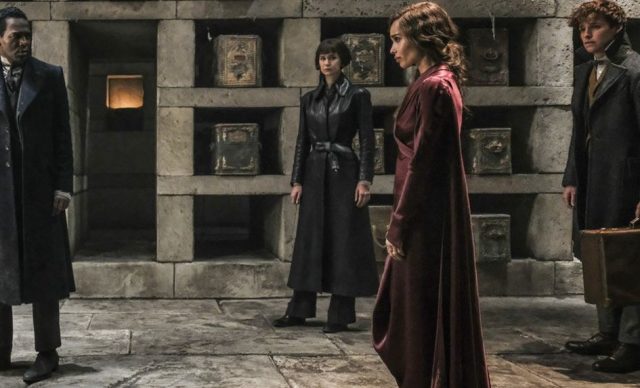
Four wizards walk into a mausoleum… : Warner Bros/Heyday Films
JK Rowling is just making this nonsense up as she goes along isn’t she? If that makes me sound like I’m anti-Potter, nothing could be further from the truth. As a 90s kid I devoured Rowling’s books and I see the films as an important part of my formative years. I even really liked the first FANTASTIC BEASTS film. But for the best Potter movies were those that didn’t feel too constrained by the text and I really think we’re at the stage where Rowling as screenwriter needs a script editor to pull back on her worst excesses. THE CRIMES OF GRINDELWALD typifies these excesses and director David Yates has no power here.
Following the damage caused indirectly by his trip to New York, magizoologist Newt Skamander (Eddie Redmayne) is banned from traveling by the Ministry of Magic. At this most inconvenient of times, Albus Dumbledore (Jude Law) gives Newt a special mission in Europe, where dark wizard Grindelwald (Johnny Depp) is at large and expanding his power base.
I know it’s Rowling’s world and she can do whatever the hell she wants with it, but little inconsistencies niggle. While I might not care that unlike in the book magic users can apparate inside the grounds of Hogwarts (it’s a film, it moves more quickly, it’s more elegant than showing people walking for miles) I do care that they made Dumbledore professor of Defence Against the Dark Arts rather than Transfiguration only to have an excuse to do the Boggart scene again. What makes a circus so amazing to a magic-using audience who can surely perform similar feats themselves? What was the point of revealing that Nagini was once human? Does it effect her role in the HARRY POTTER series in any way (aside from making Neville a murderer)?
I know people have issues with Newt Skamander as a character, but I find his sheer oddness and discomfort around other people incredibly endearing. His scenes with Tina (Katherine Waterston) and his fumbling professions of love amounting to comparing her to a salamander are really sweet. While his beasts are even more incidental to the story this time round, I really liked that one Chinese dragon-cat one.
There are admittedly some very nice visuals. The ambitious opening scene of Grindelwald’s escape might have been more exciting had I been able to tell what was going on through the rain, brake-neck speed and rapid-fire editing. A brief return visit to Newt’s menagerie, a magical circus packing itself away in seconds and a conversation between him and Dumbledore as they apparate around a foggy London all leave an impression.
The plotting might be too busy and indistinct, but the film’s real stumble is in characterisation. What did they do with Queenie (Alison Sudol)? Why bring Newt’s much-idolised big brother Theseus (Callum Turner) into the fray if he’s not really an ally or an obstacle? The big revelation about Creedence’s (Ezra Miller) heritage is nowhere near as interesting as they think it is. The final twist, the type of thing that usually makes everything suddenly slot into place and prompt a review of the entire plot, fails utterly. You just think, huh?
I’m sure Law will be good once they give him some decent screentime. Dumbledore being a tricky bugger fond of sending young wizards on perilous quests, it’s never said outright what his endgame is. His prior romantic relationship with Grindelwald is alluded to but outright confirmation saved for a future instalment. Speaking of big bad G, Depp couldn’t be bothered inventing a new voice for Grindelwald so he just recycles his Barnabas Collins and struts around in another big coat.
I’ll say this for Rowling: she’s not holding back on the adult elements of her wizarding story. Worryingly, though, she seems to think that in order to fight fascism you need…more fascism? But it’s OK because these fascists can just magic the world better! Or maybe I’m just misreading the film’s tasteless, borderline offensive use of certain provocative imagery.
Like a lot of modern franchise films looking to the future, they answer as little as they can get away with. Seeds may well have been planted to pay off much later, but at the moment it just feels like teasing and time-wasting. We know approximately where this story is going and who makes it, but Rowling and Yates are taking us on the scenic route. A scenic route with poor visability. And a boring ever-talking co-passenger. With bad breath. SSP
Review in Brief: Hold the Dark (2018)
Blue, green, dark? Dark isn’t a colour Jeremy Saulnier! HOLD THE DARK is relentlessly miserable and pointlessly vague. I get that Saulnier doesn’t seem to have much faith in humanity, that he is depicting real monsters whose actions could never be rationalised here, but there’s got to be something that gives us a handle on the characters. Jeffrey Wright is good in the lead, a typical Saulnier lead in a constant state of physical and psychological suffering, but this is yet another film that makes me doubt Alexander Skarsgard’s range. I respect the uncompromising bleakness, the effective use of wilderness locations and attempting to explore what living in such a place does to a person’s mind, body and soul, but the characters are more frustrating than interesting and much of the time the darkness (actual, not tonal) just makes it hard to see anything. Squint and you can make out people’s outlines, not their motivations. SSP
Review: Widows (2018)

Ballsy: Regency Enterprises/See-Saw Films
WIDOWS is a mighty fine thriller. If you consider it a thriller, which I do. A dramatic one. A Steve McQueen film always leaves you emotionally spent and with plenty of food for thought, but this is easily his most outright enjoyable work. You might even leave with a smidgen of hope in your heart.
When her career criminal husband’s (Liam Neeson) failed heist results in the demise of his entire gang, Veronica Rawlings (Viola Davis) recruits her fellow widows for one last job to secure their future. Meanwhile, a highly contested Chicago ward election is taking a morally dubious turn…
Steve McQueen casts flawlessly and there really isn’t a weak link in this cast. Every character is given room to breathe. Viola Davis bears the brunt of the dramatic lifting in the lead, but Elizabeth Debicki’s performance as the used and abused Alice also leaves a mark, proving her versatility and lightness of touch in a tricky role. Michelle Rodriguez and Cynthia Erivo arguably have more conventional role to fill playing working mums, but they have chemistry with the others and their characters’ skills prove invaluable.
McQueen has one of the clearest, cleanest visual sensibilities of any director working today. You can tell he’s an artist because every shot is a (sometimes grisly, sometimes grim) painting. The action is no-nonsense and visceral, the most emotionally fraught moments held in close-up, the city of Chicago and its many problems another character.
Violence in a McQueen film always has weight and consequences. In the opening heist-gone-awry scene, some of the crew are offed without introduction, others get a few lines to register how far south things have gone. Later Daniel Kaluuya’s terrifying enforcer plays with his victims like a big cat before dispatching them and the widows’ big night is far from free of bloodshed.
The strongest stretch in a strong film is the gang making their plans and assigning roles in the upcoming heist. Some of the challenges ahead require creative solutions and every member of the gang has to make the most of their respective strengths and to think on her feet to some extent. While it’s always great to see a group of interesting characters not defined by their gender, what marks the widows out even beyond them exploiting the fact that “No one will think we have the balls to pull this off” is that they’re allowed to be as flawed, as fallible, as their late husbands who managed to get themselves killed. They’re capable, intelligent and determined but they make mistakes and have to improvise to survive.
I can definitely see us getting more socially conscious thrillers like this in next few years. This has all the elements of a polished and visceral heist movie (it even has a propulsive Hans Zimmer score) but it also has something to say about the world. Inequalities in contemporary American society are neatly and punchily summed up by a long-take of Farrell’s politician being driven away from a rally in a deprived area, rounding a couple of corners to pull up at the very nice house that serves as his campaign headquarters.
About the only thing I had an issue with was a slight storytelling misstep midway through the film that lessened the impact of a key moment of drama towards the end. McQueen didn’t need to show his hand so early, and if he hadn’t the ending might have hit with more of a bang than it already does. Very minor problems aside, Widows is a stylish, gripping and resonant crime drama with layered characterisation and a conscience. SSP
Review in Brief: Errementari (2017/18)
ERREMENTARI is a little gothic gem. It feels like what would happen if Guillermo del Toro remade one of James Whale’s darker Universal Horror films. “Errementari” is Basque for blacksmith, so appropriately this tells the tale of a village blacksmith (Kandido Uranga) trying to outwit Satan and his followers after committing an atrocity in his past. The film uses the classic rural paranoia as a catalyst for evil trope to great effect, and uses its modest budget well to create memorable imagery. The appearances of the demons are all achieved with prosthetics and the seriously dark themes and gloomy atmosphere gives way to slapstick and over-the-top bombast. The villains are a bit cartoony and the broad strokes of the plot can be seen a mile off but there’s a lot to like in this. Worth a watch alone for the sight of a little girl (Uma Bracaglia) torturing a caged demon with dried chickpeas. SSP
Review: Peterloo (2018)
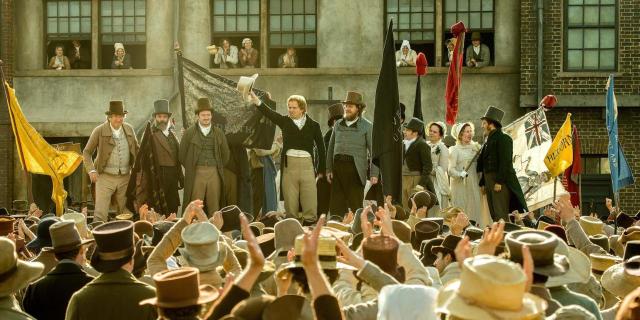
Not a bad sized crowd. And without Twitter too: Film4/Thin Man Films
I’m fully behind everything PETERLOO as a film stands for, and with individual liberties under threat ever more stories like this have become vital. Unfortunately I found the the manner in which Mike Leigh tells this story deeply frustrating.
Lancashire, 1819. In a period of economic and social upheaval following the Napoleonic Wars, a massive peaceful protest advocating Parliamentary reforms was organised on Manchester’s St Peter’s Field. The people of one of England’s most populous northern counties demanded fair representation, but those in power saw a mass gathering of such a number of the lower classes as a great threat and took extreme measures to disperse them, to disastrous effect.
The smaller “Mike Leigh” moments, like the protesters chatting about which towns they’re from and how far they’ve walked as they wait for the big speech, are great. But there’s just not enough of them. The film is two and a half hours and yet I never thought I knew these characters.
When people aren’t speechifying they’re stopping scenes dead to explain the Corn Laws. Mike Leigh’s method uses character workshopping extensively to produce natural conversation, but here the artifice is clear and nothing rings true. Nobody in the ensemble gives a bad performance, but they all struggle to give their characters more than a single dimension. Maxine Peake’s Nellie and her family (not given a surname) are dignified in their poverty, Rory Kinnear’s Henry Hunt is an impassioned self-promoter, Neil Bell’s Samuel Bamford enjoys any cause that gives him an excuse to be a loudmouth.
The antagonists are most effective if you see them as political cartoons made flesh. The cabal of brutal magistrates are particularly good value for money (especially the shouty Vincent Franklin) though they perhaps belong in a different film, maybe a Dickens adaptation.
The film does get a lot better as it matches on. Once the crowds and the banners finally reach St Peter’s Field you can really feel the story start to thrum with the power it was previously lacking. The last forty minutes or so of Peterloo has momentum.
The desired electoral reforms were well worth fighting for. At the time the populous northern districts of Manchester, Salford, Bolton, Oldham and the surrounding areas had to share two county MPs between them. With no direct representation and only privileged landowners able to vote, the vast majority of the population of Lancashire were without a voice. The people of Manchester simply wanted the government to give serious consideration to the election of their own representative. The magistrates’ grasp of what actions were illegal (actually electing an MP without the king’s consent, not just talking about it) was ironically tenuous. The assembled crowd were only ever meeting to “consider the propriety of adopting the most legal and effectual means of obtaining a reform of the Common House of Parliament”.
It’s funny the things Leigh chose to leave out. There was an (unused) artillery unit at St Peter’s Field, and showing this would have been a very easy way to communicate the overreaction of the English establishment to the people rising up. Leigh also calls his story to a close immediately post-Peterloo, not covering the riots in Manchester that raged into the night (arguably a more justifiable reason for military supression) and he does not furnish his audience with any contextualising information in summary. Leigh has stated that ending on facts and figures would have lessened the emotional impact of the piece, and it doesn’t really fit with his usual naturalistic style. And yet, he opens with text setting up Waterloo and little else in his film is truly naturalistic or honestly emotional.
Peterloo stumbles on the march and Mike Leigh overreaches himself. I’m pleased that I’ve finally seen a Mike Leigh film on the big screen (though I wish it had been this one) and that I now know how pivotal an event Peterloo was. But this story deserves a better vehicle, one with more nuance, real emotion and clearer communication of facts. SSP
Review: They Shall Not Grow Old (2018)

We will remember them: Trustees of the Imperial War Museum/WingNut Films
This isn’t just another war documentary, it’s an important historical document. Despite the upsetting imagery, I sincerely hope it’s shown in schools to acknowledge the Centenary of the First World War’s end. Peter Jackson has really pulled out the stops on this one, crafting something thoughtful, affecting and deeply personal.
An account of British soldiers’ experiences during the First World War from joining up to life in the trenches and the horrors of battle, all in the survivors’ own words.
So the central gimmick being sold in marketing THEY SHALL NOT GROW OLD (and whatever the honourable intentions behind the film, it is a gimmick) is the restoration and colourisation of a massive amount of footage from 1914-1918. The film’s aspect ratio gradually widens as soldiers march towards the camera and the WIZARD OF OZ moment that greets our brave boys’ arrival in Belgium is admittedly striking.
Even more so than the image restoration, the craft evident in the foley artistry is astounding. Every diegetic sound had to be matched perfectly to what is on screen, appropriate soldiers’ accounts had to be selected from a vast catalogue and knitted together. Little touches like the whir of a film projector dying away as the footage opens out and colour seeps in, snaps of post-recorded conversations between soldiers matched to the footage by lip-reading experts (“Hi mum!”) brings this story to vivid life.
The colourisation is at times jarring, looking almost uncanny, but your eye gets used to it and the sharpening and smoothing of the image does make the people on screen seem less lost in the past. I think the act of giving black and white footage the same pastel colour palette as a lot of the propaganda posters of the time was an intentional artistic decision, and it almost works.
This is my favourite kind of documentary; unbroken stream of consciousness and propelled by emotion rather than facts. I can’t stand talking heads or chronological analysis and have always thought just letting the subjects speak for themselves is far more effective.
The thing the documentary gets across so effectively is that these men were just ordinary guys. They were happy and dedicated in a lot of their work, they forged unbreakable friendships with their fellows and took great pleasure in winding each other up in their off time. As well as the horrors of the battlefield, frank stories are told of more mundane horrors of makeshift toilets (precariously perching on a plank over a pit of filth) and the more naive young soldiers having…eye-opening experiences in the Belgian provinces while on leave.
The bodies strewn across abandoned battlefields are upsetting, but not as much as a line of soldiers blinded by gas shuffling to be seen by the medics or a man in and amongst the walking wounded who has escaped battle physically intact but with a telltale tremor in one hand. Perhaps most upsetting of all is the story one soldier tells of his elderly father not believing the horrors he has been through when he gets back home and having the nerve to regurgitate what he’d read about the war back in Blighty.
This is a social history of war. The candid images of soldiers just being themselves, the importance of the few creature comforts available like jam (plum and apple) and tea, the mad dash prompted by a beer delivery. It didn’t really occur to me that “life in the trenches” wasn’t the whole experience, but only one facet of a regular work rotation, or that the war wasn’t personal on any level. There’s some great footage of German prisoners of war hanging out with their captors, chatting and smoking, trying on each other’s helmets. The Germans of course speak decent English and we just speak louder and slower. Make They Shall Not Grow Old part of your remembrance this Armistice Day, carry on the tradition of telling stories of bad times and good, and never forget. SSP

 SSP Thinks Film