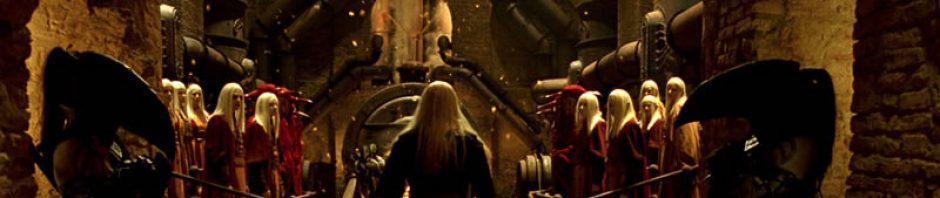
I never did review THE GREASY STRANGLER. I’m not even sure I could. I think I might struggle to talk about AN EVENING WITH BEVERLY LUFF LINN as well. Jim Hosking’s follow-up is populated by similarly freakish characters and a deliberately bizarre manner of delivery, but it doesn’t feel as nihilistic and seems to operate in the same postcode as human emotion. It’s got a heart…sometimes. All contained within a grotty hotel, a serial manipulator (Aubrey Plaza) awaits the title character’s unmissable one-night-only show, her boring bodyguard (Jemaine Clement) tries to woo her and Luff Lin’s manager/chaperone/platonic life partner (Matt Berry) tries to keep everything on the rails. When we are told exactly what has been going on this whole time it’s somehow more and less weird than we expected. That’ll probably sum up Hosking’s career going forward; it’s always going to be at odds with people’s sensibilities but you can only release The Greasy Strangler on the world once. SSP
Review in Brief: The Night Comes for Us (2018)
I never thought I’d say this about any martial arts movie, but THE NIGHT COMES FOR US makes THE RAID films look tame. It’s not just the lead who’s a mostly unstoppable killing machine but his friends as well. The body count in this thing! The final battle literally has the two combatants hacking each other to bits and I’ve never seen anything quite like two apparent layabouts defending their flat from an army of henchmen with a surprising array of skills. It’s nice to see Iko Uwais having to stretch himself a bit as a conflicted bad guy, but the film belongs to Joe Taslim and his deranged, battle-ready smile. It’s not deep stuff, and as many sick thrills the non-stop dismemberment and endlessly creative choreography provide, you do find yourself thinking, alright (director) Timo Tjahjanto, dial it back a bit mate! SSP
Review in Brief: Early Man (2018)
EARLY MAN is a gentle, cosy watch. It’s Aardman and Nick Park sticking firmly to his house style, playing it very safe. There’s maybe three cracking jokes in the whole thing, but all the Bristol claymation house’s usual handmade imagination is in evidence everywhere you look. I do think we should be past the laziness of having a “slow” character with crossed eyes in 2018 and I don’t think any of these cavemen or women we spend our time with will be as memorable as the scatter-brained inventors, organised chickens or insecure pirates that Aardman have gifted us with before. I challenge you to name any one of them that’s not voiced by Eddie Redmayne or not an intelligent pig. I’m sure Early Man could become a Sunday afternoon staple for families, but you expect something more memorable from an animation studio so meticulous and committed to doing things the old-fashioned way. SSP
Review: Beast (2017/18)
Impassive and impassioned: Agile Films/BFI
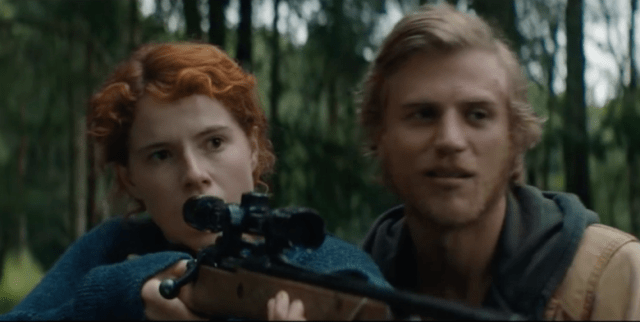
BEAST is just my jam. It’s a dark – bleak even – horror-mystery set in a far-flung and beautiful corner of the UK. It’s also a family drama where the family doesn’t enter into it much, because our lead would rather not have anything to do with a clan who will never understand or accept her for who she is.
On the picturesque and isolated Isle of Jersey, Moll (Jessie Buckley) struggles with people, especially her wealthy and propriety-obsessed family. When she finally makes a connection with a charming stranger she meets after a night of clubbing, Moll sees her life turn around and fill with passion and excitement. But Pascal’s (Johnny Flynn) arrival also coincides with a series of grisly murders that are keeping islanders watching over their shoulders, and the police hot on the heels of a prime suspect…
There’s a long line of characters in fiction called Mal, or Moll as a derivation or thematic link to malice/evil. Beast’s Moll isn’t evil, but she does demonstrate at least a level of sociopathy that only grows more dominant with the passage of time. She just doesn’t get people, and people don’t get her. They see her as little more than an animal with a (documented) history of lashing out, something to keep one eye on and to always be wary of. When she finds someone who finally does seem to understand her, an apparent kindred spirit regarded with equal suspicion by her community, of course she leaps to his defence. It’s really a testament to Buckley’s growth as an actor that she is able to convey Moll’s internal conflict so succinctly, with few words and telling actions and to Flynn’s credit that he’s so effortlessly beguiling an enigma.
I think this film will really resonate with people who know anybody prone to “acting up” on a regular basis. Moll’s mental illness and skewed view on the world is deep-rooted and multi-faceted, though the hostile, ostracising behaviour of her snobby family can’t help matters. We’re used to seeing Geraldine James playing such nice, dignified women, but as mum Hilary she’s absolutely ghastly. She may not have provoked the incident that caused Moll to become an outcast but her brand of tough love and her obsession with family appearances did not help Moll to get over her trauma or make meaningful human connections.
Not everything is answered and every potential answer as to what has really been happening on the island is some shade of disturbing. I’m inclined to lean towards the darkest, most twisted explanation for everything that has occurred. This isn’t one for those who abhor ambiguity; it’s one of those films that ends on a character giving the camera an unreadable look before cutting to black.
Ambiguity is Beast’s main weapon. It works because of the uncertainty. Moll sticks by Pascal because she can’t be certain he’s a killer. Or maybe it’s because the chance that he might be means he could be her screwed-up soulmate. She tries several times to get him to admit it and you don’t get the impression she’d abandon him if he did. The fact that he doesn’t either means that he isn’t, that he is but he doesn’t want to confess, or perhaps that he knows who the killer is and doesn’t want her to know.
I personally can’t wait to see what director Michael Pearce does next, whether he’ll further delve into this dark and twisted corner of human nature, whether he will again discuss what alienation does to a person or whether he’ll make something more cheerful. Jessie Buckley and Johnny Flynn I’m sure will keep making interesting choices and could both be stars in the making. Watch for these faces, and watch Beast if you haven’t already. It’ll stay with you. SSP
Review: Mowgli (2018)
Giving a wolf Peter Mullen’s face and all the other creatures of the jungle distinctive deformities doesn’t make your JUNGLE BOOK adaptation interesting. The mo-capped actors in MOWGLI don’t exactly have to stretch themselves; Bale can always fall back on Batman’s intense growl, Cumberbatch can become Smaug again to boom out threats and Blanchett can revive Galadriel to give the story a mythic quality. At least Serkis had the excuse for not coming up with s new voice of having to direct at the same time. It has the odd memorable image, like Mowgli underwater watching Shere Khan obliviously lap from the pool above him, or Kaa’s visions appearing in the scales of her body. I know Serkis and his crew didn’t have Disney money and they couldn’t help the House of Mouse’s version coming out first and far more prominently, but this looks retrograde, uncanny and indistinct in comparison, which is a huge shame. SSP
Review in Brief: Apostle (2018)
Gareth Evans’s APOSTLE has three things going for it: another killer propulsive soundtrack from Aria Prayogi and Fajar Yuskemal (THE RAID), the director’s usual grisly visual panache, and Michael Sheen. The rest of it is a misstep for the previously untouchable Welsh expat. I really like Dan Stevens as an actor, but this expert at playing psychological instability cannot bring depth to a character where there isn’t any to be found in the lacking script. We’ve hit all these horror beats before with much more impact. Folk horror in THE WICKER MAN, which Apostle borrows its story structure from, was scarier because it was more grounded and mundane. The occult/horror-fantasy elements are a messy mishmash and even Evans’s usual brand of ultraviolence seems without much purpose. I can’t say it’s not bold and I do respect Evans for trying something different, but I’ve no idea what it was meant to make me feel. SSP
Review: Shoplifters (2018)

“In this life, one thing counts”… : AOI Promotion/Fuji Television Network
The list of Japanese films about petty crime and forgotten underclasses is short. The other that immediately springs to mind is TOKYO GODFATHERS and like Satoshi Kon’s Christmas animation, SHOPLIFTERS follows an unconventional family unit brought together on the streets by chance, and by love.
The shoplifting Shibata family take in another child when they find her abandoned on the streets. The girl is taught the family trade while the Shibatas face further financial difficulties and have doubts about their misbegotten way of life.
Japan has a relatively low crime rate and as a culture is particularly unforgiving of larceny. In addition to harsh sentencing for such crimes (not considered petty), being caught trying to steal someone else’s property is the antithesis of Japan’s culture of respect for each other. Writer-director Hirokazu Koreeda is taking his society’s strict morality to task. He isn’t making excuses for those who commit crime but merely asking us to acknowledge that the situation is rarely black-and-white. Who are we to judge someone’s desperate actions if we don’t know the full story?
Young Shota (Jyo Kairi making an amazing debut) gets the chance so few of us do – to choose his family. He was found on the streets and his real family are a distant memory, but he only has to stick with those who took him in, to remain a Shibata as long as he remains happy. He has other options. Because she is temporarily remembered by her abusive family (and the world is watching) Lin/Yuri (Miyu Sasaki) may not ever get that same chance. She is mistreated and deeply unhappy by the family she is born into but they will not let her go because of how poorly it would reflect on them.
“Don’t make her do it” says the kindly corner shop owner. Crime is never victimless, much as the Fagin-like patriarch Osamu (Lily Franky) would have his family believe. He does it because he can, because he always has done and because he gets a kick out of it. Everyone else in the family does it as a last resort, supplementing meagre incomes from legitimate sources. As the scales fall from Shota’s eyes and his “dad” takes more risks for greater reward, he has a crisis of morality and realises that all some people care about is money. He loves his new family and they love him back, but he can no longer in good conscience go along with their lifestyle, especially when he sees the path the impressionable Lin is being drawn towards.
Surrogate mother Nobuyo (Sakura Andô) is the undoubted MVP of this ensemble. A good portion of the film’s final stretch is focussed just on Andô’s face as she has to justify not just her questionable actions, but herself, to the police. Osamu did what he did primarily out of greed with pity and love as an afterthought. Nobuyo really wanted to be a mother, to forge the family denied to her and to atone for her life’s mistakes and she ends up paying the price and taking the rap for her whole family. As harshly as the Japanese authorities deal with thieves, what really does the family in is a further transgression they commit that flouts the Japanese need for dignity and respect in all things.
Grandma (Kirin Kiki) is a more complex figure to analyse. She seems to have lived a whole other life with her late husband before they separated, he died and this new family gathered around her. She happily accepts money for looking after her late husband’s granddaughter Aki (Mayu Matsuoka) on behalf of her unloving parents and encourages the family’s criminal activities despite being able to live off her decent pension. She objects to new additions to the household and having more mouths to feed (fully expecting crime to supplement them before her own income) but comes to care for them all deeply, though she’d never come out and say it to their faces.
Shoplifters is a story about love. The Shibatas all love each other, eventually, and we come to love them all during the time we spend with them. It’s a film made in the small moments, in pure instances of bottled emotion. The family playing on a beach, huddling together listening for celebratory fireworks they can’t see, building a snowman because proud men don’t know how to say sorry. Every member of the family has their reasons for leading the life they do, some of them have a choice and some do not, but they are in it together until the day when circumstances force them apart. Shoplifters is humanist poetry on film. SSP
Review in Brief: Cam (2018)
CAM is easily the most disturbing horror of 2018, not just because of its effective technical mounting and the barnstorming lead performance from Madeline Brewer, but because it feels so relevant to the here and now. Much like INGRID GOES WEST, our obsession with, and utter reliance on technology becomes terrifying, and that’s even before any supernatural elements are mixed in. Cam girls working in adult chatrooms, adopting personas and doing what ever it takes to please their viewers comes across as draining for them and tragic for the guys who feel that alone constitutes a relationship. But what if your online self took on a life of its own and locked you out? I’m a sucker for films about fractured identities (THE NEON DEMON and THE DOUBLE are recent favourites) and this is a fine, queasy addition to the psycho-horror sub-genre that surely won’t be to everyone’s taste. SSP
Review in Brief: Outlaw King (2018)
Don’t compare OUTLAW KING to BRAVEHEART, compare it to IRONCLAD. This is brutal, dirty history, and there’s not a kilt in sight. Chris Pine is a softly spoken and dignified Robert the Bruce, Florence Pugh is a fiery counterpoint to their relationship and Aaron Taylor-Johnson is unrecognisable to the extent that I didn’t realise he played Bruce’s deadliest warrior until the credits. They get the key historical details right (locations, styles of warfare, ceremonies and rituals) though perhaps tone some down for the sake of watchability (for instance, there’s no way the witnesses in the king’s bedchamber would allow consummation to not take place on his wedding night). I’m not sure a lot of the film will stay with me, but it’s all very watchable and a much more worthy marker of a key passage of Scottish history. Now if you’ll excuse me, I’m off to read about if black ops knights were really a thing… SSP
Review: Private Life (2018)
Not everyday breakfast conversation: Netflix/Likely Story
This review contains spoilers for PRIVATE LIFE.
Netflix are having a pretty stellar year of original content. I mean, the bad stuff is still pretty bad, but the good stuff is really good and often takes you by surprise. I didn’t really know what to expect from PRIVATE LIFE beyond Paul Giamatti and Kathryn Hahn being reliably great. They are that, but this also turned out to be one of those delightful film surprises of 2018. I’m going to remember this emotional rollercoaster for a long time, and I think you will too.
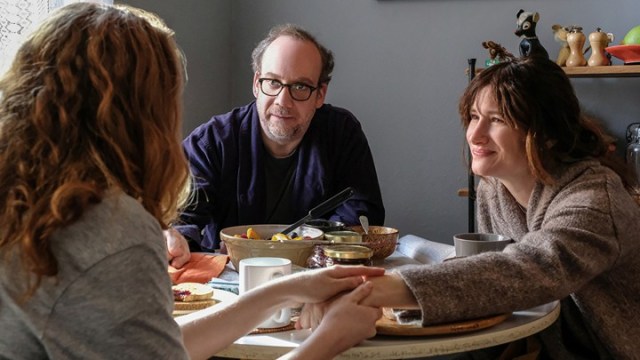
After trying unsuccessfully for a baby for several years, writers Rachel (Kathryn Hahn) and Richard (Paul Giamatti) decide to undergo IVF treatment. As their relationship bears this added strain, their niece Sadie (Kayli Carter) takes a break from college and comes to stay.
Everyone feels so real here. Rachel and Richard are a couple who love each other deeply but who can’t help blurting out embarrassing secrets at inappropriate moments, can’t resist taking little digs or saying exactly the wrong thing at the very worst time (Sadie shares this family trait of not thinking before speaking). They look like us, they act like us, when they’re around the house they don’t wear pants (in both in the American and British sense).
Rachel and Richard are trapped. They have been through so much, hit so many hurdles and they still have to keep spending and hoping to get anything out of this. They have to get pregnant before the money or their time runs out or else they will have wasted both. This must be the story and the struggle for so many expectant couples. The film was inspired by the real struggles of writer-director Tamara Jenkins undertaking fertility treatments and this adds that essential level of grounding and authenticity.
Hahn is the emotional core of the film throughout, but Giamatti gets perhaps the standout moment when the normally pragmatic Richard finally breaks and considers throwing in the towel, exclaiming “I just want my life back…I’m just some guy who injects hormones into your ass every night!”. Elsewhere, the new gold standard is set for awkward escalating movie dinner scenes. That’s particularly impressive as let’s be honest, all movie dinner scenes are awkward and escalating, that’s why you put a dinner scene in your movie, not so your characters can eat and make merry but to try them.
Discussions of morality are by no means shirked. Rachel and Richard’s relationship dynamic with Sadie is odd to say the least, as when she offers to be their egg donor she is essentially acting as both a co-parent and daughter to them. The film doesn’t make judgements about what they are asking her to do, or the somewhat dishonest way they keep their bases covered elsewhere, but it acknowledges that there is a lot to unpack in this situation.
The message, the truth of what real couples undergoing IVF treatment must go through, is mercifully balanced by some endearing comic imagery, from Rich looking more confused than aroused at his “motivational” porn in the sample-giving room to Rachel’s first IVF procedure coming with the added awkwardness of her (very nice) doctor insisting on playing prog rock throughout. The biggest laugh comes from Rachel looking over the “EBay for ova” and practically recoiling at the idea that her potential egg donor is proud of getting “a full scholarship for golf”.
If it wasn’t for BLACKKKLANSMAN absolutely killing it, Private Life would have the most memorable, powerful final moments of any film of 2018. Think CALL ME BY YOUR NAME but much more dialed back and optimistic. Private Life is painfully honest, bittersweet and I only slightly hesitate to say, important. So what are you waiting for? Boot it up – it’s not a downer, I promise. You’ll laugh, you’ll cry and your heart will be all filled up. SSP


