https://www.thefilmagazine.com/far-from-home-throwing-shade-at-the-superhero-factory/ SSP
Review: Midsommar (2019)

The poster-girl for hayfever sufferers: B-Reel Films/Square Peg
MIDSOMMAR is a trip, and no mistake. Two features in and Ari Aster is already an aesthetically and thematically distinctive auteur, but is still capable of shocking us all.
In an effort to overcome her grief after a family tragedy, Dani (Florence Pugh) travels with her boyfriend and his postgraduate friends to the remote Midsommar solstice festival in Sweden. Despite a warm welcome and a pleasing sense of tradition, something darker is at work behind the festivities.
WICKER MAN comparisons are inevitable, and there is shared DNA, but the Robin Hardy classic looks rather tame by comparison. I was most reminded of Darren Aronofsky’s more out-there films in the way that perception of reality is constantly played with. If you took the bad batch nightmare trip from the finale of REQUIEM FOR A DREAM, spliced it with metaphoric murkiness of MOTHER! and adorned the resulting hybrid with garlands of garish flowers, that’s Midsommar.
This is the antithesis in presentation to Aster’s previous effort HEREDITARY (bright, colourful and in the open vs dark, oppressive and claustrophobic) but it’s also a lot more disturbing. I said at the time that Hereditary impressed me as a film but that I didn’t feel it was effective as a horror, but Midsommar works on both accounts. It’s the classic dark fable setup; naive young people being beguiled by a welcoming culture in a seemingly idyllic environment only for a much more sinister truth to be gradually revealed by which point it’s far too late to escape.
Midsommar is a full sensory-enveloping experience. They should really give you a handful of grass to fondle and some suspicious tea to sip at every screening to complete the effect. You’re dazzled and mesmerised by the visuals, from the vivid colours, the intricately detailed production design and the grotesque individual images burned directly onto your brain. The wall of sound encompassing scored music, foley artistry and the actors’ chilling vocalisations of their distress envelops you, traps you.
Florence Pugh is simply sensational. Aster is unforgiving with the film’s shot construction, more often than not holding tight on her face and putting her through the emotional wringer in a long take. I’d say that Pugh takes Dani to some interesting places, but I’m not entirely convinced she was always in the driver’s seat, that the character and the process didn’t take over in some primal fashion. Dani’s fellow solstice tourists (Jack Raynor and Will Poulter stand out) are various shades of unlikeable and may well face symbolically appropriate fates in the end. Dani and Christian’s relationship is an interesting and contradictory one, though Dani edges it in the audience sympathy stakes by virtue of not being a manipulative bastard.
From the start you’re trying to work out what the town’s big deal is, what they have in store for their unsuspecting visitors. Even as everyone’s role in the grand plan becomes clear (and Aster isn’t subtle in much that he shows you) you can’t predict how far things will go.
It seems odd to have such a dark (thematically) and full-on horror released at the height of summer, but when else would it make sense to see a solstice shocker? The brightness of the sun and the prettiness of the surroundings can be deceptive; you didn’t expect abject terror in such plain sight.
When the film really goes to extremes it might put some off, especially after enduring such a gruelling run-time. Heads splatter, clothes are discarded and trespassers dealt with cruelly. This is in no way a horror that leaves it to your imagination.
Like Hereditary you could look at the film as purely metaphorical, but for me I think we weave in and out of reality based on characters’ emotional unrest and ingestion of psychoactive substances. Dani’s emotional journey, her recovery from grief, is her reality. She has to keep looking inward and look after her own well-being even as paradise is festering around her and people are dying. However you read it, Midsommar is a fascinating and unusual horror that draws you in and doesn’t let go. Maybe Florence Pugh will get some acknowledgement come awards season just as Toni Collette was unjustly snubbed. SSP
Posted in Film, Film Review
Tagged Ari Aster, Darren Aronofsky, Florence Pugh, Hereditary, Jack Reynor, Midsommar, Mother!, Requiem for a Dream, Robin Hardy, The Wickerman, Will Poulter
Leave a comment
Review in Brief: The Kid Who Would Be King (2019)
I didn’t entirely get the shower of praise that greeted Joe Cornish’s directorial debut, tower block invasion ATTACK THE BLOCK, but he’s clearly a distinct talent. It’s surprising how little of Arthurian legend he needed to change to make this modern retelling work. A lot of the famous plot points have to be more tongue-in-cheek when your story takes place in carparks rather than castles it’s true, but other than that it’s the same timeless tale of becoming a better person. The tone inevitably skews younger, but this fits the bedtime story feel they’re going for. The young cast are real finds, but unfortunately the adult actors range from generic (Rebecca Ferguson) to completely extraneous (Patrick Stewart). Why would you draw attention away from the perfectly good Merlin you already have (Angus Imrie), a character whose whole deal has always been ageing backwards! Not everything works, but this is a lot of fun and demonstrates a lot of imagination. SSP
Posted in Film, Film Review
Tagged Angus Imrie, Attack the Block, Fantasy, Joe Cornish, Patrick Stewart, Rebecca Ferguson, The Kid Who Would Be King
Leave a comment
Review in Brief: Last Breath (2019)
There’s some really good non-fiction on Netflix. I had to watch LAST BREATH in three sittings to avoid bringing on an anxiety attack, it’s that intense. As told by the survivors, this documentary with reconstructed elements follows a 2012 deep sea dive that goes horribly wrong when one of the three man team becomes trapped underwater and the support ship their diving bell is tethered to drifts off course in a violent storm. Do yourself a favour and don’t look up the ending, then you’re guaranteed to be on the edge of your seat and appropriately short of air. Get terrified by the numbers, be amazed at the kind of outlook you’d have to have on life to do this as a career and swept up in the remarkable story of Chris Lemons, Dave Yuasa and Duncan Alcock compellingly recounted by the men themselves. SSP
Posted in Film, Film Review
Tagged Chris Lemons, Dave Yuasa, Documentary, Duncan Alcock, Last Breath, Netflix
Leave a comment
Review: Spider-Man: Far from Home (2019)
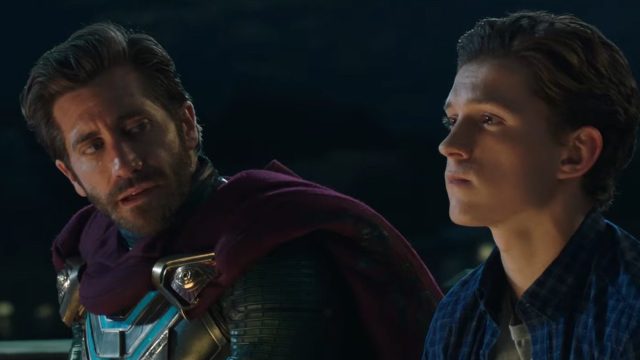
Friends or foes?: Pascal Pictures/Columbia Pictures/Marvel
I always feel a bit sorry for the Marvel movies that directly follow an AVENGERS because of the expectation that they’ll be the same scale. They never can or will be, so they have to be different. Unlike last time where being a sort-of Avengers film hamstrung the Spider-fun, FAR FROM HOME neatly ties up any loose ends from ENDGAME in the first ten minutes then just gets on with telling the story at hand.
Peter Parker’s (Tom Holland) school trip to Europe and plans to make his feelings for MJ (Zendaya) clear hit a snag as mysterious elemental creatures begin to attack major cities. Enter Mysterio (Jake Gyllenhaal) a powerful potential ally for Spider-Man.
This is arguably most subversive Marvel film since IRON MAN 3. The first half of well-mounted superheroics and awkward teenage relationship stuff gives way to a second half that is an extended deconstruction of the superhero movie factory and its priorities in general. It’s never smug about it though; it’s clever and witty and I appreciated it. That’s not to say the film is stingy on what we’ve all turned up for, far from it in fact as there’s plenty of supersized fun to be found throughout.
The new Spider-Man movies are doing the right thing with regards to their villains (or antagonists if you feel like so far they’ve actually had a point!). Just pick one we haven’t seen yet and do something really interesting with them. Gyllenhaal’s Mysterio is superb, and a take on the character that only an actor with his range and unpredictability could make work: he’s charm itself when he needs to be and…not when he doesn’t. If you’ve got even a passing knowledge of his main “deal” in the comics you’ll likely know the direction they’re going with him, but perhaps not to what extent. His character’s unique powers also allow for some vivid visual flourishes that makes me think the psychedelic madness of DOCTOR STRANGE 2, when it comes, will need to up its game.
Tom Holland is still a great Peter Parker, wrestling not just with great power and great responsibility but with girl troubles and the expectations of being Iron Man’s heir apparent. His party of friends on the most lethal of school trips are all great value for money especially in their reactions to the city-destroying dangers happening around them. Even as Peter is trying to steer them away from disaster hotspots, a recently de-snapped and unusually information-light Nick Fury (Samuel L Jackson) counter-steers them right back to get Spider-Man where he’s needed with the least amount of fuss. Jake Batalon, Angourie Rice and Zendaya in particular stand out among Peter’s class, the latter reaffirming that she was perfect casting for MJ with heart, attitude and self-awareness.
As entertaining as they both are, they could have probably dialled back on the comic relief teachers (Martin Starr and JB Smoove) a little. I would also hope nobody working in the education sector (not even in a comic book movie) is that trusting of really dodgy-looking bearded men in tactical gear.
The mid-credits scene sets up a giddily exciting next film, throwing Spidey’s world wide open and and putting him in a position we’ve never seen him in before. It also made me ludicrously happy in another regard with one simple act. You’ll know it when you see it.
Spider-Man: Far From Home has all the best aspects of Homecoming (charm, humour, great performances) and none of the drawbacks (extraneous plot, cameos from Avengers). It fits into the Marvel Cinematic Universe nicely but is allowed to be its own thing and tell a good standalone story built around character. The propulsive action and next-level reality-blurring visuals are just the webbing on the cake. This Peter Parker is here to stay, and despite being snapped out of existence and back again, his greatest challenges still lie ahead… SSP
Review in Brief: Vice (2018)
Reminder: a compelling protagonist doesn’t have to likeable, or good, they just have to be interesting. Dick Chaney was, and remains, an evil bastard, but he and his rise to power behind the throne is fascinating nonetheless. Adam McKay approaches political biography with the same cheeky glint in his eye as he did the World Financial Crash with THE BIG SHORT, but despite some killer one-liners this is a more serious-minded affair. The performances by Christian Bale, Amy Adams and Steve Carrell carry the film through some serious stylistic and tonal whiplash. For a film based mostly on conjecture and word-of-mouth, you can buy most of this could have happened based on how screwed up the world is now. Worse than any one thing the man did is the political climate he helped perpetuate, as hammered home in a bile-inducing post-credits scene set in a particularly vocal think tank. SSP
Posted in Film, Film Review
Tagged Adam McKay, Amy Adams, Biopic, Christian Bale, Dark Comedy, Steve Carrell, The Big Short, Vice
Leave a comment
60s Review: Dr. Strangelove or: How I Learned to Stop Worrying and Love the Bomb (1964)
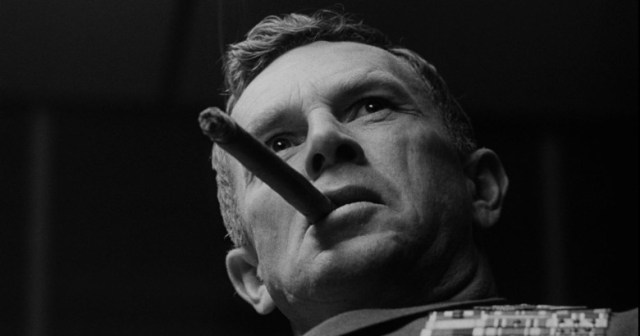
Kubrick stare, eat yer heart out: Columbia Pictures/Hawk Films
When author Terry Pratchett wrote about his time working as a publicist for a nuclear plant, he described how he came to realise that there’s no funnier phrase than “two completely independent failsafe systems”. The extent to which everything goes as wrong as it can go because a madman easily exploits a supposedly foolproof system is at the heart of the satirical brilliance of Stanley Kubrick’s DR STRANGELOVE.
When a fanatical and unhinged Air Force officer orders a nuclear strike on the USSR, it’s up to a pushover RAF Captain (Peter Sellers) the President of the United States (Peter Sellers) and a mad scientist (Peter Sellers) to prevent nuclear Armageddon. The only trouble is that the foolproof failsafes put in place do not allow for an active bombing wing to be contacted, let alone recalled…
This is Kubrick at his leanest, punchiest and most mischievous. He exaggerates to ridiculous degrees for comic effect but clearly hit a nerve given the US Government’s overblown response. I’m sure he found being put on a watchlist hilarious, and deeply satisfying.
You might find yourself asking if it’s sexist that the only visible female character is a secretary in a bikini. But then you think about it and realise that of course everyone else in this farce is a man: no woman could be this stupid. Speaking of Miss Scott (Tracy Reed) her scene has her repeat and shout high-end military secrets delivered over the phone to her general/lover in the bathroom.
Absurdist gems are scattered throughout. Bombing wing officer Major Kong’s (Slim Pickens) cowboy hat is kept in the safe next to the military codes. Captain Mandrake doesn’t have enough change to call the president with vital intel to prevent Armageddon, so has to ask the poor operator tasked with connecting him to the White House to reverse the charges. The titular character’s…quirks.
Captain Mandrake might be a character Sellers could have performed in his sleep with the cut glass accent and nervous tics, but the way he plays being forced to humour a psychopath is mesmerising. Dr Strangelove as a character is an excuse for Sellers to explore the art of over-the-topness and President Merkin Muffly is Sellers as his best straight-man, acting with utter incredulity at the escalating situation. His one-sided phone conversations with the (unheard) Soviet Premier play out like Bob Newhart routines with the President faltering and becoming increasingly embarrassed at his own country’s sheer incompetence.
Several key members of the ensemble threaten to steal the show from Sellers, Sellers and even Sellers. Of particular note are Sterling Hayden’s paranoid conspiracy theorist, and main antagonist, General Ripper. Hayden walks that knife-edge of playing madness convincingly, terrifyingly, without turning into a parody of a dangerous and severely mentally ill man. George C Scott is also great as the posturing blowhard, nuke-first-ask-questions-later General Turgidson (see a trend with these names yet?). Considering how much of the film takes place at the American airbase on lockdown or in the war room, you’ll rarely not be entertained by Hayden or Scott playing off one of Sellers’ colourful creations.
This is one of the few films where we’re cheering, nay praying for, the classic war movie heroes not to succeed. The teamwork, camaraderie and improvisation in a tight spot demonstrated, not to mention the matching song played throughout their scenes runs counter to what we know they are trying to achieve. The movie language runs counter to what we’ve learned over the course of the story, it’s mocking our expectations of a war film.
It’s a comedy, and yet everyone dies. We’re destroyed by our unbelievable stupidity. It has to be up there with the bleakest movie endings ever. Kubrick clearly thinks we as a species deserve no better. At least we’ll go out (slightly uncomfortably) laughing. SSP
Posted in Classic Film, Film, Film Review
Tagged Black Comedy, Classic Film, Dr Strangelove, George C Scott, Peter Sellers, Satire, Stanley Kubrick, Sterling Hayden, Terry Pratchett, Tracy Reed
2 Comments
Chernobyl: Audience Adulation vs Critical Consenus

Nuclear shroud of lies: HBO/Sister Pictures/Sky
According to the IMDb, HBO/Sky’s miniseries CHERNOBYL is now the most critically acclaimed TV show of all time. It’s in all the trailers now: “9.6/10”. This does not matter. I’m not one of those “who cares what the critics think?” viewers – pop cultural criticism has its place. What I’m here to argue is that the success of a show like Chernobyl goes much deeper.
Having a significant, perhaps one of the most significant of all world events as the basis of your TV series helps. Even if you don’t know the ins and outs of what happened, just saying “Chernobyl” to the average person on the street conjures certain phrases – “nuclear meltdown”, “radiation poisoning”, “cancer” – and images of deserted grey tenement blocks. The show presents the evidence for academics and experts to debate and the gut-wrenching real human experience for everyone else.
Word of mouth is far more important to selling a hard-going and upsetting true story than 5* reviews. A guy down the pub telling his mate he gave the show a go, expecting to find simply depressing but instead became completely enraptured by it, contributes far more to people watching, and therefore a show’s actual success, its current place in the public consciousness, than a critic banging on about the performances or the political and thematic subtext.
The thing is, unless you have a prior interest in the subject you likely won’t “feel like” popping on an episode of Chernobyl straight after, say, a long day at the office. But if someone you know and trust has recommended it and you give it a go, then you’re hooked. I’ve spoken to a few friends who were reluctant to start it lest it left them depressed, but they still ended up watching a couple of episodes back-to-back because they had to see what became of these characters they came to care about.
The atmosphere on the show is pervasive, the near-constant soundscape of nuclear hums and Geiger counter clicks envelops you in this world. Once you’re sucked in and the characters and their stories compel you, the real-world injustices hit home. It’ll probably compel even the most history-phobic viewer to do their own reading, to verify just how wrong the “official” story is.
I was told I had to watch Chernobyl by my parents and by a friend. They were right. Three moments in particular will stay with me. When the arrogant Chief Engineer Dyatlov (Paul Ritter) still refuses to accept that the Chernobyl reactor exploded even when presented with incontrovertible evidence – there’s this little moment, a pause as he looks at the photos, a crack in his armour appears dead you realise he’s just a Party Man who’s terrified of what will happen to him if he admits the truth. Then when during the trial Legasov (Jared Harris) repeats a statement given in defence of the actions of the USSR, “Why worry about something that isn’t going to happen? That’s perfect – they should put that on our money”. Finally, as the final episode draws to a close we are presented with some statistics, and the final one left me livid: regarding the death toll, “the official Soviet recording puts the figure at 31”.
Watch Chernobyl because it’s worth seeing, because it’s a story worth passing on. Then tell others to do the same. It’ll stay with you. SSP
Posted in Film, Film Review, Television
Tagged Chernobyl, HBO, Historical Drama, IMDb, Jared Harris, Paul Ritter, Sky, TV
2 Comments
Review in Brief: Green Book (2018)
I can’t say GREEN BOOK is a bad film, it’s too competent. But it’s a very ordinary Best Picture winner. To its credit, the realities of being a touring black musician of any calibre during this period are not ignored. A handful of good scenes and the easy chemistry between Viggo Mortensen and Mahershala Ali nearly make it all worth it. But it relies too much on easy stereotypes without saying anything even remotely profound about them, and some of these shortcuts to characterisation are damaging, even if you’re aiming for a lighter tone. Even when you’re bringing class and intellectualism into the mix for your discussion of prejudice you’re always on dodgy ground if your white character gives a black character a lecture on how to be better at being black. Yes, even if by the end of the film he and his family put a pin in being racist for Christmas. SSP
Posted in Film, Film Review
Tagged Drama, Green Book, Mahershala Ali, Oscars, Viggo Mortensen
1 Comment

 SSP Thinks Film