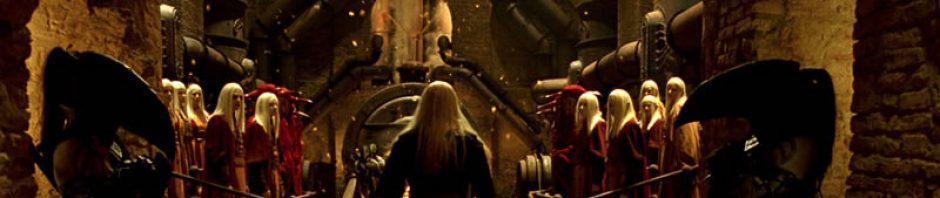
THE ACCOUNTANT, about an autistic money launderer/assassin is beautifully obsessive in its visuals, less careful elsewhere. Christian Wolff (Ben Affleck) is only autistic when it suits the plot and he is able to turn on the charm and have social skills when the situation requires (basically when he shares a scene with Anna Kendrick). The most interesting thing about the film should have been not where the lead character is on the spectrum or what he can do because of the way his brain works, it’s that Wolff essentially plays both chief protagonist and antagonist. This SILENCE OF THE LAMBS-esque plotline of puzzling out an unconventional criminal’s actions is quickly forgotten about and hurriedly resolved(ish) later in favour of exploring Wolff’s origins. The film clearly comes from a real and caring place, you just want more character consistency, more risks and sharper plotting in a film about unconventional brilliance. SSP
Review in Brief: The Accountant (2016)
Review: The Raid (2011)

I felt that from here: Pt. Merantau Films/Celluloid Dreams
THE RAID, or: the Fine Art of Ultraviolence, as it really should be subtitled (subtitled REDEMPTION in the USA, which is sort-of a spoiler) was the finest martial arts film for a decade when it was rolled out over 2011-12 around the world. Simple, high-octane and beautifully brutal. Not bad for a previously unknown Welsh expat and his buddy who does martial arts.
A SWAT team is tasked with liberating an apartment block from a malicious drug lord (Ray Sahetapy) and his private army. Rama (Iko Uwais) the young new addition to the SWAT team, bids goodbye to his pregnant wife and before long is surrounded on all sides by rapidly degrading concrete and heavily-armed henchman. With much of his squad soon injured or dead, it is up to Rama to shoot, stab and brawl his way to the top of the high-rise and confront the mastermind behind it all.
Never before had human brutality looked so beautiful, presented in a way which would resemble an intricate dance if it weren’t for the copious blood and bone-snapping. It’s a joy to see a relatively unknown martial art being practiced on the big screen, and the Indonesian Pencak Silat allows for the choreographing of action unlike any you’ve ever seen before. Movement is unpredictable, full-on and incorporating the environment in nastily brutal ways (the manner in which Rama makes creative use of a door jam still makes me shudder slightly).
Uwais is far more than a blunt instrument however, and in the long tradition of strong silent types with a good heart throughout film history, it is established early on in the film that Rama is only committing the acts of brutality he does to provide a safe and financially secure life for his wife and soon-to-be-born child. The drug lord Tama is also shown to be the most diabolical of evil-doers, a representation of everything wrong with contemporary Indonesia, and thoroughly deserving of everything that comes to him. Uwais, along with Yayan Ruhian, who plays the terrifying and volatile bodyguard Mad Dog, choreographed the film and made the numerous action sequences so explosive and memorable.
Though the film in a sense de-sensitises you to violence, such is the extent and frequency of it on screen, you are brought crashing back down to reality by Writer/Director Gareth Evans’ human characters and subtextual comments on social problems prevalent in modern Indonesia (poverty, the break-down of family units and the dominance of the illegal drugs trade are all referenced within the film’s narrative). Evans is not just incredibly talented as an action director, guiding cinematographer Matt Flannery’s stylish camera work, and undertaking the striking, expert film editing himself, but he’s also an effective and intelligent, though minimalistic screenwriter, and as a passionate promoter of Indonesian culture, which he clearly has a great love of. He’s certainly a real talent to watch, and I am incredibly excited to see how else he can elevate the action genre, and perhaps other areas of cinema in the future.
The Raid was the finest martial arts film in a decade on release. What would Gareth Evans follow it up with? An even better one. Seriously, if you haven’t seen THE RAID 2, correct that right away. In fact if you’re reading this without seeing either then I can highly recommend a double-bill. The characters grow, the world expands, the action gets bigger and more ridiculous, Indonesia is put on the map of action cinema. What’s not to like? SSP
Review: Guardians of the Galaxy Vol. 2 (2017)
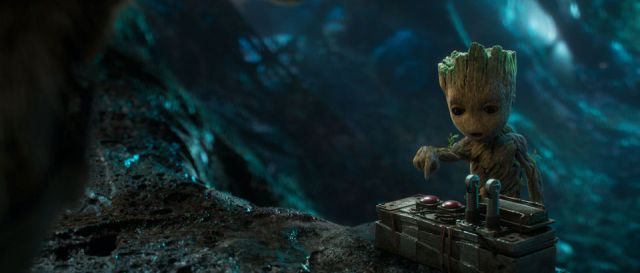
We are still Groot: Marvel/Disney
Expectations can be a powerful thing. Nobody expected GUARDIANS OF THE GALAXY to turn out quite as well as it did three years ago. And yet the batty space-opera starring Marvel Comics D-List characters and directed by the guy who wrote the live-action SCOOBY-DOO set the world on fire and captured viewers’ hearts. So I’d like to warn you to subvert your expectations for VOLUME 2. Don’t worry, James Gunn’s sequel still good, but you’ll be left disappointed if you’re expecting something quite as special as last time.
The continuing adventures of the reluctant intergalactic saviours dubbed the Guardians of the Galaxy. Peter Quill/Star-Lord (Chris Pratt) finally reconnects with his long lost alien dad Ego (Kurt Russell), a reunion which brings with it a whole host of new problems for the cosmos.
The new additions to the Guardians lineup quickly feel like they belong. The adorable antennaed empath Mantis (Pom Klementieff) brings innocence and idealism to the team and old frenemies Yondu (Michael Rooker) and Nebula (Karen Gillan) make the dysfunctional-family-in-space even more so. Michael Rooker is definitely the MVP here, with Gunn giving his long-time collaborator’s blue space pirate ample room to breathe and to grow, and the rest of the cast do what they do well (maybe not Sylvester Stallone, who despite seeing the film I am not sure why he was there or what he was doing). I found myself wishing Chris Pratt could have played his big moments a bit bigger, but his scenes with Kurt Russell on Ego’s Prog Rock album cover world (the contents of which I’m not spoiling) are still well worth waiting for.
It must be challenging for sci-fi filmmakers to avoid ripping off STAR WARS when their spaceships need to “jump” to another area of the starmap. Gunn and his imaginative effects team have come up with a neat visual of the ship shooting through a net of hexagonal cells, and they let their imaginations run riot elsewhere as well. From the slapstick result of henchmen tangling with Rocket’s (Bradley Cooper) arsenal of mischievous gadgets, to a hive of laser-bots scuttling around the hull of a ship to get a better shot and another elegant action sequence proving Yondu’s whistle-controlled flying arrow is the coolest sci-fi weapon since the lightsaber.
The highlight of the whole affair comes early on with the opening credits, set to Baby Groot (Vin Diesel) dancing to ELO as all hell breaks loose behind the blissfully unaware sentient sproutling. Elsewhere the music doesn’t pack quite the same eclectic punch as last time, and seems more incidental than essential to character. There’s a music-related gag at the end that falls a bit flat as well, and it comes at a point where Quill’s character might have undergone some important development.
I love that the filmmakers heavily lean on the pulpier, more OTT elements of the “cosmic” marvel universe, from a brief but explicit nod to Ego’s Living Planet form from the comics and that old sci-fi rag staple of a Big Glowing Space Brain making an appearance later on. Pre-Guardians vol. 1, it is doubtful if we’d have ever seen the like of these ideas with quite the same aesthetic in a major blockbuster, but with Vol. 2, DOCTOR STRANGE and the upcoming THOR: RAGNAROK, these are clearly films Marvel have faith in, and that’s encouraging to see.
Gunn’s script might not be as neat as the last one, but it’s full of good lines, my favourite being Star-Lord’s comment that Yondu, escaping from danger hanging on to his flying arrow makes him look “like Mary Poppins”. After a confused pause, Yondu responds, “Is he cool?”. The story offers few surprises when you know how sequels tend to go, but at least the finale, which at one point looks dangerously like the standard endless superpowered punch-up, is colourful, creative and character-driven. Guardians Vol. 2 can’t match the original, but it offers up enough fun, spectacle and character moments to make the revisit worth your time. SSP
Review: The Handmaiden (2016)

Power-plays and pedicures: Moho Film/Yong Film
During the Japanese occupation of Korea, a thief (Kim Tae-ri) masquerades as a handmaiden an elaborate scheme to cheat an heiress (Kim Min-hee) out of her fortune. The plan is complicated considerably more when Sook-Hee falls for Lady Hideko, her employer, playing the part of a Count (Ha Jung-woon) muscles in on their relationship and the various parties involved make their true intentions clear.
Presented as a sprawling dark-romantic epic with stately, languid cinematography (by Chung Chung-hoon of OLDBOY and STOKER) to match, The Handmaiden undeniably looks great, both in prettily adorned scenes of comfort and passion and also when the plot takes far more sinister turns. Few can pick out moments of beauty in brutality and sadism, but somehow Park manages it. The setting allows him to pick and choose from a collage of cultural influences and gives the mansion at the film’s heart a unique aesthetic.
By transposing Sarah Waters’ story to 1920s Korea, the already intriguing character piece is given added socio-historical punch, with Koreans choosing to play Japanese for status or aspiring to be accepted as such by their invaders th, this in addition to the deception and power-plays already present in the story. No-one is who they say they are and every character plays multiple parts depending on the situation and where they currently find themselves in the pecking-order.
Park could admittedly have probably shaved off twenty minutes from the runtime (I write this not having seen his longer Director’s Cut), but where would the cuts come? Well, for a start, the sex. As I’ve said before, I consider SHORTBUS one of the finest and most moving films I’ve ever seen, but I got so bored with the sex scenes in The Handmaiden. “Sex, sex, sex, that’s all you think about”, as Brian’s mum would say. Unless you’re Shortbus, in which every act of lust said something new about the characters, I’m not convinced any film needs more than one sex scene. Once it’s done it’s done. Said scenes are fairly artful and aren’t presented quite as porny as in BLUE IS THE WARMEST COLOUR, but they still become tedious. The Handmaiden shows us the same sex scene twice, with an extension (oo-er) for the second go, and variations of scenes in which an exclusive club of dirty old men listen to pornographic stories.
I also had a problem with the film’s portrayal of madness. Even in a sometimes soapy period melodrama, there are other ways to depict a character with mental health problems than boggling eyes and sharp strings on the soundtrack (composer Jo Yeong-wook could have dialed it down on a few occasions really). It’s not a subtle film, and that doesn’t bother me in a film with big emotions and big acts of deception, but for me this almost approached parody-level.
What will enrapture you is the sumptuousness of the visuals and particularly the richness of the key characters. The lead pairing of thief-turned handmaiden Sook-Hee and her seemingly fragile mistress Hideko makes for a fascinatingly contradictory relationship to match the contradictory world they live in. Their passion-at-first-sight has to weather a lot of manipulation by other parties and the dynamic of their relationship changes drastically multiple times over the film. Kim Tae-ri completely steals the show, embodying Sook-Hee’s endearing awkwardness and her relishing usually being the most intelligent and in-control person in the room despite seeming completely nonthreatening. Kim Min-hee comes into her complex own in the film’s second act and he third side in this triangle of control is “Count Fujiwara” made conniving but beguiling by Ha Jung-woo, who has the quote of the film with, “Where I come from it’s illegal to be naive”. Seemingly from another film entirely is Jo Jin-woong’s Uncle Kouzuki, a cartoony pervert with a black tongue, leather gloves and awful dusty old man makeup.
Despite the odd stumble and some scenes outstaying their welcome, The Handmaiden remains Park Chan-wook’s most ambitious film to date, a depraved and well-appointed feast for the senses that draws upon his country’s traumatic past to embellish an already compelling story. SSP
Review: Free Fire (2016/17)
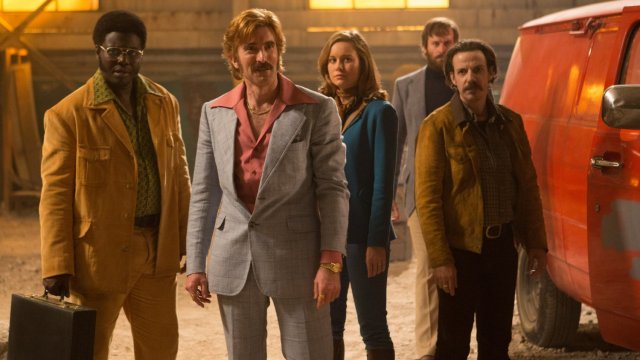
Is this an arms deal or a fashion show?: Film4/Protagonist Pictures
Does Ben Wheatley ever sleep? Over the past eight years the British polymath has produced kitchen sink drama, folk horror, black comedy, Avant-garde, period-sci-fi-satire and DOCTOR WHO. He never does the same project twice and tends to mix it up in terms of his style and collaborators (writing partner Amy Jump and good luck charm Michael Smiley aside). Judging by FREE FIRE, Wheatley isn’t done with trying out ideas yet, though it’s unfortunately his least interesting film so far.
Various shady types arrange an arms deal in a deserted warehouse in Boston. Things do not go according to plan and before they know it everyone is fighting for their lives as well as their money.
Considering the painstaking purpose-building of a vast Boston warehouse on the outskirts of Brighton, the geography of the action gets jumbled pretty quickly. It’s a good job the characters are dressed in every shade of the 70s or might be even more difficult to work out who is who through the dust. Wheatley captures the hectic panic of a shootout, but I’m not convinced he’s a born action director. The editing is a bit bewildering and the shootout, aside from the timely unleashing of flying gas canisters, pretty bog-standard. That’s fine, by the way – he’s plenty skilled at other styles.
I liked that nobody in this world is a good shot and pretty soon it’s a case of everyone dragging themselves around being winged by ricocheting bullets. Sharlto Copley does his quirky nutjob thing as a disco arms dealer, but it is Sam Riley as a volatile junkie and Armie Hammer as an anachronistic hipster who steal the show. You really have to feel sorry for Michael Smiley, who is so loyal to Wheatley but who spends most of the film splayed on his back and slowly lurching around the battlefield as his character becomes more maimed. You’ve got to hope the cast gelled and had fun making this, because they sure spent a lot of time lying in the dirt.
The film falters not because it’s mostly action, and not because it doesn’t have much in the way of plot. MAD MAX: FURY ROAD was mostly highly destructive car chase, but it maintained momentum with vivid characters whose arcs were explored through actions rather than words. RESERVOIR DOGS, which Free Fire has been compared to repeatedly, jettisoned the plot after the opening sequence with no negative effect on the arcs or the memorability of Mr Pink and co, so I’d have to suggest that it’s the characters in Free Fire that ultimately let it down. To be honest I’m having a tough time remembering any of their names (accept for Ord, because who’d forget that?).
The most interesting elements in the film are the moments of relative quiet, the banter and quips that start off cocky and become more desperate and clumsy as the chaos progresses and the wounded become more so. Little moments, reactions to bizarre turns in the battle (Brie Larson’s eye-roll at Copley’s macho posturing behind his back and another character’s comment, again to Copley in the latter, more desperate stages of the battle, “Hey, I like your cardboard armour!”) and snippets of half-heard, overlapping bickering make the film. The “resolution” of the shootout has a character slumped against a colourful wall advert and fruitlessly attempting to unfurl the skeleton of an umbrella as the warehouse’s emergency sprinkler system kicks in – a beautiful summing up of the escalating and ultimately stupid and pointless events we’ve witnessed. This moment will stay with me, as will some of the one-liners, but this mad gun-toting group likely won’t. SSP
5 Years On: The Avengers (2012)

Team photo: Marvel Studios/Paramount
In 2012 it finally arrived – the blockbuster to end all blockbusters (as if). There was so much riding on THE AVENGERS, so many moving parts and so many things that could have gone wrong. Thankfully they didn’t, and it turned out to be rather good. Did it change mega-budget filmmaking? In a way. Does it still hold up? Let’s examine that further.
When an alien army invades Earth, the world’s mightiest heroes must put aside their differences, unite and defeat an unprecedented threat they would never be able to overcome in their own.
Over four years between 2008-12, Marvel delivered a series of mostly underwhelming origin films that seemed to spend as much time setting up The Avengers as they did introducing the hero on their own poster. This is arguably the most irritating trend that has hung around since The Avengers; studios yearning for a piece of Marvel’s pie and rather than steadily world-building over time and multiple movies, brute-forcing franchises into messy shared universes or spending more time setting up what is to come than telling the story at hand. Sony tried it and fell flat on their face. Warner Bros have clumsily rushed it through and eclipsed the hero who was meant to be at the centre of it all. Even GHOSTBUSTERS and TRANSFORMERS universes have been mooted for no justifiable reason.
Incredibly, Joss Whedon managed to marshall all the Marvel big-hitters, played by some seriously big personalities (Robert Downey Jr, Samuel L Jackson and Chris Hemsworth’s biceps alone are competition enough for screentime) and somehow make the result work as one coherent film. The highlight of the impressive ensemble is unquestionably Mark Ruffalo, playing the latest incarnation of Bruce Banner/The Hulk (though he’s the first actor to truly play both sides of the character with the assistance of motion-capture). Whedon appears to truly understand and love the character, and Ruffalo is able to effectively communicate to the viewer through a sensitive and understated performance the extreme fear, paranoia and depression of Banner, and by really letting rip in his mo-cap suit he demonstrates the volatility and terrifying power of “the other guy”. Robert Downey, Jr.’s wisecracking playboy Tony Stark/Iron Man gets all of Whedon’s best lines – my personal favourite being when Stark is trying to reign in the furious new arrival Thor and mocks his flowing red cloak with “doth your mother know you weareth her drapes?”. Scarlett Johansson also holds her own in a largely testosterone-fuelled cast, and manages to develop Natasha Romanoff/Black Widow from the stereotypical sexy femme fatale we saw in IRON MAN 2 to a fully-rounded, deadly and viciously intelligent character tormented by her violent past that we see here.
The final act showed the pinacle of superhero action of the time; with the six heroes working together to defend Manhattan from an alien invasion lead by the increasingly manic Asgardian exile Loki (Tom Hiddleston). In one particularly slick and visually eye-popping moment the camera snakes its way through the city and in one unbroken shot takes in each of the Avengers in turn working as a team to repel the invaders. I will say that the film is largely responsible for Marvel’s tendency to end their films with a battle in either a city, the sky, or both, and also influenced other studios to end their films with 45 minutes + of action monotony, but this was hugely enjoyable the first time round.
The most rewarding and enjoyable moments for me were the more intimate encounters, particularly a fine early scene which has Black Widow traveling to Calcutta to retrieve and recruit a reclusive Banner, and the on-edge scientist feigns a transformation into his greener side to test Romanoff’s true intentions. I also loved Black Widow’s interrogation of Loki before the mid-film set piece – the scene gives Johansson and Hiddleston plenty of room to play off each other and it’s intelligently scripted, brilliantly tense and beautifully performed by the actors, resulting in an incredibly revealing moment for both of their characters.
The Avengers is exactly what a great blockbuster should be – grounded enough to be relevant and dramatically effective in the contemporary world (with references to worldwide energy shortages, WMDs and the terrifying future of warfare) but also fantastical enough to be fun, and to provide a level of escapism for the audience. I must admit, the film does lose momentum here and there, and there are some incredibly convenient plot devices employed to get the heroes together, but you can’t really hold these minor gripes against a filmmaker like Whedon. This is a man who achieved the impossible in making Marvel’s crowning glory worthy of the time and effort dedicated to laying its groundwork over the last half-decade, and with the addition of his trademark playful sense of humour, the film doesn’t look like it’s taking itself too seriously, which could have been fatal. Awesome is a criminally misapplied adjective in this day and age, but there really is no better way to describe this super-powered extravaganza. SSP
Review in Brief: Moana (2016)
MOANA is colourful, energetic and heartfelt, and enriches its world with Polynesian cultural influences in a far less patronising manner than was attempted in POCAHONTAS with Native American folklore. It’s also very safe in its storytelling, falling back on Disney tropes – “I want” song; mismatched duo bickering on a quest; royal parents forcing destiny on their children – that have been worn down to the grain. Aside from the catchy tunes (“How Far I’ll Go” will burrow into your brain), the film is most worth recommending for being endearingly aware of what it is, with Maui (Dwayne Johnson) commenting much to Moana’s (Auli’i Cravalho) chagrin that, “If you ware a dress and have an animal sidekick, you’re a princess”. Said animal sidekick this time is a mentally ill chicken inexplicably voiced by Alan Tudyk, one of the many oddities on offer which include diminutive coconut-wearing pirates and a bling-encrusted crab (Jemaine Clement) who performs like the lovechild of David Bowie and Dr Frank-N-Furter. SSP
Review in Brief: When Marnie Was There (2016)
WHEN MARNIE WAS THERE works so well on multiple emotional levels, and can be read in a number of ways. One of those ways is a little creepy, but I think I we’ll skip that. Anna (Sara Takatsuki) is a low-key but compelling protagonist, a champion for all of us who feel more comfortable in their own company, who overcomes her doubts and hangups searching for fulfillment, ironically as she discovers her connection to the tragedy of others. The fantasy elements are underplayed, but the unconventional portrayal of time, memory and the near-supernatural power of love marks this story out. Ghibli animations never feel like they’re in a rush, but this goes doubly so for Marnie. It’s tentative, thoughtful and searching for the perfect beautiful image to capture, much like the film’s anxious and creative protagonist. Studio Ghibli certainly didn’t tail off in quality as it approached its indefinite hiatus, this and THE WIND RISES being amongst their most complex and beautiful work. SSP
30 Years On: Withnail and I (1987)
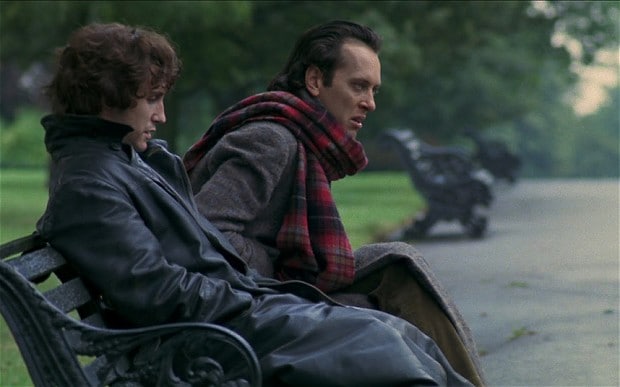
Just you try and fight the schadenfreude: Cineplex-Odeon Films/HandMade Films
There are few films out there that will make me laugh myself to tears every time I watch them. Monty Python does, as does Mel Brooks, but as I’ve mentioned before, I also have to add the gem that is WITHNAIL & I to the list. Now celebrating its 30th birthday, this very British ode to being stuck in a rut is just as entrancing as ever.
Two out of work actors (Richard E Grant and Paul McGann) escape their moldy student digs and head off to the Lake District for the weekend. Cue rain, scary locals and an even scarier predatory thespian to spoil their holiday and make Withnail and his flatmate long for unemployment.
The film is just so quotable, from Withnail’s pathetic, soaked-through plea to a farmer, “We’ve gone on holiday by mistake” to again Withnail’s alarmed explanation, “Monty you terrible c**t!” and Withnail once more’s “Fork it!”. Grant’s Withnail may get all the best lines, but “I” (now widely known to be called Marwood in the script) is fixed as the passionate, beating heart of the story by McGann, an underrated low-key performer who proves himself here by not being overshadowed by the manic Withnail (as a pair they make for astounding feature debuts). It’s Marwood’s story, his struggle to re-start his life and move on despite the best (or should that be worst) efforts of his best friend.
The film is a tonal masterpiece. Much of the humour relies on humanity’s tendency towards schadenfreude. We’ve all had terrible holidays like the one that Withnail and Marwood endure (hopefully few city folk have been forced to improvise how to prepare a still-clucking chicken for the oven) and we’ve all had times in our life where nothing is going right. I’m not sure the same goes in the USA and elsewhere, but in Europe and especially the British Isles there is an innate pleasure in seeing people in worse situations than ourselves. This isn’t out of meanness or lack of compassion, it’s more an unconscious thing and goes with our self-deprecating nature. It’s not quite dark enough to be dubbed black comedy, but the jokes go through various shades of brown and grey just like the pair’s holiday.
The ending is tragic but bittersweet, with Marwood shorn of his student locks and catching the next train to his future, Withnail desperate to stop him, or at the very least see him off in style. He ends up walking Marwood, in the pouring rain, swigging wine from the bottle as they go. Withnail is left alone giving a grandstanding monologue to zoo animals, perhaps the finest performance he will ever give to the biggest audience he will ever perform to. We’re pleased that Marwood got his chance and heartbroken for Withnail, who will more than likely continue doing what he is doing, never escaping his eternal rut. He’s one of the most counter-intuitively likeable prigs in film history.
The film stock may be grainy as it always was, the scenery and the clothes drab (ditto) and it may not have made a particularly big splash outside the UK, but Withnail & I still hits hard and gives me so much joy. I remember showing it to the student film club at university and it bringing much mirth to a room full of students taking life as it came (I wonder if we saw parallels?). If you haven’t seen this quietly philosophical, witty and damp romp yet, what are you waiting for? SSP

 SSP Thinks Film
What the Hell, Hollywood?
Oh crap: Dark Horse Comics
Look, I know the reasons for Hellboy III not being made are complex and many, from Perlman’s age and schedule to del Toro’s schedule and need to occasionally sleep, to the usual studio guff, but I don’t see how does rebooting the whole thing helps matters. If Hellboy III was going to be too expensive with not enough of a guaranteed audience to turn a profit, how will it be any different if they start again? Surely you’ll be marketing towards the same audience, the already-initiated, who would prefer another movie in the previous continuity.
It’s currently rumoured that they want to improve on the del Toro HB movies’ moderate performance by making it R-Rated. Why? Hellboy isn’t Deadpool or one of the Watchmen. The Hellboy comics could get dark, but they weren’t gratuitously violent or reliant on swearing aside from the odd “crap” before something big and otherworldly punched Hellboy really hard.
Revolution then Universal were lucky to land a project with such a perfect match of talent to material after the original film’s troubled early years. Guillermo del Toro and Ron Perlman brought Mike Mignola’s world to vivid and textured life in two immensely satisfying instalments. Inspired by Mignola rather than direct adaptations of his storylines (which are episodic and weave in and out of each other) they were respectful but not slavish to his vision (as if del Toro could be slavish to any imagination but his own). The ending of HELLBOY II: THE GOLDEN ARMY demanded resolution, but the uncertainty/hopefulness of the final freeze frame now has a bittersweet edge to it.
The only glimmer of hope for this new project is that Hellboy’s father Mignola is personally helping to pen the script (hopefully adapting another storyline than “Seed of Destruction”) so it should do the writer-illustrator’s ideas some kind of justice. Doing said justice falls to Neil Marshall (solid director of THE DESCENT and GAME OF THRONES) and new Hellboy David Harbour (good shout for HB, and still with the miles on him to do many sequels if required).
Maybe I’m taking it a bit personally, still smarting over not getting to see the resolution to Guillermo del Toro’s Hellboy journey, or more annoyed that yet again this gifted auteur seems to have been screwed by the system. Who knows, I might be wrong and this new Hellboy might be good. At least it should be a different take. Also, studio execs need to come to accept that Hellboy will never be mainstream, and may never be a box office smash no matter how “adult” you make it. He’s a unique contradiction who appeals to all us oddballs, so they’d better get used to it. SSP