
SWISS ARMY MAN is like one of those weird one-off dreams. It questions humankind’s fear of death by allowing one of us to have a (admittedly skewed) relationship with a symbol of that fear. Hank (Paul Dano) loses it in the wilderness after a near-death experience, and contemplates ending it for real until a farty corpse washes up beside him. Said cadaver “Manny” (Daniel Radcliffe) becomes Hank’s survival tool (it’s amazing how many uses there can be for stored gas and rigor mortis) and his confidante as they both take a long, hard look at their tragic lives and deaths. It’s an odd one to take Cannes by storm, but the jarring tone, creative slapstick and feelgood way it looks at mortality certainly makes it one to recommend. Radcliffe’ sheer physical control is impressive and Dano proves once more to be one of the most underrated talents in Hollywood. It won’t be to everyone’s taste, but I challenge you to sit through it and not at least crack a smile. You might be bewildered, disgusted, unimpressed, but you will smile. SSP
Review: Swiss Army Man (2016)
Review in Brief: Seoul Station (2016)
SEOUL STATION brings back slapstick zombies and a good punch of dark satire in its final act, but as a companion piece to TRAIN TO BUSAN, it falls rather short in terms of character. None of the supposed protagonists are compelling or even particularly interesting: most of the characters are hurriedly sketched placeholders so annoying you can’t wait for them to be eaten, the only one holding any kind of surprise used as a plot twist and little more (no, I’m not saying which). The animation is decent, but nothing all that special. Recycled frames are obvious and you miss the energy and detail of Japanese anime or even contracted-out Korean animation houses’ work on American cartoons. You wonder how the film came about, whether writer-director Yeon Sang-ho had the ideas but not the budget for two feature films, but decided to do them both anyway. For whatever reason, this is an animated prequel you can miss. SSP
Review in Brief: Assassin’s Creed (2016)
Do you need to have played the games to get something out of the ASSASSIN’S CREED movie? No, but it’ll certainly help. Anyone can enjoy the detailed costume designs, the well-mounted action and the moody atmosphere, and equally fans of the games and non-fans can be confused by the editing or bored by the exposition porridge. Who on Earth thought it would be a good idea to constantly jitter between time periods mid-action scene? You only need to establish that Cal (Michael Fassbender) is in a simulation the once, otherwise it seems like you don’t have faith in your audience’s attention span. You’re better than that, Justin Kurzel: if you’re going to commit to subtitling your moody historical action, you can at least trust in your audience to remember the general premise of the film. Plus Fassbender for some reason mentions he’s hungry twice on the same scene before another character repeats it back to him, and Charlotte Rampling – poor Charlotte Rampling – is unlucky to find herself in this. SSP
Review: The Levelling (2016/17)
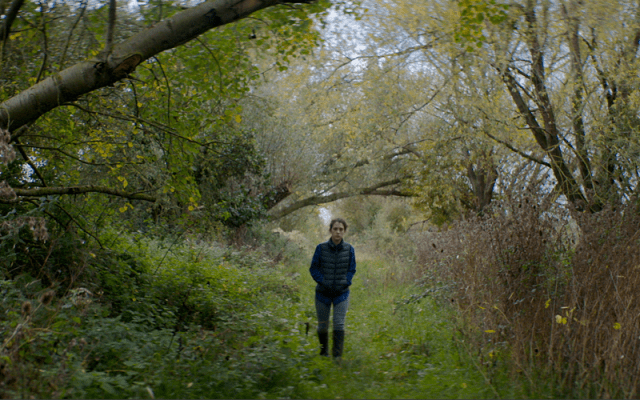
Alone time: Wellington Films
THE LEVELLING is very much like farming soap opera THE ARCHERS, only bleaker, with better acting and real animals. If you’re American, or not middle-class enough know about The Archers, don’t worry about it.
Taking a forced sabbatical from her veterinary studies, Clover (Ellie Kendrick) returns “home” to a flooded farmhouse, her father Aubrey (David Troughton) living in a caravan on bricks and a whole lot of grief to deal with following the sudden death of her brother Harry. Will this tragedy bring the estranged family back together or push them further apart?
The arguments between Clover and Aubrey are heated but calculating, cutting but coming out because deep down they care. They are father and daughter who don’t really know each other, attaching and counter-attacking, trying to figure the other out and coming to terms with the fact that it’s both their fault. On the farm it becomes clear that they make a good team, they work well together in an identical methodical way. This is probably why Aubrey resents his daughter so much for leaving home to pursue her own dreams: all he was left with was Harry, and he just didn’t have it with him. Clover was called back home by a neighbour, Aubrey may not have ever been able to tell her what happened himself. It might never have occurred to him that it should be a father telling his daughter about her brother’s sudden, tragic death.
On moving on from, dealing or not with grief: “You have to get up, get out of bed and milk the bloody cows”. At a key moment Clover comes out with one of the most heartbreaking and yet non-judgemental things possible to say to a grieving parent.
The film has an understated beauty to it. Emotionally and visually it’s grey but full of life. There’s a hint on the edge of the bleakness, the unplowed, rubbish strewn earth and the people keeping everything bottled up that something better must be around the corner. As well as being solidly grounded and naturalistic, there is also a strange eeriness to The Levelling. It’s something about the sound design, the out of place human-animal wooping and a very sprawl sense of something horribly sinister lurking below the surface. It’s almost a relief when the final revelations come and the answers are so mundane, so “that’s life”.
When there finally is an emotional release, when the characters are at their rawest, must vulnerable state, the heavens open and the film world cries with them. As a metaphor I loved that, though I can’t say I’m certain what the rabbit was meant to represent. Perhaps it’s intentionally ambiguous or maybe it just passed me by.
The Levelling reminded me a lot of one of my favourite films of last year, NINA FOREVER in its approach to grief. The presence of the again excellent David Troughton in a broken emotional state certainly helps. He has the showier role here, the biggest and most heartbreaking outbursts, but Aubrey only has emotional power because of the reasons he locks horns with Ellie Kendrick’s relatively dialled-down, vulnerable Clover. She is easily the strongest character in their family, and when she left things went South fast. Her dad couldn’t cope without his rock.
The Levelling is an intense experience that feels all too real to ever feel emotionally manipulative. Using very little more than two barnstorming central performances and the bleak beauty of untended rural landscapes, it sensitively explores grief, guilt and the inability of many families to communicate with each other. What a sublime, affecting feature debut from Hope Dickson Leach, a name to watch. SSP
40 Years On: Star Wars (1977)

Team photo: Lucasfilm/20th Century Fox
2017 marks 40 years of STAR WARS. The galaxy far far away (….) has been part of my life since I’ve been watching movies. For me, George Lucas’ creation is a cornerstone of who I am. I may not have been around in 1977 for the original release, but I did get to see it on the big screen in the 1990s, and subsequently went straight out to rent the sequels on VHS (remember those?) from my local library (remember those?).
If you really have never seen Star Wars, it follows farmboy Luke Skywalker (Mark Hamill) who is swept up in an adventure to rescue Princess Leia (Carrie Fisher) who has intelligence to cripple to Tyrannical Galactic Empire. With the guidance of old hermit Obi-wan Kenobi (Alec Guinness) and dashing rogue Han Solo (Harrison Ford), Luke becomes the new hope for a free galaxy.
This year’s Star Wars Celebration was particularly celebratory, with an appearance and much fond (and not so fond) reminiscences from Lucas himself, the premiere of THE LAST JEDI trailer and a loving and teary tribute to Carrie Fisher. Lucas probably shocked the floor when he proclaimed that “It’s a film for twelve year olds”. That’s not to say that Star Wars, or being really fond of it, is immature, or even that you should put away childish things you love. Star Wars is innocent, it’s fun, and its escapism. It captures imagination and it caused a much smaller me to run around the garden swinging a broom handle (adding the vroom myself) happy as Larry. Then there were the games in the school playground when I always wanted to be Darth Vader (is that weird?).
One of the first blockbusters was an indie film. Lucas was fed up with the wheeling and dealing involved with working with major studios, he wanted to avoid reaching the inevitable stage where they could say “we own you” as soon as a major hit was produced. Looking back now, the practical effects essentially made in someone’s garage and filmed in a car park look understandably old-fashioned, but in some cases they feel all the realer for it. The budgetary limitations are still evident but less obvious in the “Special Edition” that were cleaned up, enhanced and extended to bring particularly the first film in line with the more polished presentation of the rest of the trilogy.
The opening sequence of the Rebel Blockade Runner fleeing the imposing triangular juggernaut that is an Imperial Star Destroyer and subsequent messy boarding skirmish has to be up there with the greatest first scenes ever committed to film. It’s exciting, it sets the tone and it shows us things we’ve never quite seen before. The fizz and fun of the Cantina scene, the ominousness of “That’s no moon” and of course the spectacular WWII movie-inspired Death Star trench run finale also spark the imagination.
As Harrison Ford famously quipped, “You can type this sh*t, but you can’t say it”. There’s a reason the two best scripts pre-FORCE AWAKENS were for EMPIRE and RETURN OF THE JEDI – Lucas didn’t write the dialogue. The best exchange in the film comes from Ford going off-piece, improvising Han’s “everything’s fine now” intercom conversation during the prison break sequence. Ford smartly spotted that it would result in a better performance if he, and by extension Han, really didn’t know exactly what they were going to say to the person on the other end of the line when their plan went awry. Elsewhere, Lucas tries to pack too much sci-fi exposition into too small a window, resulting in garbled, strangely paced dialogue (“Will-you-forget-it-I-already-tried-it-it’s-magnetically-sealed!”).
Luckily the dialogue is made up for by the great character moments: how Leia takes complete charge of the situation when she is “rescued”; Han’s progression from self-serving scoundrel to hero when he has something to fight for; the most shocking and brutal image of the saga setting Luke on his path, and you really believe him when he says “There’s nothing here for me now”. A special mention should also go to the actors who rely almost entirely on their physicality – David Prowse as Darth Vader, Anthony Daniels as C3-PO and Peter Mayhew as Chewbacca – who make their characters completely their own.
Four decades on and, for me, I still feel the Force of Star Wars. The otherworldly yet familiar galaxy Lucas and his craftsmen created got bums on seats, but the characters and and the spectacle kept them coming back time after time. Here’s to another 40 years of both rewatching and brand new adventures…. SSP
Review in Brief: Everybody Wants Some!! (2016)
With EVERYBODY WANTS SOME!! (there’s probably a reason for the two exclamation marks) nobody is especially likeable, Richard Linklater is on very comfortable ground and it could be argued he doesn’t exactly stretch himself, but it comes from a real place nonetheless. The best sequence in the film sees the house-sharing baseball team hurriedly changing clothes and personas as they move from punk bar to country and western bar to performing arts school party over the course of a night. The boys put a lot of thought into how they look and whether they will fit in, but sooner or later any pretense falls by the wayside and they realise they can just be themselves. It’s a beguiling watch despite the fact that not a lot happens, and I have a sneaking suspicion that you’ll get the most out of it if you’re really into either/or baseball or 70s music, though the film isn’t really about either. SSP
Review: Alien: Covenant (2017)
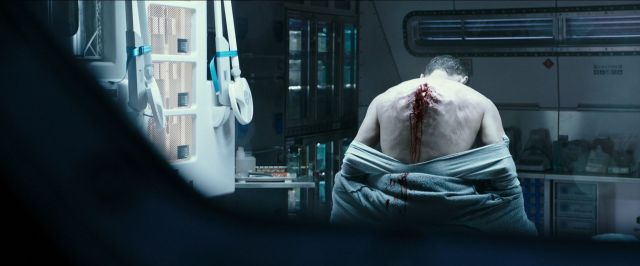
I’ve got an itch, right here: 20th Century Fox/Scott Free Productions
There’s a reason ALIEN: COVENANT re-adopts the parent franchise title. PROMETHEUS seemed stuck in an identity crisis, whereas Covenant is proudly a proper Alien movie. You’ll get everything you expect and then some from Ridley Scott’s real return to marshaling the Xenomorphs, but a fair few twists and surprises along the way as well.
A human colony ship on route to a new home diverts its course when it receives a strange signal from a nearby planet. Already bloodied by a freak accident, the crew of the Covenant desperately make their way through the strange and murky jungle hoping for a sign to give them hope. What Daniels (Katherine Waterston), android Walter (Michael Fassbender) and the rest find is something deadly has been waiting for them…
Most of what happened in Prometheus is left by the wayside after this film’s opening prologue, and that’s fine because Prometheus didn’t really go anywhere. Everything you need to understand in the upcoming story is laid out in this clean, stylish and thoughtful scene between David and his creator Peter Wayland (Guy Pearce). “You created me, but who created you?” is the only question we need to carry over from Prometheus.
The film is all about the evil of emotion, the cruelness of creativity. It’s pretty bleak and hopeless stuff, exploring how we brought it all on themselves. We may have made great advances as a species, made great leaps forward because of our creativity (Scott loves to reference current innovations, for instance here humanity’s exodus to the stars is assisted by solar sails) but our free will has birthed many horrors as well. After all, every war and every genocide in our history began with someone with an idea convinced they were right, and Covenant uses this to great effect to drive the plot.
It’s Fassbender’s playground, giving twin androids David and Walter a very different physicality, personality and views on life, the universe and everything. Walter is hulking, methodical and sounds a bit like Kryten, David moves like a dancer; skipping and gesturing flamboyantly, his actions all driven by a need to find out what if? Whereas David’s final act switch of allegiance in Prometheus was baffling, his further actions here have a warped logic to them, and heighten the dark thematic undercurrents of the film at large. Waterston as Daniels isn’t a superwoman but is a problem-solver, getting out of many a tight spot using her wit and guile. I also enjoyed seeing an unusually downplayed and semi-serious Danny McBride, his character growth as helmsman Tennessee being perhaps the most unexpectedly compelling in the film.
Covenant does, as demanded by the genre, rely on people being stupid, but unlike Prometheus, which had some of the best minds, the top people in their respective fields, making the worst decisions possible, here it’s just a group of ordinary guys and gals. They are couples recruited to maintain the colony ship, get it where needs to go before beginning a new life among the stars. Being ordinary people, they quite often make the situation worse when they react badly to everything going to hell. They are wracked with grief by a fatal accident early on, and the crew clearly feels every single loss they suffer to their core, some of which are not noble or glorious, but messy, accidental and cowardly. Alien has always done death scenes well, and Covenant delivers them in a wave of satisfying splats.
The plot isn’t in any way surprising, the only unusual element being one of the twists not being used as such from the audience’s perspective, but rather as an act of how long our heroes can miss seeing what is really going on. With the story and visuals hitting such familiar (if well executed) beats, it is the subtext, the thematic richness that must bear the weight of the story, and here Covenant excels. It’s vintage Ridley Scott on his best angry and conceptual form, with added glossy gore and very stupid people dying spectacularly stupidly. Alien: Covenant may be downbeat, even hopeless in its outlook, but it’s a hell of a lot of fun as well and sets the franchise back on firm ground. SSP
Series Retrospective: Scott-directed Aliens
Just in time(ish) for the release of ALIEN: COVENANT, I thought I’d look back at Ridley Scott’s two previous encounters with Xenomorphs, Engineers and Last Women Standing.

Which came first?: Fox
The characterisation is lean and unfussy – Kane (John Hurt), Brett (Harry Dean Stanton), Ash (Ian Holm) – all simple but memorable creations, particularly when they die (not a spoiler nearly 40 years after the fact). Then of course there’s Ripley (Sigourney Weaver: sublime) who arrives so fully-formed a presence and a hero; strong, level-headed and independent, finding herself in a bad situation and puzzling her way out of it. I know there are plenty of fans out there who prefer ALIENS, but I can’t get past James Cameron softening the character to the extent he did by making the maternal instinct her driving force. Aliens was a good film about mothers and they needed a human counterpart to the Xenomorph queen, but why did it have to be Ripley? Why did she have to lose so much of her independence and agency?
Alien maintains its sweaty tension throughout, and plays cleverly with our fear of the unknown and makes the most of the cramped, hemmed-in setting, not to mention Scott’s long-running theme of the people running the show behind the scenes being the most terrifying, inhuman threat of all. You’d be hard pressed to guess the order of the crew’s grisly ends if you go in cold, and who’ll make it out alive, as you often can in contemporary horror. You might want to poke holes in the DIY spaceship sets and archaic computers, but I see it as all part of the charm. I’d still love to know whether the camera knocking against a crate in the film’s opening tracking shot was an intentional early jump-scare or a happy accident…

You just had to touch it: Fox
Review in Brief: Teen Titans: The Judas Contract (2017)
JUSTICE LEAGUE VS TEEN TITANS was the best superhero movie of 2016, and it was only 80 minues. With TEEN TITANS: THE JUDAS CONTRACT, the animated arm of Warner Bros once again manage to embody what DC heroes represent so much more succinctly than recent live-action efforts. Epic runtimes and supposedly “serious” takes on comic book lore do not a good movie make on their own. For instance, “Pain forms a hero, either making them a diamond or grinding them into dust” pretty much sums up Batman and his extended family, and you don’t even have to point out that his mum shares the same name as another hero’s. The final combo-villain the Titans have to face is boring, but it’s still a pleasure to revisit this world and the film’s final moments are genuinely moving. As long as the DC Extended Universe continues its present downward trajectory and relentless moodiness, I sincerely hope Warner Animation keeps this series going, especially with this cast involved. SSP
A Few Thoughts More: Guardians Vol. 2

Enough about me, let’s talk about me…: Marvel/Disney
This following contains spoilers for GUARDIANS OF THE GALAXY VOL.2.
I still stand by my initial review of Guardians Vol. 2. It’s definitely a better film on the second pass, and better still on IMAX. No, I still don’t think it’s as good as the first one, though I appreciate the character progressions if not so much the overall story.
There’s no getting around the fact that Vol. 2 takes about an hour to get warmed up. The first stretch is basically a series of (admittedly entertaining) skits and setup for ongoing plot points. The wider plot goes more-or-less exactly how you’d expect it to, as being an EMPIRE STRIKES BACK-esque sequel it goes darker, splits the central group up and brings with it unresolved baggage with absent parents. But Vol. 2 really comes into its own in an emotionally-charged and visually brazen final act. We haven’t really seen a superpowered father-son bust-up since Ang Lee’s HULK, and this one is a lot more accessible and looks so much better.
It is perhaps the best-looking film Marvel have produced to date, with out-there aliens, original sci-fi imagery (quantum asteroids that pop in and out of reality, spray-on ship repair) intricately jumbled rusty starship sets, Technicolor galactic panoramas and Kurt Russell reassembling himself layer-by-layer before our very eyes. They’re even almost there with de-aging VFX, from the terrifying mannequin-looking thing that was Jeff Bridges in TRON: LEGACY to the close-but-no-cigar Michael Douglas in ANT-MAN and Robert Downey Jr in CAPTAIN AMERICA: CIVIL WAR. I’m all for special effects giving actors an opportunity to expand their roles, and it’s nice to see Russell in his 80s heyday again, and fitting so comfortably into the Guardians-verse.
I’d also failed to fully appreciate the thematic richness of the film the first time I watched it. Ego is by some distance the most devious maniacal bastard the heroes of the Marvel universe have yet faced. When it becomes apparent that his grand plan has been shagging across the cosmos for millennia until he finds a genetically suitable host for a progeny, all in the name of making the galaxy in his own image, he becomes deliciously irredeemable. His portrayal feeds right back into the thematic underpinning, with both sets of baddies, Ego and the genetically engineered Sovereign striving for perfection and uniformity, and the Guardians stubbornly remaining square pegs in round holes. Everyone’s been torn apart on some level and painfully reformed, but their individuality, the reason for being outcasts and gravitating towards other outcasts, is what makes them.
This was a slow-burner for me, but it certainly hasn’t fallen short as many of Marvel’s sequels tend to. It’s unexpectedly complex if you’re prepared to make a second or third trip, and the criminally underrated Michael Rooker providing this film’s “We are Groot” moment towards the end is almost worth it all by itself. SSP

 SSP Thinks Film