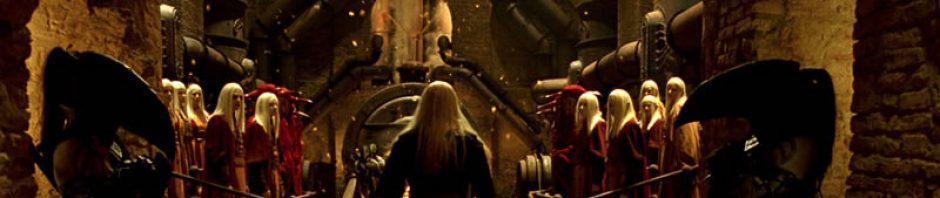
Creative fight choreography and full-on violence is one thing, but what really blew me away about THE VILLAINESS was the cinematography. I can’t even begin to imagine how they achieved some of these impossible shots. For once a POV action scene isn’t jarring, in fact the gang hideout slaughter that opens the film is smooth and seamless. It doesn’t just look like someone’s just holding a camera at head height either, with the view shifting naturally as a person’s head would move to, for instance, avoid a machete flying towards your face. The spectacle is no less jaw-dropping elsewhere, particularly a death-defying (for the camera operator as well as the stunt performers if it was done for real) and ridiculous three-way bike chase/sword fight. Deliberately elusive storytelling is made even tricksier by non-linear plotting and a lead character (Kim Ok-bin) that changes her face halfway through, but if you make the effort and concentrate this is a satisfying, deliciously dark, and far from straightforward affair. SSP
Review in Brief: The Villainess (2017)
Review in Brief: Hacksaw Ridge (2016)
HACKSAW RIDGE is firmly in Mel Gibson’s wheelhouse. It’s a brutal depiction of an inspiring true story with copious religious symbolism with a lot of Australians in it. From a very earnest beginning, the film becomes pretty horrific in its imagery, a full-on body horror with explosions. I’m all for war being presented as brutally as it is, but I still find the tone and construction of the battle scenes weird: they look too carefully choreographed and feel calculated. I know plenty of filmmakers have religious hangups, but it’s a case of Scorsese’s guilty, inward-looking Catholicism vs Gibson’s somewhat worrying bordering-on-zealotry (though Andrew Garfield is better in the this than in SILENCE). Gibson brings it back with a rousing finale which takes much dramatic license and some moving archive footage before the credits. You still feel like you’ve been put through an unnecessary ordeal, an almost perverse revelry in battlefield gore, but the emotional connection thankfully remains. SSP
Review: Kingsman: The Golden Circle (2017)
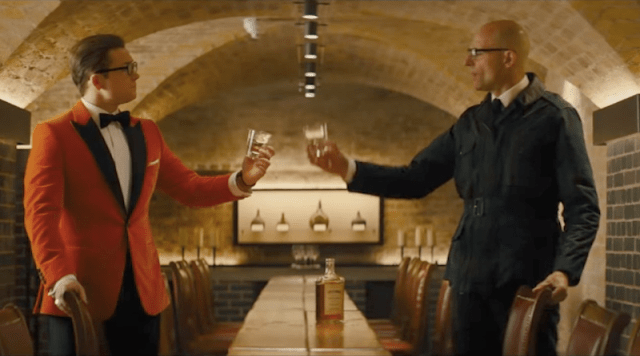
Here’s to going through the motions: Fox/Marv Films
The more I think about KINGSMAN: THE GOLDEN CIRCLE, the less I like it. When I first came out of the cinema, I thought it was OK, but I’m getting increasingly frustrated at mulling over a film with next to nothing to it. For all the dynamic action and bigger, shinier spy toys, Kingsman has lost the charm, the wit and the clear vision for what it wants to be that made the previous instalment such a joy.
When the entire support network for the Kingsman agents is destroyed, it is up to Eggsy (Taron Egerton) and Merlin (Mark Strong) to bring down the culprit, a drug-producing terrorist called Poppy (Julianne Moore). They must enlist the help of their better-funded American counterparts, the Statesman and also an old friend presumed dead…
The Kingsman story seem to have lost a beating heart somewhere along the way. The potential poignancy in the state in which Colin Firth’s Harry Hart returns (not a spoiler – it was in the first trailer) is completely squandered, digging further into his backstory made into a recurring joke. About the only moments which make any kind of emotional connection come from Mark Strong as a more fleshed-out and human spy drill sergeant Merlin, and he’s the only real acting highlight in the whole rotten affair.
A lot of people complained about a particular tasteless joke that ended the last film. Fear not, everyone, it’s now a recurring gag! The distasteful, puerile stuff is still prevalent throughout, particularly in an appalling sequence set at Glastonbury that makes AMERICAN PIE look the height of sophisticated comedy. Everyone involved is above skits about unwelcome advances while glamping and intimately-placed tracking devices. I never thought I’d think this this about a comedy movie, but thank goodness for Elton John: his willingness to act as a silly plot device is about the only really funny thing in this.
Once again I’m annoyed about Roxy (Sophie Cookson), who should have had an action scene last time (she was always better than Eggsy) but spent the whole third act tied to a balloon while the boys did the legwork. That would have been almost forgivable if they’d have used the sequel to correct these mistakes, but again Roxy is given absolutely nothing to do.
The film isn’t about much of anything. The War on Drugs is a plot driver, but what are they saying about it, that narcotics peddlers want to profit without impediment and politicians want to be seen as taking a hard line on criminal activity? What a revelation. It’s just a series of vaguely linked events driven by thin motives and reactions to such. When director Matthew Vaughn and writer Jane Goldman run completely dry on ideas, they just repeat, retread and reestablish the status quo. Harry returning far from fighting fit is glossed over as soon as it’s convenient for him to be useful in the action scenes again (said action is dominated by not one but two re-hashes of the bar fight in the first film) Eggsy learns exactlythe same lessons as he did last time but with an added awkward scene with the in-laws. What little character development there is for the Statesman (Channing Tatum, Pedro Pascal and Halle Berry) all seems to happen between the scenes we actually get to see.
The new gadgets are at least entertainingly ridiculous – robot-armed henchmen, robot hench-dogs, an amphibious taxi and a machine gun-cum-shield in a suitcase – all very spy movie-tropey, but fun when they’re wheeled out for a scene all the same.
Kingsman: The Golden Circle is a big letdown. Other than the odd glimmer of inspiration and jolt of fun within the pumped-up action sequences, this is a bigger, emptier version of the same story. I’m hoping against hope that this is just a blip and Vaughn hits his stride again next time. SSP
Review: It (2017)
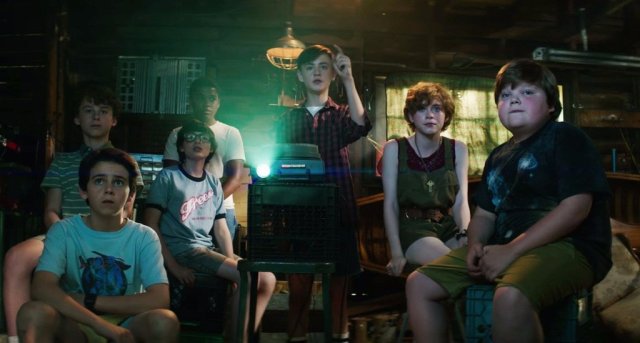
Who wants to see my jump scare slide show?: New Line/KatzSmith Productions
Nobody does a slow build like Stephen King. In both THE STAND and IT, he’s still introducing new characters and concepts with 250 pages to go and he can spend chapter after chapter establishing history, geography, mood and layer -upon-layer of hangups and neuroses driving his heroes and villains. I think that’s why a lot of his material works better on TV: it’s all a matter of time. In the new film adaptation, King’s doorstopper book has been split right down the middle. Part One tells the kids’ story, the adults’ encounter with the shapeshifting It will follow…
Something rotten lives below Derry, Maine. It takes many shapes and I’s been there for a long time, every 27 years waking for a spree of child-killing. After his brother Georgie (Jackson Robert Scott) is taken by It, Bill Denbrough (Jaeden Lieberher) and his gang of Losers face their fears and battle It’s multiple guises, most notably Pennywise the Dancing Clown (Bill Skarsgård).
What they do get right with It is is casting. What a talented young ensemble this is. Straight from the page steps a determined, passionate Bill, a wisecracking Richie (Finn Wolfhard) and a nervy, hypochondriac Eddie (Jack Dylan Grazer – the highlight). Reinterpreted we have Tomboy outsider Beverly (Sophia Lillis), tragic orphan Mike (Chosen Jacobs), local history nut Ben (Jeremy Ray Taylor) and a world-on-his-shoulders Stan (Wyatt Oleff). It’s interesting the character traits they swap around in this version, the changes in the kids’ backstories they make, but they all make sense, especially in this setting, updated from the 1950s to the 1980s (tying neatly into the story’s 27 year cycle – this will make Part Two contemporary). What makes an outsider and the dynamics within friendship groups have changed a lot over three decades. I would have liked to have seen psychotic bully Henry Bowers (Nicholas Hamilton) get less of a short shrift, but there are admittedly a lot of characters to divide screentime between, and the chemistry between these kids is just right everywhere else.
What makes even more sense in this adaptation, and the thing that gives it its most hard-hitting punch is what they do with the concept of fear. Rather than the grab-bag of horror tropes and stories around the camp fire King presents in the book, here every form Pennywise takes is tied to, and is essential to who each of the Losers are. They each get their own horror set-piece that delve into their respective psychologies and the traumatic events that made them.
The kids are all great, but Skarsgård is something else. I know I’m going to tread on a lot of toes here, but the 1990 TV movie was fine, and that’s about it. Nothing against Tim Curry, but this was TV limited by budget and the time it was made. In the film, Pennywise is primal and animalistic but also chillingly calculating and malicious; creepily almost human. He plays with his prey, mocks them for their weaknesses and wears them down, changing into manifestations of each child’s phobia but always settles back into the shape he has grown accustomed to over the centuries (at least three judging by the ruff and stockings), the dancing clown. You get glimpses below the surface, hints at what It really is, but they’re saving most of these reveals for the (presumably more sci-fi- tinged) sequel.
But here’s the rub: for me, It wasn’t all that scary. I’m not saying this will be the case for everyone – on the contrary I can see many well-placed and executed moments that will scare the bejesus out of some – it just didn’t particularly chill me. I’m more into creeping dread, much like director Andy Muscietti’s previous exercise in horror, MAMA (which is cannily referenced in one of It’s forms). Perhaps they’ll be able to do something more stylistically daring and different with the horror element beyond jump scares and unnatural, jerky J-Horror movement in the sequel, when they have to nail on what scares grown adults.
It might not be an original horror in its presentation, but it connects where it counts and brings King’s Losers and their struggles with fear and growing up to real life. What Muscietti and his writers understand from Stephen King’s words and living life itself is that what really scares kids the most, beyond blood and ghosts and clowns, is growing up and having adult responsibilities. Because adults themselves are the scariest thing in the world. SSP
Review in Brief: The Discovery (2017)
THE DISCOVERY is quietly thought-provoking sci-fi, and more worth your time than a lot on Netflix. The premise: what would the world’s reaction be if scientists proved the existence of an afterlife? The debate over faith, the meaning of life and human nature is covered from several angles, and often not the most obvious ones. The film’s final stretch packs a punch and manages to keep a few final, stubbornly ambiguous revelations under wraps right to the end, and it’s not a film which offers answers, only more questions. I don’t know whether Jason Segal is the most compelling dramatic lead in the world (at least not at this stage in his career), but he has good chemistry with Rooney Mara and does seething family resentments well. Having Robert Redford on board – even when he doesn’t have to try very hard – can’t hurt your film’s chance to get noticed, whatever the outlet. SSP
Review: God’s Own Country (2017)

Come here often?: Inflammable Films/Magic Bear Productions
Johnny (Josh O’Connor) is a young farmer without passion or drive, barely able to keep the family farm afloat and only blackout-drunk nights out to keep him sane. When his increasingly frail father (Ian Hart) hires help for the busy lambing season, Johnny finds something to live for with the arrival of Romanian migrant Gheorghe (Alec Secareanu) .
Farming is dying, and this death is only accelerating thanks to Brexit. The film takes great pains to regularly remind us of this changing landscape (though it was in post-production by the time of the referendum). Look at the scene when Johnny takes a cow to market, a room full of old boys aren’t going to be around forever, or the industrial farm we see at the end seemingly manned entirely by migrant workers. This essential processes, hard work that keeps society fed and warm, from lambing to putting down animals and using the woolly fleece (and scent) of a dead lamb to give a runt a chance of survival, are presented full-on and matter-of-factly. These scenes could only have been achieved so convincingly if they were for real, which they are. It must have been an interesting audition for the two leads, not only bringing chemistry and passion but a willingness to live and work as farmers for a few weeks. Speaking of which, what a double breakthrough for O’Connor and Secareanu.
I’m from the same area the film is set and filmed in, “Bradford, or somewhere”, but I’m a city boy. I could not live this harsh a life of early mornings, long days and longer winters and subsisting on pot noodles when you need to keep a closereye on the sheep. Be on the look out for shared locations with 80s classic RITA, SUE AND BOB TOO, this story explores very different thematic territory, but gets pretty dark and intense at times as well.
I’m a big fan of THE ROYLE FAMILY, and the best episode of that Northern sitcom had Nana finally confess to her long-suffering, ever-patient daughter, “I do love you Barbara”. There is a moment like that in God’s Own Country, with Johnny and his cantankerous father finally showing vulnerability to each other, that absolutely floored me.
Talk about sex appeal. Not so much the full-on, sometimes rough gay intercourse, but between Johnny’s sheepish smile and Gheorghe’s big sexy jumper I can completely understand if this becomes a favourite in LGBTQ Cinema. Their relationship has a real power to it, as well as heady love-almost-at-first-sight there is an honesty that doesn’t try to sidestep Johnny’s sometimes abrasive and self-destructive side or Gheorghe’s idealistic views on romance and how he doesn’t quite fit into the world (especially the UK and Europe) the way it is.
If I’m being ultra-critical, the pub scene doesn’t quite convince (especially if you’ve been in said pub and have never seen it quite so quiet) and the film could have ended a few shots sooner to make it feel a bit less tidy and more real.
What a punchy, passionate debut from writer-director Francis Lee, born and bred in Keighley, West Yorkshire and basing a lot on his own experience as the son of a farmer. It’s telling that this film was fighting for funding against The Levelling (which secured a release first), another farming drama and another of my favourite films of 2017. I guess there’s (sadly) only so much support to go round for small grounded movies filmed and set in the UK (thanks Brexit). SSP
Review in Brief: The Founder (2016)
THE FOUNDER could have easily been a shrine for brand worship, and this story of the birth of McDonald’s must have been signed off by the fast food franchise. The filmmakers largely avoid this by making a very clear (romanticised if not entirely inaccurate) distinction between the principles Dick and Mac McDonald founded their modest company on and what Ray Croc turned it in to. We are under no illusions that Croc (Michael Keaton, tanned and appropriately reptilian) would throw his own mother into the frier if a buck was in it. Dick (Nick Offerman, dignified and formidable) and Mac (John Carroll Lynch, a big teddy) may be very different kinds of businessmen to Croc, but see eye-to-eye on his hard work ethic and revolutionary improvements to their industry, eventually seduced and exploited by their partner. The film is stylish (look at the aerial shot staff training drill on a chalk-sketched restaurant) impeccably acted and sharply written, but it requires you to be a little bit enamored by those Golden Arches. SSP
Review in Brief: Lion (2016)
LION, the meaning of which is not revealed until the film’s closing moments is sometimes remarkable. There’s no denying this true story is remarkable. The script is punchy and well-judged, with very strong work from Dev Patel, and especially newcomer Sunny Pawar (for some reason only Patel seemed to get nominations despite probably not being on screen as Saroo for any longer). But annoyingly, this is very standard storytelling for such a miraculous life story. The odds of lost boy Saroo not only surviving childhood poverty and being separated by hundreds, then thousands, of miles from his family, then finally succeeding in finding his mother in adulthood (not a spoiler, it’s a true story) demands something more special. I think we’re past chronological biopics, and Nicole Kidman, well she’s just Nicole Kidman with different hair. I challenge you not to shed a tear at the final real footage they insert at the beginning of the credits, – having this cap off the film makes it all worth it. SSP
Review: Batman and Harley Quinn (2017)
In 1992 Paul Dini and Bruce Timm created Harley Quinn. Since then, the Joker’s abused girlfriend has been a popular but problematic character. In BATMAN AND HARLEY QUINN, she’s finally over Mr J, a limited supply of his Joker venom “the only useful thing I ever got from that asshat”. She’s still crazy, but she wants to be her own kind of crazy. If there’s one thing I wasn’t expecting of a Batman film, even an animated one, it was PINK PANTHER-esque slapstick titles. If there was another, it was Batman’s rogues gallery henchmen singing Karaoke. Both are in this film, along with childish humour and risqué jokes throughout. It’s all pretty entertaining and doesn’t outstay its welcome. I’d happily see Melissa Rauch play Harley again on her vocal work here, and Warner Bros Animation need to keep on giving their big projects to Sam Liu to direct to ensure the quality is kept high (though he may have peaked with JLvTT last year). SSP
Review: Kiss Kiss Bang Bang (2005)
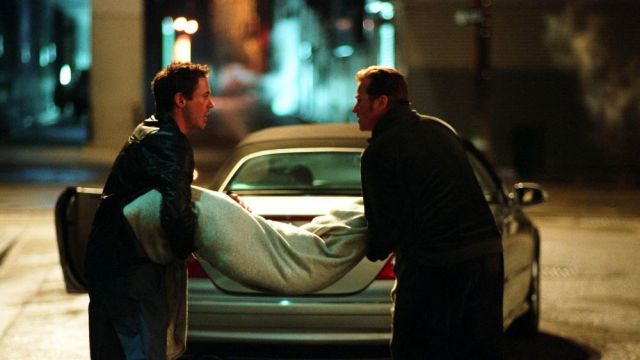
There are friends, and there are friends who will help you move a body: Warner Bros/Silver Pictures
Nobody writes stupid as well as Shane Black. Much like his contemporary Aaron Sorkin, he doesn’t write people talking how people actually talk, but within his own distinct worlds his dialogue for bewildered characters crackles almost as much as Sorkin’s dialogue for the brilliant. He’s also really funny and self-aware, a master of salty one-liners and wry commentary on increasingly bizarre events taking place, all served up in a pleasing black comic broth that is his directorial debut, KISS KISS BANG BANG.
Harry Lockhart (Robert Downey Jr) is a swindler living in a town of swindlers, Los Angeles, more specifically Hollywood, LA. When he reconnects with childhood friend Harmony (Michelle Monaghan) at a party, people start dying in strange circumstances and along with PI “Gay” Perry (Val Kilmer), the three of them are drawn into a sprawling mystery straight out of a pulp rag.
With Kiss Kiss Bang Bang, Black has fun pointing out the worn-out conventions of the detective genre, but indulges himself in a fair few along the way as well. Usually I’d get annoyed by a filmmaker who makes fun of cliché but still commits the same tropes to screen with an eye-roll, but Black pitches it about right. The plot is convoluted as one might expect from a pulp mystery story and the twists come thick and fast just as you think you’ve figured everything out. The fictional series of Harry Gossomer novels that feed the plot and drive character action as well as giving Black an excuse to reference tried-and-tested formulae (such as foreshadowing that two unrelated plot-lines will inevitably turn out to be connected and realising when the body count isn’t high enough just before the resolution of the mystery).
Despite heavily referencing other noirish stories and employing well-worn tropes, what is refreshing is that characters also react to the bizarre turns of the plot and the grisly deaths with an appropriate whimper. We see some nasty things as the mystery unfolds, but it never feels sensationalised, just portraying a dark, real world. Nobody is unfeeling in this story and many are changed, and not necessarily for the better. When Harry is forced to take a life, Downey plays it as a soul-destroying catastrophe.
Juxtaposed against the added realism is Black’s trademark postmodern commentary. And Christmas, because of course a Shane Black picture is set in the holidays. In a blatant nod to SUNSET BOULEVARD (that I, to my shame didn’t pick up on first time round), Harry introduces himself to us while staring into a pool. “I’m Harry and I’ll be your narrator this evening” is just a taste of Downey’s anti-hero’s disdain for the events and how they are being relayed (by him and by the filmmakers). We know Downey cracks wise well, but he also brings a compelling flawed humanity to Harry, and along with Michelle Monaghan’s fiery turn as Harmony and Val Kilmer’s career-best as the sardonic Gay Perry, Black has assembled one of the best lead trios around.
Shane Black films are always entertaining, but he may never strike as perfect a balance as he did with this, his directorial debut. Kiss Kiss Bang Bang is clever without being smug, self-aware without being glib, playing to the cast’s strengths without just recycling what they’ve done before. If you don’t like Black’s other work, you’re definitely not going to like this, because it is very “him”, but if you’re a fan of his writing for mismatched buddy movies or this one has passed you by, Kiss Kiss is well worth checking out. SSP

 SSP Thinks Film