
Yep, it’s definitely an S Craig Zahler film. Much like his Western BONE TOMAHAWK, BRAWL IN CELL BLOCK 99 is intense, drip-feedy in its pacing and almost cartoonishly ultraviolent. Also like Tomahawk it seems to become an entirely different film in its final stretch, where things go bloody (and I mean bloody) bananas. Zahler has a distinctive voice, a inky black take on the world best summed up here when asked how he’s doing after being fired, Bradley replies “South of OK, north of cancer”. As Bradley, I get why Vince Vaughn is getting attention; the control he displays as a permanently coiled spring is impressive, and when he goes off you really believe the damage he can do to cars, arms, faces. Yes, the final act has him rock up at a maximum security prison which is castle torture chamber manned by Nazis (I smell a metaphor!) but overall, this is keen-edged stuff. SSP
Review in Brief: Brawl in Cell Block 99 (2017)
Review: Justice League (2017)

At least Flash seems to be enjoying himself: Atlas Entertainment/Warner Bros/DC
JUSTICE LEAGUE is the most boring superhero extravaganza (or should that be urgh-stravaganza?) I’ve ever seen. You’ve got six superheroes to provide spectacle and colour, how do you end up with something so dull?
Superman (Henry Cavill) is dead, but the world still needs saving. Batman (Ben Affleck) and Wonder Woman (Gal Gadot) gather a team of gifted individuals to face an incoming threat. But can a kitted-out billionaire, a demigoddess, a merman and a couple of freaks stop an alien conquest?)
As I’m writing my memory of the film is rapidly fading, but I’m fairly certain that my last two hours in front of a big screen was something…that happened. There is so little that gains any traction, nothing that lingers. Even in action terms there’s very little to get excited about. There’s two fights in two different holes in the ground, a couple of busy large-scale battle scenes, quick stop-offs at Themyscira and Atlantis and a whole lot of bad compositing. I said it in my review of BATMAN V SUPERMAN, but I’ll say it again: Warner Bros have a real problem with making their top-level, mega-budget films look cheap. Characters and foreground objects pop horrendously against greenscreen backgrounds, transitions between physical actors and digital doubles often feel off, especially when the heroes start moving more superheroically. All too often you can see the joins and too much of it, for whatever reason (basics like getting the lighting and framing right spring to mind) this doesn’t look as good as it should.
There’s no real conflict either; we’ve all seen team-ups before, superhero or otherwise, much of the appeal in these types of movies comes from the ensemble working out their issues with each other, but the filmmakers never seem to want to linger on this. The film’s best scene has Batman and Wonder Woman justifiably criticising each other’s attitude to saving the world – Diana has shut herself away for a century when she could have been inspiring humankind, Bruce has been acting as judge, jury and executioner of Gotham for long enough to lose his humanity – but it peters out and is completely forgotten the next scene.
What cripples Justice League is schizophrenic characterisation. Bruce Wayne is a completely different character to who we saw in Batman v Superman, and it’s far more than him defrosting in order to make friends. Affleck looks deeply uncomfortable trying to quip as Batman and he seems to have shed most of his dark side without much difficulty despite the earlier scene I described and the events of the entire previous film. The world is in mourning for a Superman it never knew, and the Justice Leaguers talk about him like they’d worked together for years. This film universe hasn’t earned such a reaction, we needed at least another solo film for him to make an impact, and maybe be seen to save a few more people in the process. When he does show, Cavill (with horrific CG-ed off moustache) seems even more uncomfortable as a cheerier, hopeful Superman than he was as a serious, introspective one. Ray Fisher and Jason Mamoa seem to have had anything that made their characters interesting surgically removed in the edit, so instead of digital Frankenstein and underwater Hamlet, they’re just Mr Frowny and Prince Sarky. We all know by now that Gadot does what she does well, but if there’s a single saving grace in the cast, it’s Ezra Miller’s take on the Flash, mostly because Miller is an interesting young actor much better than this material. It’s not even worth talking about Ciaran Hinds as alien dictator #457.
I’m not going to analyse what could have been. We don’t know what Zack Snyder’s complete vision would have been had he not had to bow out early, or what Joss Whedon would have made of the film were he involved from the beginning. We’ve got to judge the final product we’re presented with, and said final product is lacking. It’s scattershot and inconsistent and missing wonder, intrigue and Flash aside, laughs. There isn’t as much to get angry about as Batman v Superman, it just prompts a resigned shrug. SSP
Review in Brief: The Fate of the Furious (2017)
FATE OF THE FURIOUS starts with Vin Diesel winning a race, whilst driving backwards, and on fire. This is the movie being subtle: later there’s a scene in New York that has cars doing acrobatics in the streets and raining from skyscrapers and of course the much-trailered submarine chase. It’s a good job they brought on board the charm monster that is Dwayne Johnson four movies ago, because try as he might, Diesel doesn’t have range, even when he’s forced to go after his friends. Toretto seems to turn on his team a little too easily, even before he’s found out exactly what leverage Charlize Theron’s Cypher (yawn, they’re using that as a character name again) has over him. But let’s not quibble over plot or why anyone still thinks Tyrese Gibson is funny, the eighth instalment of the Fast franchise still makes you smile and boasts some of the most impressive stunt work of the series. SSP
Review: Paddington 2 (2017)
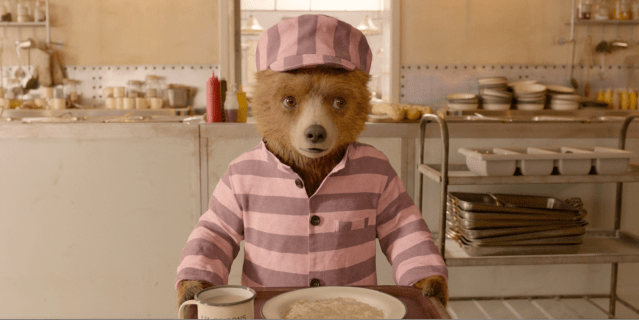
Grin and Bear it: Studio Canal/Heyday Films
If there’s a film cure for what ails you, it’s surely PADDINGTON 2. The concept of Paddington being sent to prison for a crime he didn’t commit sounds like a particularly twisted ROBOT CHICKEN sketch, but it’s actually the route to a lot of heart and humour.
Paddington’s (Ben Whishaw) idyllic family life is abruptly ended after he is framed for robbery by a devious actor (Hugh Grant) with a score to settle. The little bear finds himself serving time with some not terribly nice people with only his family marmalade recipe to protect him, while the Browns attempt to clear his name on the outside.
‘Be polite and look for the best in people” is still such a lovely message to promote. It’s a moral for an ideal world, one where you don’t get shanked in prison for dying everyone’s uniform pink, but Paddington’s world – a world where you always try being nice to your enemies, or you buy a printing press to get over a bad breakup – is one to aspire to.
I found myself increasingly thinking of Paddington as a Charlie Chaplin-esque character in the way he is animated to move and behave, then director Paul King put in an explicit MODERN TIMES reference to complete the picture. In contrast to the Tramp, the chaos Paddington causes is never malicious, or even mischievous. It comes out of genuine misunderstanding and innocent mistakes.
Paddington is one of the fictional characters I identify with the most because he looks for the best in people, but when someone really crosses him he never forgets it. We’re naive but potentially ruthless people, as evidenced by our trustful natures and hard stares.
Hugh Grant must have had such fun as luvvie baddie Phoenix Buchanan, a past-it thespian reduced to doing dog food adverts and having Gollum conversations with his costumes in the attic. Speaking of costumes, seeing Grant trotting (never quite running) around in a series of increasingly ridiculous outfits that Inspector Clouseau would be proud of never gets less funny. The cast is still a very well-rounded ensemble, with the addition of Brendan Gleeson as the cuddliest possible-murderer ever seen in a family film and the Browns (Hugh Bonneville, Sally Hawkins, Madeleine Harris and Samuel Joslin) are all still excellent and lovely. Look out too for cameos from all of British acting establishment who didn’t get a go at HARRY POTTER, plus several who did.
What an accomplished visualist Paul King is, and what a winning partnership he develops with DP Erik Wilson (who has made his name with grittier material like SUBMARINE and TYRANNOSAUR). Between a reprise of the “doll’s house” shot from the first film, a magical dip into a pop-up world and time and passion put into making every shot as beautiful as it can be, Paddington 2 is one of the best-looking films 2017.
I can’t quite put my finger on it, but something has been lost between the first Paddington and its sequel. Maybe it feels a little looser, plot-wise than last time, maybe it’s the the unnecessary chase scene that goes on and on with Paddington riding a wolf hound in pursuit of a burglar. Maybe its the seeming need to for a second film to provide increased (if still quirky) spectacle than last time. Quibbles aside, maybe the world itself is now so lost not even Paddington’s optimism can save it, or his hard stare convince it to change. Paul King and company can put out loving tribute after loving tribute to Michael Bond’s little bear and enthrall all ages doing so, but Paddington might be trying to lend a paw too late in 2017. SSP
Review in Brief: The Mummy (2017)
Well, it’s not the worst film of 2017. The latest take on Universal’s THE MUMMY has Tom Cruise running, jumping, shooting, swimming with all his usual aplomb, the problem is there is nothing likeable, even redeemable about his character Nick Morton. I’ve often said that protagonists don’t have to be likeable, the other problem is Nick isn’t interesting either. Even worse, the other characters aren’t so much written but are just…there. The scenes of battling the undead horde have an entertaining amount of splatter and dismemberment, but elsewhere what visuals that might be striking are spoiled by a telling CG gleam. I’m not opposed to the idea of a shared Monsters/Dark Universe, but it’s going to take much stronger glue than Russell Crowe as Dr Jekyll (why not Van Helsing?) the monster hunter who just changes his accent and gurns when he becomes his darker half, to retain coherency. Also, don’t rip off AN AMERICAN WEREWOLF IN LONDON and expect us not to notice. SSP
Review in Brief: Pirates of the Caribbean: Salazar’s Revenge (2017)
The fifth instalment of the ridiculously lucrative PIRATES OF THE CARIBBEAN franchise is cinematic flotsam. Actually, it’s probably more accurately jetsam because some panicked throwing overboard of everything from plot to character motivations was definitely involved in the making of this film. The opening set piece – which sees Cap’n Jack Sparrow (Johnny Depp who I’m not convinced is just acting drunk anymore) riding atop a bank building being pulled by a team of horses through winding streets – is at least entertainingly bad. The rest is an uncomfortable slog only punctuated by decent slapstick, overly optimistic fanservice and truly risible innuendo. There’s a major character death along the way as well, a death which would have surely packed more of a punch had the character not died once already this series. A while ago I said that there wasn’t a Pirates movie I disliked, that they all had something to recommend. Sadly that’s no longer true: Pirates 5 is messy, repetitive and a bit sad.
My Favourite…Animation

No following… (I’m not going to cry, I’m not going to cry!): Warner Bros Animation
My favourite animated film is THE IRON GIANT. I can’t claim to have known all this when I first watched it, but for a number of reasons it still made a profound connection.
Hogarth Hughes (Eli Merienthal) is lonely. His single mom (Jennifer Aniston) is usually at work, he’s usually alone and he has developed an overactive imagination to compensate. A world of late night B-movies and vague fear of being vaporised by the Russians is shaken when a rather large metal man comes into his life, shady government types not far behind…
The Iron Giant came at just the right time for me. When it was released in 1999, I was about Hogarth’s age, and like Hogarth I was an imaginative child. Running around the garden making up my own stories and fighting imaginary enemies was pretty standard. I’d also just studied Ted Hughes’ THE IRON MAN in school, which helped, then one Friday night I came home to find it premiering on late-evening Cartoon Network along with a very pleasant introduction from the Giant himself, Vin Diesel.
Review: Thor: Ragnarok (2017)

Show me your war face: Marvel/Disney
Some of you may remember THOR: THE DARK WORLD wasn’t that good. It wasn’t that bad either, but between storytelling falling over itself to cram in more of a certain God of Mischief after the fact and the worst villain in a Marvel film so far, it left a lot to be desired. THOR: RAGNAROK sends the trilogy out with a bang, and at the moment I’m struggling to remember the last time a film left me grinning ear-to-ear throughout. It was probably another Taika Waititi film.
Following the destruction of his all-powerful weapon Mjolnir by the vengeful goddess Hela (Cate Blanchett), Thor (Chris Hemsworth is dumped on a distant planet to fight for his life as a gladiator. Thor reconnects with the Incredible Hulk (Mark Ruffalo) during combat, and along with morally iffy brother Loki (Tom Hiddleston) and outcast warrior Valkyrie (Tessa Thompson), the God of Thunder must return to Asgard and prevent the end of their world, Ragnarok.
This is the most vibrant ensemble that doesn’t feature wisecracking raccoon. We already know Hemsworth and Hiddleston were born to play the sons of Odin, but the new additions of Jeff Goldblum’s campy despot, Tessa Thompson’s formidable Valkyrie and Waititi himself as a rock monster with incongruous New Zealand accent kept the smiles coming. Plenty of random cameos are sprinkled throughout as well, from inside the Marvel Cinematic Universe (Doctor Strange gets a scene) and out (nope, not going to spoil those).
Here we see Thor and Loki’s relationship actually grow, with the brothers coming to finally accept that they’re just different people. It’s a vibrant space romp, but everyone is given room to grow and their own moment to shine. Between this, IRON MAN and CAPTAIN AMERICA, Marvel now have unparalleled form in giving their trilogies satisfying denouements.
I love that even when dealing with gods and superheroes, Waititi isn’t averse to making pretty much everyone a bit crap at what they do. Thor still has ego issues (when he can’t work out the solution to a problem in the final act, this results in the best put-down of the film); Loki is still up to his old tricks despite most now being wise to his slipperiness; Valkyrie is a high-functioning alcoholic, the Grandmaster is an insecure tyrant and a glittery perv. The one-liners keep on coming, but so does the action, which is among the most eye-catching and creative in the Marvel series so far, lacking the bone-crunching wallop of fights in CIVIL WAR but more than making up for it with its own flow, style and fireworks.
Denis Villeneuve seems to have been all-but chosen as the next filmmaker to take a crack at DUNE, I don’t think Waititi would be a bad shout for the job either. He can clearly do over-the-top but doesn’t lose sight of what his ensemble is going through. In Ragnarok, he really leans into the pulpiness of the source material, everything being as big, bold and colourful as any Jack Kirby splash panel. Expect luridly coloured costumes and industrial spaceships decked out with war paint, imposing CG-extended sets and larger-than-life characters squabbling, scrapping and quite often just talking.
While some might criticise the gag-rate, the fact that we’re seldom allowed a moment to mull over anything, Ragnarok is still pretty bold in its iconoclastic aims. The shock destruction of Mjolnir is only the beginning, and the ultimate cost of Thor’s battle with Hela ends up pretty high. Blanchett might not have had to bring her A-game (as much fun as she looks like she’s having) but Hela’s presence and how she leaves things by the end is key. This is Marvel making another confident statement going forward: give them a couple more films and nothing will be the same. The big changes have already started, and after this thrilling mirthful ride, darkness and death looms on the horizon. At least it feels like they’ve earned it. SSP
Review in Brief: Gerald’s Game (2017)
There’s such fine, detailed character work here and such a limited pool of performers and locations that you can imagine GERALD’S GAME working as well on stage as it does on film. Sooner or later, one of the usual Stephen King backstories for a female character comes to define her, but Carla Gugino still gives a heart-rending and nuanced turn as the captive Jessie nonetheless. Bruce Greenwood, as the stubbornly talkative dead husband Gerald manages to be deplorable and mocking but stops short of being a monster (that is saved for a player who arrives late in the game, to mixed success). Mike Flanagan is rapidly becoming my favourite director of suspense films, and he seems to be a real actor’s filmmaker, encouraging great performances from his cast and with a devious eye for nasty (and I mean nasty) visuals. Put Gerald’s Game on this Halloween for a sweaty-palmed ride with real jeopardy and jolts of leftfield weirdness. SSP


This does put a smile on my face…
There’s a palpable crackle in the atmosphere, enough to make a teenager’s Spidey-sense kick in. That can only mean one thing: Marvel have given us an early Christmas present with the first trailer for next year’s AVENGERS: INFINITY WAR.
So what lept out at me in this superpowered teaser? The decidedly forlorn version of Alan Silvestri’s Avenger’s theme tune; android Vision looking a lot more like Paul Bettany, then later finding himself at the wrong end of the Glowstick of Destiny; the return of Iron Man’s (Robert Downey Jr) Hulkbuster armour; a fearsome Wakandan army charging into battle; Josh Brolin sounding menacing and looking purple as big bad Thanos; every hero involved looking battered and bruised and/or boasting new haircuts.
It’s just a taster of course, but the groaning cast sheet alone speaks to the scale of this enterprise. Yes, it’s another invasion of Earth by a space dictator ahead of a horde of minions, but we’ve been with some of this ensemble for a decade now, and some of the most beloved Avengers surely must make the ultimate sacrifice when they lose.
THE INFINITY GAUNTLET storyline in the comics gets bloody, with Thanos dispatching most of our heroes easily, and horribly creatively. The Vision scene mentioned above – along with the fact he has one of the all-powerful McGuffins Thanos is hunting lodged in his forehead – makes it look like at least one established Avengers’ fate is inevitable. We’ve been promised this will be, if not the end, then the beginning of the end for several characters, and not even the addition of the Guardians of the Galaxy, Doctor Strange (Benedict Cumberbatch) and a newly powered-up Thor (Chris Hemsworth) can save them all.
The stakes are bound to be the highest we’ve yet seen in Marvel’s Cinematic Universe, but I’m hoping that along with the biggest of visual spectacles we get some laughs along with the sobriety; something, in short, to put smiles on our faces to match the Mad Titan’s. SSP