Is it Wrong to Have it in for a Movie?

amazingspiderman2_finaltrailer_blog2

It’s always a tough one to discuss, the subject of critical objectivity. In an ideal world every film critic, every viewer even, would be completely objective when watching a film. But alas, there are always external forces working against us, influencing us, bringing out our subjective views. We all have likes and loathes, and we’ve all had different experiences watching movies on screens big and small.

I can’t deny that I’ve been guilty of making up my mind about certain films long before their release. I, like many others, hated THE AMAZING SPIDER-MAN 2. I’d more-or-less decided that I wasn’t going to be on board with it months beforehand. I wasn’t bowled over by the first AMAZING SPIDER-MAN, in fact I thought it had several serious problems. Then Sony’s aggressive marketing campaign began, and I got a feeling for how excessive, cynically profiteering and soulless the whole affair was. I still hadn’t seen the film from start to finish, but I felt obliged to dislike it because of what it seemed to stand for – crass commercialism and the artificial delay of plot revelations in order to trick audiences into coming back again. Once I finally watched the film, very little changed. Would my final opinion be noticeably different if I’d lived in a bubble, ignored the bombardment of clips released to the public in addition to all news that emerged about the sub-par story Marc Webb was creating?

The same could be said for another of my most hated films of the past few years, WORLD WAR Z. I was prepared to hate it, chiefly due to the behind-the-scenes horror stories that emerged over the film’s production. It was reported that there were massive fallouts between director Marc Forster, studio executives, cast and crew, and the script was re-shaped, cut and mangled by numerous writers while the cameras were rolling. I was prepared to hate it, and I did. Would I have been able to bypass the lazy, disjointed and audience-disrespecting filmmaking completely dominated by Brad Pitt’s ego if I wasn’t aware that it wasn’t all smooth sailing on set?

On the opposite end of the scale, I heard similar bad things from the set of THE LONE RANGER. Delays and ridiculous budget escalation caused Disney to shut production down completely at one point, and the script was subject to extensive re-writes. The end product wasn’t good, but it was…fine. American critics seem to have received this particular one far worse than us Brits, and I can’t really defend Gore Verbinsky/Johnny Depp’s end product with any real passion. It was an energetic romp, and nowhere near as bad on a technical level as some across the pond made it out to be, but it was culturally insensitive and for a family film, thematically offensive. I might have been more forgiving, less determined to spot the flaws if I wasn’t expecting something dreadful, but I was still pleased to just not be bored, and to be able to enjoy the indulgent, truly ridiculous action sequences.

Sometimes you are pleasantly surprised precisely because a film receives a critical panning, or you hear of production problems like last-minute recasting and rewrites, studio interference and bad blood behind the camera. Going back a fair way, some films considered the greatest ever made (like APOCALYPSE NOW) seemed like a mess right up until release. But then again, before the turn of the 21st Century, we didn’t live in a world driven and dominated by multimedia. We will never again live in a world where secrets don’t leak from sets and studio meetings, though JJ Abrams is certainly trying to make it that way (and not making friends among journalists or audiences while he’s at it).

I guess if we’re determined to rip apart a movie long before seeing it, actively resisting being swept up in a story for one or more reasons, then your opinion can be warped. At the same time, if you prepare for the worst, you’ll rarely be disappointed, and when something surprises you it can be unexpected and wonderful. Personally, I’m probably a bit too nice to be a film critic. Apart from the examples above, I try my utmost to not condemn a film before I see it, I try to remain open-minded wherever possible. For my money, there are far more middle-of-the road films than outright good or bad ones, but when I like a film I tend to adore it, and when I dislike a film, I tend to detest it.

Having a preemptive opinion about something shouldn’t – if you’re a balanced and fair critic, at least – seal the fate of a film in your eyes. It might colour your final perspective, but it makes unexpectedly good viewing experiences all the better, and allows you to be all the more smug about your ability to read the signs when something turns out to be just as bad, or worse, than you imagined. SSP


Posted in Film, Film Feature | Tagged , , , , , , , , , , , , , , | 1 Comment

Review: Calvary (2014)

calvary03

Calvary (2014): Fox/Irish Film Board/BFI

Being the ignorant atheist I am, I had no idea what the word Calvary meant.  In fact, when John Michael McDonagh’s follow-up to THE GUARD was first announced, I thought it was called Cavalry. Calvary is actually the name given to the site of Christ’s crucifixion, and the film CALVARY covers similar, and related thematic ground.

The film opens with Father James Lavelle (Brendan Gleeson) in confession, where a parishioner describes in vivid detail the abuse he has suffered at the hands of Catholic priests from an early age. Father James is shocked and disgusted at what he hears, and is unable to provide answers, and the parishioner makes a vow to kill him in a week’s time. Over his final few days, Father James meets his colourful flock, listens to their grievances and endures mockery, rudeness and outright aggression at their hands. As James tries to find peace within himself before he meets his maker, his depressed daughter (Kelly Reilly) comes to visit after a failed suicide attempt, and dredges up their troubled family past.

The meat of the film is challenging, to say the least, and a lot of it can be hard to watch. It’s not often visually explicit, but sickening details emerge in dialogue and conjure gruesome images in the mind. Pretty much everything perceived to be wrong with contemporary Ireland is in there somewhere, but mostly it focuses on the horrific abuses of trust committed by Catholic priests that have dominated the press over the past few years. Calvary is not a Catholic apologist film, and is very much of the view that the atrocities took place, and should never be forgotten (or allowed to happen again) but they should also not provoke a shared guilt of those members of the clergy who have done nothing wrong.

The film’s greatest strength comes from its thematic undercurrents, subtext and the social commentary they allow for. Father James, as a priest, represents the church. He is a good man, an innocent man, but is blamed for the crimes of his fellows. Symbolically, he stands in for the Catholic Church in general, which has been viciously attacked by victims of abuse, and blamed for the monstrous actions of a few individuals by the wider public. Early on, despite being completely and utterly guiltless, he decides to take his punishment on the church’s behalf, becoming a martyr for the sins of all Christians, and symbolically becoming Christlike in the process.

Brendan Gleeson, like he did with The Guard, proves he should be front-and-centre of a film more often. He’s great as a distinctive supporting actor, and that is where he’s made his name, but here your focus never leaves him, your resolve is shaken when his is, your faith is brought into question as his is, your heart breaks as his does. The way the story is filmed also leaves Gleeson with nowhere to hide – more often than not he is filmed in stationary closeup to take in the smallest of nuances, notably in the striking opening scene which never leaves the confession booth. Father James’ parish is inhabited by a range of recognisable archetypes, all of whom could have a reason to want revenge against their priest. The archetypes that appear in the film are smartly commented on by Aidan Gillen’s Frank, proclaiming that as a pragmatic surgeon he’s “one part humanism, two parts gallows humour” before he probes Father James over what role he sees himself playing. Various professions, classes and backgrounds are represented in Father James’ parish, all of whom are united (more or less) by one thing – their faith in the church has been shaken.

It’s mostly doom and gloom, but there are flashes of levity, all in McDonagh’s distinctive dry, slightly sardonic style. He once again comes up with a great prejudice-based joke, though unlike The Guard’s brilliant “I’m Irish – racism is part of my culture”, the humour comes from Chris O’Dowd’s butcher Jack actively trying not to be offensive, but showing his ignorance in hilarious fashion in the process. You also get Dylan Moran acting up in his usual inebriated man-child fashion (but in expensive suits), and get to find out just what an Irish police inspector (Gary Lydon) gets up to after dark.

A particular performance highlight is O’Dowd, who previously I wasn’t entirely convinced of his potential as a movie star (beyond comedy) but he’s given ample opportunity to demonstrate his great range here. Reilly  again proves how well she plays troubled individuals, and it’s refreshing to see a female character who’s gone through mental and emotional turmoil who isn’t instantly reduced to a wilting flower (she mostly tells anyone offering patronising pity to f*** off). Her scenes with Gleeson are tender, but with a slight undercurrent of bitterness, making for a convincing father-daughter relationship. Dylan Moran also shows he can do more than “Irish alcoholic grouch”, giving his country toff Michael a real, deeply-rooted vulnerability. Aidan Gillen just plays Little Finger in scrubs, but I’ve got no complaints about that because he’s hilarious. An unexpected treat later in the film comes from Brendan Gleeson sharing a scene with his real-life son Domhnall, playing an imprisoned cannibal murderer in a particularly atmospheric and disturbing dialogue sequence in a dimly-lit cell.

Though Calvary is initially set up as a Whodunnit, in the end it doesn’t really matter who will turn up to kill Father James. The film is constructed in such a way that pretty much any of the characters we meet could have been victims of the church’s abuse in the past and be seeking retribution. You might guess the eventual culprit, but what really matters is that scars of the past still weigh down heavily on the present. Everyone in Father James’ parish seems to have it in for the church for one reason or another, just as many in contemporary Ireland and around the world have had their faith shaken by the atrocities committed by priests that have come to light in recent years.

Calvary isn’t anywhere near as fun as John Michael McDonagh’s previous directorial effort, The Guard, but neither should it be. It’s a very serious film in contrast to the black comic Irish-western that also starred a flawless Brendan Gleeson in the lead, and it shows that McDonagh and his muse can be very versatile in their sly deconstructions of rural Ireland. It discusses a controversial subject that is still painfully raw in the minds of many, but rather than damning the Catholic Church for all eternity, it asks you to practice that very Christian of virtues: forgiveness. Father James allows himself to become a scapegoat for the wrongs of his brothers, and though he has a clear conscience, he accepts his fate willingly to give his killer some form of satisfaction. It’s a canny and beautiful spiritual journey that pays dues to the past but firmly commits to moving forward, and moving on. SSP

Posted in Film, Film Review | Tagged , , , , , , , , , , , , , | 2 Comments

Review: The Raid 2 (2014)

?????????????????????????????????????????????????????????????????

Stop, hammer time! (Sorry): Pt. Merantau Films/XYZ Films

Sometimes bigger is indeed better. Whereas Gareth Evans’ breakout film THE RAID astounded audiences and critics alike by giving them a visceral and pulse-pounding experience that made up for its modest budget with ingenious filming techniques and clever scripting. THE RAID 2 has been given a welcome financial boost which allows for Evans to put his wildest, bloodiest dreams up on screen. Whereas the first film was small-scale, tense and personal, the sequel is far grander in scale, infinitely more complex in plot and thematic exploration. Also, violence-wise, it astoundingly makes the first film seem rather tame.

A few hours after Rama’s (Iko Uwais) almost single-handed purge of a drug gang’s tower block, he is recruited by Bunawar (Cok Simbara) who heads the anti-corruption unit of Jakarta’s police, to go undercover and shadow Uco (Arifin Putra), the ambitious son of infamous mob boss Bangun (Tio Pakusadewo) in the hopes of flushing out corrupt officials. Once out of prison, Rama infiltrates Bangun’s outfit while Uco and devious criminal mastermind Bejo (Alex Abbad) engineers a war between Bangun’s crime family and their underworld rivals, the Japanese Gotos.

The layered, twisty-turny crime epic plot, in addition to the film’s general aesthetic and tone echoes some great films like INFERNAL AFFAIRS, HARDBOILED and the GODFATHER, and even when these shoutouts become explicit, you don’t begrudge Evans for showing off how well read in film terms he is, and his own movie ends up being an able competitor to these classics. The film is a lot longer than its predecessor, but there’s a lot more story to tell, a lot more plot points and character exploration to cover, so it doesn’t feel overlong. It’s intricately plotted, with surprises coming out of left-field and fully formed, fascinating characters of various moral shades of grey (along with a few outright monsters) driving the story.

The action highlights undoubtedly come from the genius character creations of sibling assassin team Hammer Girl (Julie Estelle) and Baseball Bat Man (Very Tri Yulisman). They’re both terrifying, and use their chosen weapons to deadly and sickening effect, and steal every scene they’re in. The pair even allow for a touch of jet-black humour in how they mock their prey before moving in for the kill, and in how obsessively attached they are to their unusual weapons of choice.

On the stunning final fight between Rama and the Assassin (Cecep Arif Rahman), I’ve never seen a movie scrap where two opponents are trying harder to not die. Uwais gratifyingly has to flex his dramatic muscles this time round as well as his actual muscles, particularly in a moving scene where, after his two-year imprisonment, Rama calls his wife (Fikha Effendi) and asks to simply listen to his young son playing in the background. Rahman, a Silat champion and not a professional actor, is a real find, and makes the Assassin an utterly terrifying antagonist, while Estelle and Yulisman play two of the most over-the-top and entertaining henchmen outside of a JAMES BOND film. Speaking of Bond films, Alex Abbad’s Bejo, with his supportive cane and black leather gloves is straight out of one. Arifin Putra is also one to watch, stealing every scene he’s in, and making Uco far more complex and memorable than the standard jealous son of a movie mob boss.

Evans well deserves his current crown as the best action director working today. As he’s stated in interviews, he can’t fight or act, so the logical move was to go into directing. Though he doesn’t do martial arts himself, as a martial arts fan and a talented visual artist, he knows what looks good. He works with Iko Uwais and actor-choreographer Yayan Ruhian (Mad Dog from the first film) closely – he has a firm idea about what he wants to see, and it’s up to Uwais and Ruhian to know whether it’s feasible to execute in reality. Speaking of Ruhian, he plays a different character in this film (since Mad Dog is a little bit dead) who is the moral antithesis of the ruthless psycho he so recently inhabited, with a completely different physicality and motivation. It also seems like Ruhian is in a contest of one-upmanship with Uwais in their action scenes – who can take out the most henchmen lining up for a pasting in a single scene?

I did have a slight issue with something that happens in the first five minutes of the film, which somewhat undermines the emotional journey of the first Raid, but I didn’t dwell on it and was happily distracted again before long.

The Raid 2 is an equally disgusting and beautifully violent film. I remember thinking when I saw the first film that it should have been subtitled “The Fine Art of Ultraviolence”. This film perhaps should be subtitled “The Fine Art of Oh Jesus Did You See That?!” It’s one of the most violent I’ve ever seen, but it’s so over-the-top and creative in its brutality that you’re more hypnotised than horrified. It’s a marvel of craftsmanship, and, rarely for an action film, of character as well. We’ve known for years that Gareth Evans is a ludicrously talented action director and editor, but The Raid 2 proves he’s nearly as talented as a writer. Where will his promising career lead next? But maybe give us a bit of a breather before THE RAID 3, eh Gareth? SSP

Posted in Film, Film Review | Tagged , , , , , , , , , , , , , , , , , , , , , , , , | 5 Comments

The First Step into a Larger-er World

At long last the cast for JJ Abrams’ STAR WARS EPISODE VII been revealed to the world, and I’m extremely excited about seeing this particular ensemble in action.

Aside from the expected return appearances of Harrison Ford, Mark Hamill and Carrie Fisher (not to mention Peter Mayhew, Anthony Daniels and Kenny Baker), we have final official confirmation of the involvement of the long-rumoured Adam Driver (GIRLS) and John Boyega (ATTACK THE BLOCK).

Then we have the interesting choices. Also joining the veterans and the odds-on-favourites are newcomer Daisy Ridley, Andy Serkis, Oscar Isaac, Domhnall Gleeson and Max von Sydow. So it looks like Abrams, Lawrence Kasdan, Kathleen Kennedy and co have gone for an enticing mix of promising young talent and established genre names, much like filled out George Lucas’ original STAR WARS, and to a lesser extent the prequels. I’m particularly psyched about Max von Sydow’s involvement, as his varied and prolific career suggests he could be playing anything from an all-powerful Sith, to a wise old hermit to a politician (or all three!).

The one glaring absence is Billy Dee Williams. Unless he’s to shoot a small role at a later date, it seems a little odd that a man who’s kept his bank account fat and happy over the past decade voicing Lando Calrissian in animation is not reprising his most famous role in live-action.

Obviously, the film is still in its early days, we don’t know anything about the story apart from the equivalent real-world passage of time, and there’s lots of time yet for Abrams to disappoint when his latest Mystery Box is unwrapped. But as the situation stands at the moment, I couldn’t be happier – there’s a nice variety in the casting, John Williams and Ben Burtt are back to make the galaxy far, far away continue to sound amazing, and Lawrence Kasdan – the writer of the only great Star Wars script – is hopefully inspiring JJ Abrams to be a better filmmaker. Now, if only I could alter time, speed up 2014 or teleport to Pinewood… SSP


Posted in Film, Film Comment | Tagged , , , , , , , , , , , , , , , , , , , , , , , , , , , , , , , | Leave a comment

Review: The Amazing Spider-Man 2 (2014)

Image

Spidey-diving: Columbia Pictures/Avi Arad Productions

THE AMAZING SPIDER-MAN 2 opens with a thrilling, emotional action sequence. Peter Parker’s (Andrew Garfield) parents, who left him on the doorstep of his aunt and uncle when he was a child before vanishing without a trace, attempt to flee the country by air and upload incriminating evidence to a secure storage facility. Whilst onboard the pilot is assassinated and their jet plummets to the ground, and Richard and Mary Parker (Campbell Scott and Embeth Davidtz) who know their fates are sealed, try in their dying breaths to secure their young son’s future. The scene is tense, heartfelt and quite beautiful in its way. If only the same could be said for the rest of the movie.

Peter Parker is having a blast being Spider-Man. He wakes up, pulls on his tights and beats up the bad guys before returning victorious to the arms of his highschool sweetheart Gwen Stacey (Emma Stone). But trouble is on the horizon for our web-slinging hero. Max Dillon (Jamie Foxx) a lonely electrical engineer has an unfortunate accident at work (he of course works for Oscorb) which transforms him into an ego-driven luminous living electrical conductor who dubs himself Electro. Meanwhile, Harry Osborn (Dane DeHaan) has returned to New York to inherit his dying father’s empire, along with all the morally dubious genetic experiments that went with it. Spidey is up against it – he’s conflicted about continuing his relationship in case Gwen is put in harm’s way, and the villains are lining up for a piece of him and his city.

The relationship between Peter and Gwen, easily the best and most compelling thing about the first AMAZING SPIDER-MAN starts to grate alarmingly quickly. Not only are their scenes clunky and syrupy and too knowingly kooky, but you want to scream at the screen for the amount of times Gwen forgives Peter for being a tool. I know they’re supposed to love each other unconditionally, but you can only give someone so many chances, even someone you’re deeply fond of, before you have to throw in the towel and accept that it will never work. Spidey’s wisecracks coming from Garfield get really irritating after a while too, and suggest that if he does indeed have any kind of natural comic talent, then it’s more geared towards the physical (Peter tinkering explosively with his web-shooters in a shed) than the verbal.

The unfunniness of the verbal gags is largely down to the film’s atrocious scripting (how do Alex Kurtzman and Roberto Orci keep getting work?), but I don’t get the sense director Marc Webb was able to get the best out of his actors either. When the screenplay isn’t smashing together disparate plot elements and trying to force a good fit, it’s putting simpering, woolly proclamations of affection or lazy, clichéd theses about destiny and duty in the mouths of the quietly suffering cast. I’m still not convinced Andrew Garfield is the next big thing, but Emma Stone and Dane DeHaan are good actors, and both look lost here. Paul Giamatti of course has the well-deserved reputation for being good in everything he’s in, but even his almighty talent can’t make “I AM DA RHINO!” anything other than laughable. At least Sally Field seems to be coming from a warm, genuine place as Aunt May, and as already mentioned Campbell Scott and Embeth Davidtz are very strong in the film’s first, and only, good scene.

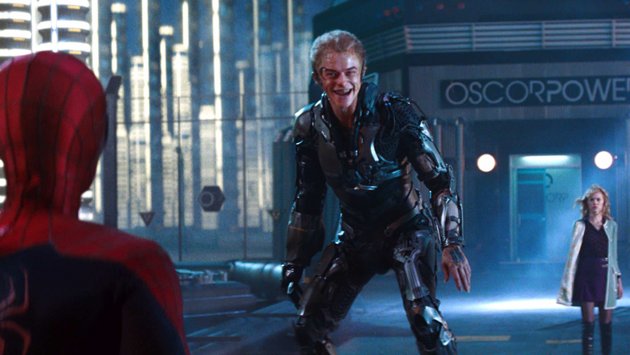
Did Sony learn nothing from the SPIDER-MAN 3 debacle? If your movie is starting to drag, chucking in another villain or two never helps. Electro is the main antagonist, but isn’t remotely interesting, and Warner Bros and/or Zack Snyder should definitely consider legal action against the blatant plagiarism of a scene where Electro reconstructs his body cell-by-cell in mid-air in exactly the same way, down to the shot’s framing, that Doctor Manhattan did in WATCHMEN. I found myself audibly sighing when Harry, as the latest incarnation of the Green Goblin (here with bad teeth and extreme green acne) turns up for a scrap once the story (such as it is) exhausts the limited potential of Electro. That’s not to mention Chris Cooper as daddy Osborn, whose one and only scene has him detail Harry in their family’s fascinating hereditary disease, and Paul Giamatti who gamely screams his head off in two scenes that bookend the film as a Russian thug who become the hulking Rhino. The film ends up having more endings than RETURN OF THE KING, and Marc Webb and his screenwriters are still laying groundwork for Sony’s foolhardy SINISTER SIX project rather than giving the current story on any real closure (beyond an event that anyone even remotely familiar with the comics knows is coming up).

I didn’t even like the way the film looked. You can see the mountain of money up on the screen, but everything is too clean, too glossy. There’s not a single rough edge or imperfection in anything – it looks more like a high-concept Sony product advertisement (which it is, in a sense) than a superhero blockbuster. This is pretty fitting with the company’s disgusting over-advertising of their latest cash cow. Anyone who has turned on the TV or visited Youtube over the last few months has seen a good chunk of the film already, and the whole campaign smacks of the financier’s lack of faith in the finished product.

I hated this film. The reboot from two years ago was flawed, but it didn’t offend me. It looked like there was potential for something a little different in the latest telling of Peter Parker’s story. The unresolved plot threads annoyed me, but now they’ve been more-or-less tied up, they really make me angry. The revelations are moronic and are neither worth the wait, nor do they justify the extent this deliberate withholding of information has gotten in the way of good storytelling. The whole enterprise is a glorified marketing exercise, which would have been fine if the final product was good or even decent. But with lurching plotting, embarrassing scripting, the waste of good acting talent and the torture of making us spend so much time with characters who are either irritating or dull, this superhero sequel is far from satisfactory. The Amazing Spider-Man 2 is a massive letdown, and it makes me dread what these particular holders of rights to Marvel characters have planned next. Come back disco dancing emo Toby Maguire, all is forgiven! SSP

Posted in Film, Film Review | Tagged , , , , , , , , , , , , , , , , , , , , , , , , | 12 Comments

Review: The Family (2013)

Image

I was hoping this might be Luc Besson back on form after years of mediocrity, but disappointingly THE FAMILY is mostly more of the same.

The Blakes aren’t like any other family. They spend their lives changing their name, moving on and starting again, all because their patriarch (Robert De Niro) is a known and ruthless mobster. When he upsets the wrong people, he and his loved ones are driven into hiding and a nomadic existence. Their latest destination is a sleepy village in northern France, where they must blend in fast to avoid detection by their deadly former associates.

De Niro is looking startlingly like Topol in his twilight years. He seems to be trying to meet his critics head-on by playing a parody of one of his go-to character archetypes. Michelle Pfeiffer seems stuck in a rut of playing eccentric, slightly past their prime matriarchs (see also: DARK SHADOWS), and it would be nice to see her given an opportunity to stretch herself again. John D’Leo is pretty funny as Warren, the world-weary son who has known all the tricks of the organised crime trade from an early age, and sees the wider world firmly in these terms, building his own little empire in his new school, plus he looks just like a diddy De Niro. Dianna Agron is a little one-note as the daughter Belle, but it’s a refreshing tweak to formula that she effectively functions as the family’s muscle. Tommy Lee Jones looks permanently disinterested in everything his character, an FBI agent assigned to watch over the family, says and does, and blatantly recycles Agent K’s mannerisms, but he’s easily the most entertaining presence in the film, snarling and wisecracking his way through every scene he’s in.

Everyone’s stereotyped to within an inch of their lives – the Americans are brash and unsophisticated, the French are rude, obnoxious and obsessed with women, the Italians miss Mama’s cooking and don’t like the French. Now obviously, Luc Besson is French, and De Niro is Italian-American, so they’re essentially “in on” these portrayals, and are being pretty good-natured about it, but what about their audience? I’m struggling to think of any positive portrayals of Frenchmen in a film Luc Besson has been involved in over the last decade, and there’s a point where good-humoured self-deprecation becomes plain old self-loathing.

I’m also not sure Besson quite grasps what black comedy is. Showing a plumber being beaten with a baseball bat doesn’t become funny because De Niro is deadpanning over it, or because a lot of people don’t like plumbers. Dark stuff can be funny, but there has to be heart to go with the humour to strike a chord, and The Family, for the most part, lacks this.

The film doesn’t do itself any favours belonging to a pretty short list of movies about mobsters in the witness protection programme. Obviously, the key example of this kind of film is GOODFELLAS, and who in their right mind would invite comparisons to that De Niro-starring Scorsese masterpiece? Luc Besson, that’s who! One scene actually has De Niro’s character watching the film with his eyes alight with excitement, following an introduction by an intellectual film society’s host (who conveniently glosses over who stars in it). Some were apparently pretty offended by this postmodern, intertextual joke, as if it somehow undermined Goodfellas, but I just see it as just another gag that wasn’t particularly well executed, and De Niro clearly didn’t have a problem being part of it (plus Scorsese executive produced), and it’s almost worth it to see Jones’s Stansfield squirming at what Blake might blurt out about the film’s “authenticity” following the screening. Besson also unwisely references his own masterpiece LEON, in an opening scene almost identical to his 90s crime-buddy-movie.

There are a few amusing moments, such as Warren’s rapid-fire deconstruction of school cliques, and the phone call where Belle is dumped by a tutor she is besotted with, while being listened to, and gossiped over by the family’s bodyguards. There are also some (probably) unintentionally funny points in the film, like a Mafia hit squad arriving in a small French town dressed exactly like a Mafia hit squad (with the addition of parkour founder David Belle who’s been drafted in seemingly just to do a single agile flip in the big action sequence at the end). De Niro can’t, and never has been able to do comedy, but he can say the F-word in a variety of ways to express many different things, as his children admiringly acknowledge. The children are also responsible for the film’s lone touching scene, but it can’t quite justify the rest of the movie being so emotionless.

The Family isn’t bad – Luc Besson has certainly been involved with worse films – but it’s a little underwhelming. It raises a few smiles, it’s pretty well filmed, and it’s worth watching for entertaining turns from Tommy Lee Jones and John D’Leo. But maybe Besson needs to learn to love his nation a little more, and give his scripts a few more passes before putting them before the camera. Also, perhaps De Niro and Pfeiffer need to sit down with their agents and work out when an audience is laughing at them, not with them, and even agree to start passing on the “easy” scripts altogether. SSP

Posted in Film, Film Review | Tagged , , , , , , , , , , , , , , , , | 2 Comments

Review: The Counsellor (2013)

the-counselor-javier-bardem-michael-fassbender

For confused British viewers (including myself), THE COUNSELLOR is about a lawyer, not a therapist. Ridley Scott’s latest brings together a seemingly talented bunch of actors, craftsmen (including DARK CITY’s cinematographer and GLADIATOR’s editor) and the legendary Cormac McCarthy writing his first original screenplay. The film then proceeds to waste them all.

The Counsellor follows a nameless lawyer (Michael Fassbender) who has gotten into unspecified trouble and now seeks to buy his way out by getting involved with a plot to steal a drug shipment from the Cartel on the request of Reiner (Javier Bardem) a playboy drug lord and his trophy girlfriend Malkina (Cameron Diaz). As he gets in too deep, he tries to maintain a relationship with Laura (Penélope Cruz) and keep the deal moving with experienced dealer Westray (Brad Pitt) as events rapidly spin out of control.

The film is not good. Rarely do you manage to assemble such an impressive dream-team and produce something so below par. There’s a giggle-inducingly juvenile sex scene resembling bad internet erotic fiction to open, and it doesn’t get any better later on as every other discussion of, or engagement with, subjects of sex is mishandled and unsexy. The already infamous scene of Cameron Diaz having sex with the windscreen of Javier Bardem’s car is described by the Spaniard to Fassbender’s Counsellor as “too gynaecological to be sexy”. It probably was, though we’ve obviously got to use our imaginations. It’s also needless spectacle, adding nothing to the plot beyond shock value, nothing to the characters beyond kinkiness, so in addition to the unavoidable depravity of the act, it’s also too pointless to be sexy.

You should be able to rely on McCarthy to deliver a decent script, but perhaps he should stick to writing novels. The film has such cringe-inducing lines as “the truth has no temperature” somehow delivered completely straight-faced by Diaz. An extended monologue about the flaws and therefore beauty of diamonds should be affecting, but it just comes across as pretentious and dull. The film also has continuous, wholly unnecessary eerie/ambient music used in every important dialogue scene that distracts. We know the characters are in a moral quandary, we don’t need another signpost for this!

The most engaging scene in the film involves the Counsellor actually doing his job of lawyering – he talks to his imprisoned client (Rosie Perez) about what to wear for her hearing and the kind of message about her character it will bring across (better she look like a “businesswoman” than a “school mom”). When the subject shifts to her son, who has also been arrested for speeding, the Counsellor amusingly quips when finding out just how fast he was going on his bike that “206 isn’t a speed, but someone’s weight or the time of day”.

We get a few disturbing images of extreme violence, particularly in two brutal death scenes, but apart from brief snippets of a montage set in a grimy backstreet garage with smoke billowing and sparks flying, you couldn’t guess that Scott directed this at all. He blends into the background, and you don’t hire Scott to blend, you hire him to pummel you with distinctive imagery, and it’s just not here.

I can’t be the only one to ask this, but why can’t Fassbender sort out his accent? He’s great at selling emotional turmoil, and is given further opportunity to do so as the Counsellor is physically, mentally and emotionally worn down, but he can’t seem to maintain his vocals consistently. It’s a recurring problem throughout his career so far, and really needs addressing unless he just wants to be remembered in the same breath as Sean Connery. Javier Bardem plays a hollow cartoon character, and Cameron Diaz’s Malkina – who with her veiled, complex motivations might have been the most interesting in the film – in her hands is vapid, nonthreatening and laughably wooden.

There’s a fundamental flaw with all the characters. Characters of course don’t have to be moral, or even likeable to tie a film together. What they can never be is boring, and every single one of the characters in The Counsellor is boring. They’re driven by lust and greed, but for no tangible reason. We know the Counsellor did something, and we’re meant to just accept that he’s in a bad enough place to think stealing Cartel shipments is worth the risk. Maybe this says something about human nature – some people are just born bad – but it just ends up feeling one-note and without colour. These characters want money, drugs, sex and power…because they do, and no-one changes or develops. There could have been some fascinating character deconstruction here, but no-one cared enough to try it.

Most of the film is bland and uninteresting. What little that isn’t is meaningless, tonally misjudged or just nauseating. The plot feels like it’s building up to something, then when everything finally goes to hell the whole affair becomes scrappy, scattergun and incomprehensible. If I didn’t already know the creative minds behind the film, I’d assume it was made by a first-time director and writer who happened to get really lucky in the casting stakes.

The Counsellor squanders an interesting premise and an interesting cast, ending up as an amateurish, sleazy and boring crime film. It’s one of the worst things Ridley Scott has made, and, putting a single memorable dialogue scene aside, a real blemish on Cormac McCarthy’s name as one of the great modern American writers. It just goes to show that you can be given all the best ingredients and still turn out something unpalatable. SSP

Posted in Film, Film Review | Tagged , , , , , , , , , , , , , , | 1 Comment

The Next Stage in Superhero Movie Evolution?

What’s being called the final trailer for X-MEN: DAYS OF FUTURE PAST made its debut online yesterday. From what we witness in just over 2 minutes, we’re in for something pretty darn spectacular.

Logan/Wolverine (Hugh Jackman) is our plot anchor once again, with his consciousness sent back in time to convince young Charles Xavier (James McAvoy) to unite a group of mutants to prevent a particularly dark future for them all. We get Wolverine trying to convince an incredulous Professor X that he’s not off his rocker, Quicksilver (Evan Peters) being all chippy and annoyingly hyperactive, before a glimpse of his daring mission to spring his long lost father Magneto (Michael Fassbender) from his cell below the Pentagon, then assorted mutant carnage and Mystique (Jennifer Lawrence) kicking all kinds of ass. There’s also a hint of an amusing reluctant buddy relationship between Logan and Hank/Beast (Nicholas Hoult) echoing their standoffishness in X-MEN: THE LAST STAND, complete with a killer line to end the trailer, and the small matter of Magneto lifting up an entire football stadium.

We see plenty, but Bryan Singer is by no means spoiling everything in the film, and we’ve still got some surprises in store I’m sure. We’ve still only had the briefest peeks at the big bads of the movie, Bolivar Trask (Peter Dinklage) and his army of mutant-seeking killer robots the Sentinels. We still don’t know exactly what Mystique is up to in Washington, though it’ll doubtless involve her dealing out punishment to anyone who’s against her being “mutant and proud”. We still don’t know how past Professor X is walking again, or how future Professor X is not dead again. We still don’t know how past Beast shed his blue feline appearance, regained his human form, before apparently turning into the Beast we saw in Last Stand. Speaking of Last Stand, we don’t know how much, if any of it, Singer has retconned.

Days of Future Past looks to be living up to its name as the biggest movie Fox has ever made after AVATAR, and I’ve got my fingers firmly crossed that Singer manages to deliver something as well-balanced and awesome as he did the last time he directed mutants 12 years ago. There’s a hell of a lot of plot, characters, effects and dues to be paid to the series so far, so it’ll be no mean feat. It should be a celebration of what has come before, tying together as it does the two X-Men series (and completing the journeys of the older cast) but it also needs to work on its own terms. I’m excited, but I’m terrified as well. Out of the big superhero movies coming this year, this is the one I really want to work, because I adore the X-Men. CAPTAIN AMERICA: THE WINTER SOLDIER didn’t excite me. I couldn’t care less about THE AMAZING SPIDER-MAN 2. GUARDIANS OF THE GALAXY could go either way. I just hope it was because Bryan Singer had his mind firmly fixed on this project that JACK THE GIANT SLAYER sucked so much. SSP

Posted in Film, Film Comment | Tagged , , , , , , , , , , , , , , , , , | Leave a comment

Review: Frozen (2013)

Frozen-image-frozen-36270022-1920-800

The first half of FROZEN is pretty near perfect. It’s dark, soulful and bold, some of the best work Disney has ever produced. The film becomes more conventional as it goes on, but you can quite easily forgive any film that looks and sounds this beautiful.

A loose adaptation of Hans Christian Andersen’s The Snow Queen, Frozen follows two princesses whose happy childhood is brought to an abrupt end as the elder sister Elsa (Indina Menzel) manifests the extraordinary and deadly ability to conjure and control ice. She is shut away by her parents for the protection of herself, her subjects, and especially her carefree sister Anna (Kristen Bell) after a tragic accident caused by Elsa’s power. Elsa lives in isolation for years, much to the dismay of her sister, until one day she comes of age and inherits the throne, and hiding from the world is no longer an option.

In the hands of Kristen Bell and Idina Menzel, Anna and Elsa make for a captivating pair of leads, and their strained relationship is always the dramatic centre of the film. You see their love, fondness and unshakable friendship as the princesses play as children, then they are heartbreakingly torn apart for their own good. As Anna grows up she’s clumsy, energetic and awkward, but also cheerful and naively optimistic about her future. Elsa is the very picture of pained control on her coronation day, and during her long isolation has become insular and paranoid about the world, her powers and what will happen if they ever collide. Of course the inevitable happens and Elsa is outed in front of her subjects, and flees leaving an all-consuming winter in her wake. At this point, Menzel comes into her own as Elsa is finally allowed to be everything she can be, unleashing the full beautiful destructive power of her gift. Bell makes the perfect slightly ditzy innocent governed by her heart, and Menzel skillfully juggles the fear, the passion, the repression and the final glorious liberation of Elsa. You’re never left in doubt for a moment that, despite being animated, these are two real people, and you care about them and what they’re going through.

I wasn’t expecting there to be a horror genre influence in the latest Disney feature, but there certainly seems to be. I don’t know whether that was the filmmakers’ intention, but there’s definately something of the Universal Horror films about Frozen, with the persecution of an innocent monster by a angry mob of “Never-Europe” townspeople. That, and the fact that as her powers emerge as she becomes an adult, Elsa’s struggle is basically a frosty iteration of CARRIE (and that’s not a criticism).

You get some light-hearted elements as well, after all, what would a Disney movie be without cute sidekicks? You get two in Frozen, in the form of Olaf the daydreaming, good-natured snowman (Josh Gad) and Sven the dog-like reindeer who’s best friends with the main male protagonist Kristoff (Jonathan Groff). I don’t know what it is about modern Disney films and the presence of animals who aren’t dogs acting like dogs (also see: Maximus the horse in TANGLED). It’s certainly a weird idea, though it’s by no means unappealing convention.

Though a Disney film based on The Snow Queen has been on the cards for a while, it would have been impossible to realise even five years ago – that’s how much digital animation has advanced in a relatively short space of time. Much was made of the realistic movement given to hair and fabrics, and the sophistication of characters’ lip movements in Tangled (supposedly the first time you could conceivably lip-read an animated character was Rapunzel). Frozen improves on these groundbreaking effects further and has the added challenge of creating realistic snow and ice. Winter weather is difficult to execute in the virtual world, something so seemingly simple is deceptively complex in how it falls and how it can be manipulated by someone moving through it or if one of your main characters happens to be able to control it at will. The execution of the cold stuff is flawless and achingly beautiful, the current high-point of environment animation.

Apart from the annoying song sung by trolls, Frozen is probably the best outright musical Disney have produced since THE LION KING. The Oscar-winning “Let it Go” is stirring and powerful, the peak of the emotional crescendo that is Elsa’s character arc of liberation. The fragile, tender “Do You Want to Build a Snowman?” sung by Anna is really quite touching. I also loved the LES MIS-esque booming opening number “Frozen Heart” sung by ice cutters working the glacier, I just wish it went on a little longer, as it seems to end a little abruptly.

Again bringing up the trolls, which effectively function as this world’s bridge between fantasy and reality (as well as providing exposition and plot convenience) – they just don’t work. Not at all. They look, feel and sound like they’re in a completely different film, and their matchmaking song “Fixer Upper” is just awful. I have a few other gripes with the film, for instance Kristoff is a little bit too much like Tangled’s Flynn Ryder, except he’s obsessed with ice rather than money. There’s a late plot twist that is somewhat underwhelming too, and the film lacks a strong villain, though it doesn’t really need one with Elsa essentially functioning as the dual lead protagonist and antagonist.

Despite a few missteps and a retreat into convention after a brave first act, Frozen delivers great music, loads of heart and visual splendor. It’s certainly the best-looking digital animated feature Disney has made, and it has songs and vocal performances to match the studio’s highest points of the 1940s and early 1990s. What it also has is intelligence and maturity, and the two most complex, rounded and compelling female protagonists to feature in an animated Disney film. The days of the one-note Disney Princess are long gone, and they’ll hopefully stay that way if Disney keep working with such talented and perceptive filmmakers as Jennifer Lee and Chris Buck. SSP

Posted in Film, Film Review | Tagged , , , , , , , , , , , , , , , , , , , | Leave a comment

Review: Noah (2014)

actor-russell-crow-stars-as-the-title-character-in-the-film-noah-slated-for-a-march-28-2014-release

NOAH may well be the worst film Darren Aronofsky has ever made. But being the remarkable auteur that Darren Aronofsky is, being the worst film he’s made isn’t exactly an insult. Noah is dense, layered and beautiful – in short, classic Aronofky. It is flawed, but always interesting, and I’ll always take a flawed but interesting film over a more solid and dull one.

A modern take on arguably the most famous story in the Old Testament, we follow Noah (Russell Crowe) as he makes extensive preparations and uncompromising sacrifices after receiving a vision from the Creator of the imminent cleansing of the world of mankind’s sins in a great flood. As the last in the line of Seth, Noah and his family live in harmony with the world around them, and build a great Ark to save two of every animal for a new beginning. In contrast, the descendants of Cain and their savage ruler Tubal-cain (Ray Winstone) drain the world of vitality, wastefully mining its resources and slaughtering man and beast alike to increase their strength. As the world’s protectors and destroyers inevitably come into conflict, the almighty deluge begins…

Personally, I don’t understand the controversy, but then again, I’m not the least bit religious. The film has miracles, divine intervention, it’s got moralising and Biblical quotation. What’s there for Christians to disapprove of? If it’s just that this isn’t the wipe-clean Sunday School vision of Noah’s Ark, then that seems more than a little petty.

The film has a clunky beginning, with an annoying and unnecessary Bible lesson to bring the audience up to speed. Surely you can give the audience credit to work out for themselves which characters have descended from sinners and which haven’t (hint: it’s the ones with the pointy sticks and bad teeth). Besides, you get Noah recounting the story of Genesis to calm his frightened family later in the film (repeating much of this exposition in the process). Thankfully, the film gets a lot better. There’s a long buildup, but once the spectacular flood finally hits, then you get the unusual but compelling combination of the emotional human drama of a disaster movie and the intense theological debate of a particularly thought-provoking religious studies seminar. As Noah becomes more zealous, and his decisions more monstrous, his family’s unconditional love for, and faith in him rapidly erodes, leaving only resentment, hatred and fear. The  further the story plunges into high melodrama, the better the film becomes.

The casting is pretty good across the board. No-one else manages to look as simultaneously remorseful and angry as Mr. Historical Epic Russell Crowe, and he sells the physical and moral weight of Noah’s mission, and leaves it pretty open to whether Noah just loses it later on as he makes more and more questionable decisions, or whether he was always a madman obsessed with his unflinching religious belief. It’s good to see Jennifer Connelly back with Aronofsky again, and playing Noah’s wife Naameh, she is quietly dignified for most of the runtime, before giving one of the great emotional outbursts in the film’s final act. Emma Watson and Logan Lerman continue to grow in ability and range as Noah’s daughter-in-law and middle son respectively. Who else would but Anthony Hopkins would have the gravitas and screen presence to play the oldest and wisest man in the Old Testament, Methuselah? Hopkins even manages to inject a little mischievous humour into proceedings with his performance. Ray Winstone doesn’t have to try particularly hard, growling and shouting his most abrasive Cockney through a massive beard, but in a sense it doesn’t matter when he’s only a secondary antagonist to the hostile weather.

Aronofsky is noted for his obsession with the look of his films, and with playing with his audience’s perceptions. There’s classic Aronofsky fever dream hallucinations in Noah, particularly striking being a creation sequence presented as the most vivid and sumptuous high-speed photo montage. It really wouldn’t look out of place playing in a gallery with other arty stills hanging on the wall around it. Despite Aronofsky’s visual drive, the CGI behind a lot of the animals is a bit…off. It doesn’t help that most of them have been tweaked to look a little less evolved, and I’ve no idea why there’s a dog with armadillo scales running around at the beginning, I mean, what in the name of all that’s holy was that? Again, you don’t really mind the effects that don’t quite work when the aesthetic is so striking and memorable elsewhere, notably the rapid-fire creation scene, the great flood itself and the haunting image of the remnants of humanity clinging desperately to a shard of rock in the tempest, all the while Noah refuses to save them and risk the ruination of the world’s new beginning.

It is admittedly pretty hard to keep a straight face at how seriously some of the film is played, particularly when a pair of doves carrying olive branches turn up. It’s admirable that Aronofsky and his cast resist sideways glances at the viewer, that they’re completely committed to telling the story they’re telling as a heady, sombre and imposing fantasy epic. And a fantasy epic it well and truly is, because the characters dress like apocalypse survivors from another dimension, and the technology level of early man veers wildly throughout the film. Whenever you can’t really justify stuff like this, you might as well point to divine intervention, or just good old fashioned magic.

Stories in the Bible have always been ripe for adaptation into spectacular cinematic fare. We haven’t had a Biblical epic trend in Hollywood for a long time, perhaps due to some people’s discomfort with explicit religious imagery turning up in their entertainment. With Noah, and a valiant attempt to balance blockbuster spectacle with more arthouse, intellectual fare, we could very well see more Bible stories making an appearance in multiplexes over the next few years. As the first film that might start such a trend, it doesn’t deliver on all levels, but it certainly gives you plenty of talking points. Like all of Darren Aronofsky’s films it’s stunning to look at, thematically layered, and narratively speaking, more than a little weird. I can’t say I agreed with every stylistic decision made in the film, and not everything is executed as well as it could have been, but there’s certainly much to debate, and a lot to savor on repeat viewings. SSP

Posted in Film, Film Review | Tagged , , , , , , , , , , , | Leave a comment