Review: Not Another Happy Ending (2013)

karen-gillan-not-another-happy-ending-movie-photos-2014-_24

On the surface, NOT ANOTHER HAPPY ENDING has the makings of the kind of film I tend to love. A British (specifically, it’s shot and set in Glasgow) dramedy with quirky characters in crisis with an indie soundtrack. But from the off, it’s trying far too hard, and just doesn’t deliver.

Jane Lockhart (Karen Gillan) is a novelist waiting anxiously for her big break. After years of trying and an entire fridge door covered with rejection letters, a similarly struggling publisher Tom Duval (Stanley Weber) sees that she has potential, and secures the release of her debut book, a semi-autobiographical weepie about a difficult father-daughter relationship. Happy Ending, as it is titled (much to Jane’s chagrin), is a smash hit, and makes Jane a household name overnight. Jane’s life is finally on track, and she is overjoyed. Tom wants to get another novel out of her as soon as possible, but Jane becomes overwhelmed and develops writer’s block, and Tom decides he must make her miserable to get her creative juices flowing again.

Gillan’s protagonist Jane dresses exactly like Diane Keaton in ANNIE HALL, unwisely inviting comparisons to a far superior film about middle-class, city-dwelling intelligentsia. Stanley Weber playing Tom is seemingly unable to emote, except for a scene late on in the film where he has a brush with hypothermia, so we know he can act cold at least. He also has a very irritating, inconsistent accent that comes from a late re-write to explain his French origins – why couldn’t he just act French, rather than trying to be French-Scottish? Gillan has zero chemistry with Weber, which is fatal for what is supposed to be a love story, especially one that suggests it is her infatuation with this man that is causing her exasperating writer’s block.

Several important moments in the story are rushed through like a soap opera highlights package. Jane’s reconnection with her estranged dad (Gary Lewis), and her relationship with Tom that grows out of them talking through, editing and streamlining her writing, could both have used more screen-time, but mostly we’re just asked to fill in what is said for ourselves while we watch a dull montage with the dialogue level dipped and some pop music playing over the top. I understand doing this if you’re struggling for time, or if you know the characters well enough to be able to have an educated guess about what they’re saying, but here it just smacks of the writer David Solomons not wanting to put the effort in to write the dialogue for these scenes. Why should we care about these characters’ relationship with each other if the filmmakers can’t be bothered to dedicate the appropriate time and focus to explore them?

What Solomons has put in the effort to write is scene after scene of pointless things for Jane to do just because they’re a bit kooky (shoving her phone in the fridge when the conversation doesn’t go her way, writing naked because it’s meant to be creatively liberating).

The story gets slightly more interesting when one of Jane’s literary creations (Amy Manson) materialises and starts mocking her creative drought, and though Darsie as a character is sardonically funny, and it allows the film to indulge in that old awkward comedy standby of “main character who looks to others like she’s talking to herself”, these scenes are too scarce to elevate the rest of the film.

The love story we are presented with beggars belief. It’s wrong on so many levels, but we’re meant to be swept up by it, to root for Jane to get together in the end with Tom. Tom’s main drive for much of the film involves him deliberately trying to ruin Jane’s life in order to reignite her creative spark, so she can fulfil her two book contractual obligation. And we’re meant to want this guy to end up with Jane. Really? At least Tom’s teacher friend/co-conspirator (Iain De Caestecker) has the sense to point out how morally horrible this behavior is. Jane also considers marrying the other guy in her life, a self-obsessed screenwriter (Henry Ian Cusick) who she shares her flat with, and who is scarcely any more appealing a charter than Tom. It’s not like in BRIDGET JONES’S DIARY where the girl could conceivably end up with either guy (even Hugh Grant, who played a bit of a berk) – here both potential partners are irredeemable, terrible human beings, yet Jane is infuriatingly easily taken in by them. The fact that Jane still has feelings for Tom even after what he has been doing to her is revealed just serves to undermine her as a character and makes me think Gillan needs to choose her scripts a bit more carefully.

The main thrust of the film, other than the love story that doesn’t really work, is built around two of the oldest clichés about creative endeavors – “The Difficult Second Album” and that true creativity is impossible to achieve while you’re happy. Surely we’re past talking about either of these misleading, untrue concepts? The only even remotely profound thing the film has to say comes right at the end, when Jane tells Tom “You don’t write because you’re miserable, you write because you have to…because if you don’t you might as well be dead” and this sort-of rings true to me, because I’m not above getting a little melodramatic when writing.

Not Another Happy Ending just doesn’t work, not as a story, not as a film. The drama and relationships aren’t given enough time to make a mark, the soundtrack and editing decisions are too showy, distracting and pointless, and the characters are one-note and their decisions don’t make any sense. I might not care so much if it had something worthwhile to say about life as a writer, or having a parent-level protectiveness of your intellectual property, or even if the film was funny, but it isn’t. Writer David Solomons shows next-to-no wit here, and though director John McKay makes sure everything is in focus, and occasionally frames shots pretty well, he doesn’t seem to be able to elevate the sub-par material by engaging effectively with his actors. It’s just a frustrating thing to watch. SSP
 

Posted in Film, Film Review | Tagged , , , , , , , , , , , , , , , , | Leave a comment

Review: How to Train Your Dragon 2 (2014)

dragon2

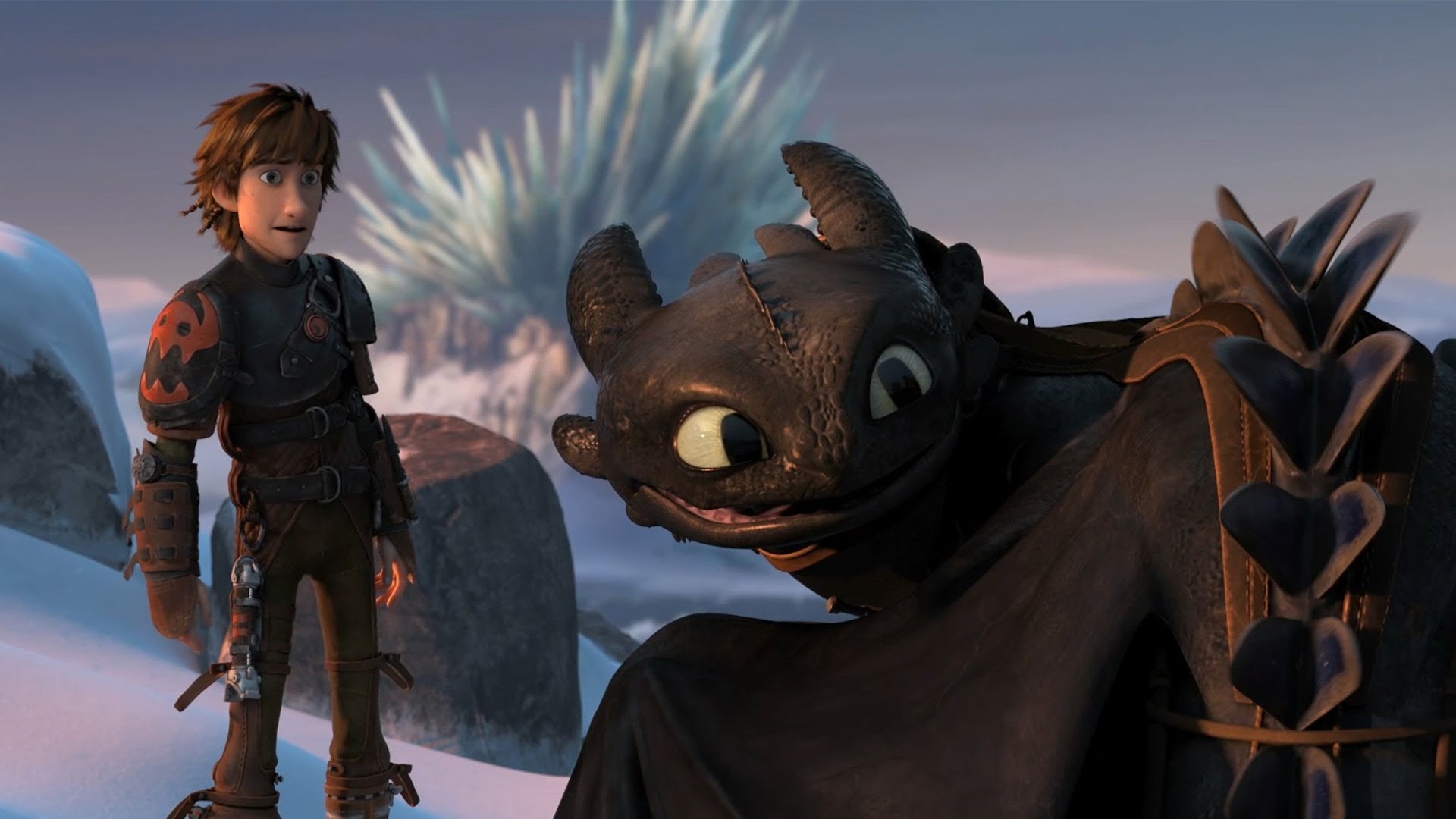
HOW TO TRAIN YOUR DRAGON 2 comes agonisingly close to bettering its predecessor. It’s not quite the pitch-perfect intimate adventure the first film was, but there’s still humanity here (not to mention dragonity) as this world of Vikings and flying reptiles is expanded upon in satisfying ways, and spectacle piled on in bucket-loads.

Five years after he met Toothless and united the village of Berk and dragonkind, Hiccup (Jay Baruchel) has turned full-time explorer, flying with his scaly kindred spirit to chart the numerous islands of the archipelago around his home and discovering new species of dragon, all the while denying his place as the next leader of his tribe after his father Stoick (Gerard Butler). His expedition leads him to reconnect with his long-lost mother Valka (Cate Blanchett)  and make the horrifying discovery of an army of dragon slavers lead by the formidable and quite mad tyrant Drago Bludvist (Djimon Hounsou) whose desire for dominance over all threatens Berk’s hard-earned peace.

In terms of the emotional journey you’re taken on, rarely has a cinematic story taken you from joy to despair and back again so fluidly. The first act is a zippy romp ending in the revelation that Hiccup’s mother is alive, well, and very like him. Then this safe, stable bubble of happiness is obliterated and we have to question everything that has come before. By the end, equilibrium is restored, though we suspect this world will never be the same again. This range of human feeling is communicated exquisitely by a cast (notably Baruchel and Blanchett) who prove that you can indeed do subtlety in voice-only performances.

The film is full of unique, original and beautiful imagery. It’s staggering how far the quality of animation has come in four years – hair, scales, elemental effects have never looked this good created in a virtual environment. There’s just so much that I’ve never seen before. Yes, there’s references to everything from SUPERMAN (Valka’s Fortress of Solitude-esque ice lair) to STAR WARS (Hiccup’s lightsaber-y flaming retractable sword) and GODZILLA (a moment with Toothless in the finale that I won’t spoil) but the vast majority of what we see is pleasingly new. I’ve never seen a giant aquatic dragon burst from the depths and expel a shower of fish to feed his fellows as they circle around him. I’ve never seen a figure dancing across the backs of a flock (if that’s the right collective) of dragons in flight. I’ve never seen a male animated character (a hunk voiced by Kit Harington) objectified to great comic effect.

One of the most entertaining ideas the film has, in fact it’s a stroke of genius, is presenting pretty much every character’s dialogue scene in deep focus so we can still see what the dragons are doing in the background, and we consequently never lose track of the personalities of the characters who can only communicate through body language. It might be Hiccup and his girlfriend Astrid (America Ferrera) talking about their relationship, but we can still see Toothless and Stormfly playing behind them. Hiccup might be having a tender moment with his mother Valka, but we can still see a display of dominance between Toothless and Cloudjumper behind them.

The action is ambitious and creative, optimised by elegant, sweeping cinematography. From the amusing and light-hearted opening dragon race, to Hiccup’s emotion-fuelled first flight through the clouds alongside his mother as they catch up on lost time, to the full-on LORD OF THE RINGS-scale battle in the final act, all tastes are catered for.

John Powell’s music is as gorgeous as it was last time, and there is even a song-and-dance musical number as a key character moment. His celtic-folk-tinged score underlines and emphasises the most important emotional beats, and ties the whole thing together wonderfully.

It’s a film full of thematic subtleties. They really missed a trick in not calling it How to Earn Your Dragon, because that’s what the film’s ultimately about, the difference between the two. Hiccup is a born leader, though he doesn’t know it yet, and his destiny has been tied to that of the dragons far longer than he could have imagined. Director Dean DeBlois has a real thing for missing limbs as symbolism, as key moments that make the characters who they are, and to create telling parallels between them.

All the returning characters have moved on, as well as physically aging (almost unheard of in animation) they are challenged and progress on fascinating lines. While we might not have equivalent heart-melting moments to the first film, the hurt the film does make you feel is a different kind of hurt, an adult realisation that we can befriend and treat wild animals well, but in the end they are still wild animals who could revert to instinct at any moment.

The main antagonist Drago is admittedly a little flat. Despite the best efforts of an almost unrecognisable Djimon Hounsou and a terrifying shout he vocalises to control his dragons, you feel like there might have been more to his character in an earlier draft of the script. It makes sense to make the bad guys are dragon dominators to contrast them with the citizens of Berk who have just learned to live in harmony with them, but they’re not particularly interesting. Even after a late in the film reveal that should really be a bigger moment, Drago still just feels like a cut-and-paste late-90s Disney villain. There’s a point when Hiccup asks incredulously what Drago’s end-game is – “to rule the world?” and the answer is basically yes.

Luckily, the main threat of the film comes not from one madman and his army, but from the emotional turmoil of depriving the citizens of Berk of their rewarding relationship with their dragons.  It’s telling that Hiccup’s big inspiring speech is not about the citizens of Berk saving their own lives, but about the importance of fighting back because “Drago is coming for our dragons”. The real enemy in the film is subjugation and hatred, not Drago himself. It’s a big idea to build a family animated fantasy-adventure sequel around, not to mention the commentary on mankind’s fragile balancing act with nature. Thankfully, all this heavy stuff is counter-weighted by glittering visuals, winning vocal performances and the development of characters who, though animated, you care deeply about like they’re flesh and blood. SSP


Posted in Film, Film Review | Tagged , , , , , , , , , , , , , , , , , | 5 Comments

A Few Thoughts More: Her (2013)

her

Spike Jonze’s HER was the cinematic high-point of 2013 for me, though I didn’t actually get to see it until the beginning of this year. I still stand by what I said in my original review, which you can find here, but I’ve had a few more thoughts since then.

I’m overjoyed that Her holds up to a re-watch, and I actually found myself getting more out of it, noticing subtleties for the first time, and found it an even deeper, richer viewing experience overall the second time round.

Joaquin Phoenix is having a phenomenal few years. I didn’t particularly enjoy THE MASTER, but I can’t deny Phoenix was a force of nature in it. His performance as Theodore Twombly couldn’t be more different, but it’s just as complex and layered. As the human face of the film (since, ya’know, the other main character doesn’t have a face), and as good as Johansson and Adams are, it is Phoenix for the most part who is responsible for  conveying the story’s humanity, making a genuine connection with us. As he gradually strips back the layers of vulnerable, endearing, but not always wholly likable character, he reveals us all for what we are, flaws and all, before promising us a brighter future when Theodore makes it through the other side of his relationship rut. Few might consider Phoenix, known for playing intense weirdos, as a romantic lead, but I’m so grateful Jonze saw something there, because his low-key sensitivity and unexpected grasp of awkward comedy (particularly in the cringe-inducing and odd sex scenes) is a winner.

I never really picked up before the interesting things the film does with sound. Most narrative films feature an original music score or a selection of pre-existing popular music to heighten the emotions of a given scene. Her is no different, with Arcade Fire and Karen O contributing compositions, but much of the music is experienced by the characters as diegetic sound since the world presented in the film has everyone constantly connected by an earpiece. No-one is left alone with their thoughts in Jonze’s future, and Theodore walks around future LA with a constant soundtrack in his head, whether he’s listening to music (“Play melancholy song”… “Play different melancholy song”), talking to Samantha or talking to her about the music she has just composed for him. Sound is such a crucial part of the emotional development of the characters, and tellingly Theodore’s good times with Samantha come with music and laughter, and his haunting flashbacks of his previous relationship are accompanied by an eerie silence.  The last thing we hear in the film, referring back to an argument about necessary and unnecessary breathing, poignantly, is a single breath.

In a film full of great ideas, one of the best is Jonze’s old-meets-new future aesthetic. In a world that relies almost completely on integrated technology day-to-day, it makes sense that people would still want to hang on to something tangible. Everyone dresses their apartments and themselves like it’s the 1950s, computer monitors are encased in varnished wood, books have become prized and rare luxuries, and people still want to receive hand-written letters despite paying someone else to write them.

While the most heart-rending punch comes a couple of scenes earlier, it’s entirely thematically appropriate that the highest point of the emotional crescendo that is Her’s finale, comes from Theodore finally composing a letter from himself to one he loves. He is finally a whole person, able to express his soul to someone with a physical presence all thanks to a life-changing experience with someone existing without one. SSP


Posted in Film, Film Review | Tagged , , , , , , , , , , , | Leave a comment

Review: Carrie (2013)

carrie_2013_endgame

From the start I’d like to say that I do like Brian De Palma’s 1976 adaptation of Stephen King’s CARRIE. I don’t see it as a classic of the horror genre by any means, but it’s mostly solid stuff, and was given a real boost by De Palma’s distinctive aesthetic and Piper Laurie’s terrifying turn as Carrie’s mother. I’d heard mixed things about Kimberly Pierce’s remake, yet another film that claims to be returning to the source material but that still ends up making reference to the earlier cinematic adaptation (see also: TOTAL RECALL).  All-in-all, I thought Pierce’s Carrie was pretty decent, at least as good as De Palma’s and with a different enough take on the story that comes from having a female director at the helm of a film about being a woman.

The book, and both films, follow Carrie White (here played by Chloë Grace Moretz), an introverted teenage girl raised by a fanatically religious mother (Julianne Moore). Carrie becomes terrified by the simultaneous onset of her first period, and the discovery that she can summon destructive telekinetic powers in moments of emotional upset. After being cruelly mocked by her classmates for her ignorance about the way a woman’s body works, she is rescued by her kindly PE teacher (Judy Greer) who makes sure the lead bully (Portia Doubleday) is excluded and banned from attending the highschool prom. As her tormentors plot humiliating revenge against Carrie, she researches and learns to control her powers, and only needs someone to push her too far again to unleash hell.

The kick-off point for the plot of both films, the now infamous shower scene is executed much more tastefully and sensitively by Pierce. As well as the shock factor, it works much better as a dramatic moment here as Moretz really sells Carrie’s horror and confusion. De Palma’s version always felt too seedy, and he seemed to be enjoying spending time in the steamy girls’ locker room a little too much. This scene is followed by an amusingly awkward conversation in the office of Carrie’s principal (Barry Shabaka Henley) who is desperately trying to avoid talking about the intimacies of the female anatomy with Ms. Desjardin, who has just come to Carrie’s rescue. He clearly just wants to get them out of his office as soon as possible and not have to deal with, or understand the situation, a reaction many men would have if the subject came up in conversation. 

It must have taken a great act of willpower for Chloë Grace Moretz to bury her natural charisma so deep inside to play Carrie White, contorting herself into an awkward stance and a nervous vocal performance without ever quite becoming a caricature. Sissy Spacek naturally felt like the out-of-place individual that Carrie is meant to be, but Moretz’s performance is arguably more impressive simply by the virtue of being so different to everything she has done before.

Julianne Moore makes for a far more sympathetic Margaret White. Whereas Piper Laurie in De Palma’s film was an irredeemable almost cartoonish monster, Moore’s character is a worn-down shell of a woman. Her religious zeal drives her to do horrible things, but her pathetic, fragile nature held together only by self-harm and unshakable piety never allows us to not pity her. Carrie could conceivably be considered more the antagonist in this version of the story, even when Moore’s version of her mother (perhaps inevitably) dons Piper Laurie’s nightdress and proffers a kitchen knife in an creepily familiar way whilst booming out scripture.  Carrie seems to get a handle on her powers much earlier on in this film, perhaps even to the extent that she could be accused of premeditating her vengeance rather than just becoming thrall to her powers. It’s still a horror about the paranoia of monstrous femininity, but Pierce, who clearly has more of an insight on the subject than De Palma or even King, suggests that if such a gift/curse of a power did manifest in a teenage girl, she might just have some fun with the utter chaos she could cause. I mean, just look at Moretz’s expression as she waves her hands around like a teen Jean Grey to psi-murder her classmates – if that’s not ecstasy brought about by horrible death, then I don’t know what is!

I didn’t really like what the film did with Carrie’s bullies. They weren’t the most memorable characters in De Palma’s film, but at least they were consistent. Here, though Chris is irredeemably nasty throughout, and she and her boyfriend Billy (Alex Russell) take far too much pleasure in slaughtering a pig one moment, then they get cold feet about their evil masterplan the next. I’m not exaggerating when I say that in a single scene they both flee the scene of their crime in Billy’s car, in a panic about what punishment they will be subject to if they’re caught, then not 30 seconds later, Carrie appears and Chris orders Billy to run her down.

It is perhaps inevitable that a remake relies more heavily on spectacle, and Pierce certainly makes the most of advances in visual effects in depicting Carrie’s terrible power. Still, the final act doesn’t quite fit comfortably with how restrained the rest of the film is. It’s an extravagant action sequence complete with buildings collapsing, gruesome deaths and explosions, one of which, Carrie almost walks away from in slow-motion. It certainly isn’t dull though, and apparently it depicts more closely what occurs in King’s novel, ideas that were discarded in De Palma’s version for budgetary reasons. The more sophisticated effects allow for moments of quiet, eerie beauty as well as action, such as when Carrie smashes a mirror in a bathroom at school and makes the shards float to reflect a distortion of her smiling face back at her. But the slo-mo is overused by Pierce and is unintentionally funny when combined with a game show “action-replay” effect used in the most iconic scene in the story.

I guess the main thing that Pierce’s Carrie is missing, crucially for a horror film, is any real scares. King is a master of delivering abject horror on the page, and De Palma and Spacek made “Creepy Carrie” live up to her name, and had Piper Laurie on hand to provide the genuine fear factor. I can’t really fault Pierce, Moretz and Moore taking the characters in a new direction and updating the story for today’s audiences, but if a horror film isn’t scary, no matter how well filmed and performed it is, then it has unavoidably failed in what it set out to do. SSP

Posted in Film, Film Review | Tagged , , , , , , , , , , , , , , , | Leave a comment

Review: Out of the Furnace (2013)

04-out-of-the-furnace

OUT OF THE FURNACE is one of those movies I’ve been highly anticipating since the first trailer was released. It looked like a gritty, powerful social drama with an impressive cast and a decent director (Scott Cooper of CRAZY HEART), and now I’ve finally seen it, I’m happy to say it does, for the most part, meet my expectations.

We follow Russell Baze (Christian Bale), a modest steelworker with family problems. Though he’s got a steady (if hazardous and underpaid) job and is in a happy relationship with Lena (Zoe Saldana), his father (Bingo O’Malley) is terminally ill and his younger brother Rodney (Casey Affleck) is getting into debt with underworld types as he refuses to throw the fixed underground bare-knuckle fights he has turned to in order to give his life a purpose since returning from Iraq. A tragic accident puts Russell, the one stable element in the Baze family, behind bars, during which time Lena moves on, his father dies and Rodney in put in peril by an encounter with a crime lord (Woody Harrelson) who doesn’t take kindly to anyone standing up to him.

Nobody plays rough working-class Americans like Bale, which is odd because he isn’t working-class or American. Casey Affleck isn’t the first name that comes to mind to play an unstable young soldier, but he gives his all, and his outburst in response to Bale’s accusation that he should be making more of his life certainly stands out. Sam Shepherd does what he’s good at as Russell’s tough uncle – standing in the back of shot and looking dependable. You can tell Harrelson is playing a mean mother because he’s got bad teeth and is drinking something stronger in every subsequent scene (first it’s whiskey, then vodka, then something clear from a jam jar), and he’s terrifying every time he’s on screen. Sadly, Zoe Saldana and Forest Whitaker are under-served, with the former just giving Russell something to pine over when he first gets out of prison, and the latter, playing police chief Wesley, just acts as a good angel to sit on Russell’s shoulder in the second half of the film. I get why the filmmakers cast Willem Dafoe as a mid-level mobster who looks out for the Baze family, but then they dress him like the owner of a back-alley 70s adult store and he just looks laughable compared to Harrelson’s snarling, bear-like Harlan.

It’s a film of great contrasts. We see Rodney in a violent brawl juxtaposed with Russell scraping flaking paint and sealing leaky windows. Russell is always the stable brother, arguably with just as many issues, with the same amount of mistakes behind him as Rodney, but he just deals with it better. He sets himself tasks, gives himself something to aim for, whether it’s making the house more livable or trying to get his ex-wife back, whereas Rodney only knows how to relieve his tortured soul through rage, through violence.

The dialogue is realistic, naturally delivered, and fuelled by white-hot emotion. Pretty much everyone has a scene to cement who their characters are and what personal issues they are struggling to overcome. Bale as Russell says far more in his intense focus on the task at hand – whether it is doing the washing up or hunting down a monster who has wronged his family – than he does with dialogue. Harrelson as the brutal Harlan DeGroat (great criminal name) grinds his teeth and mumbles his threats near-constantly, so you rarely catch exactly what he is saying, just that it wasn’t anything nice.

Cooper and his cinematographer Masanobu Takayanagi (THE GREY) pack every beautiful-depressing shot full of symbolism to decode. At about the film’s halfway point, Russell returns to the scene of a tragedy that changed his life for ever, just as his brother’s life is taking a turn for the worse. Russell stands in the dead-centre of a wide shot, isolated and alone, between a crossroads representing the difficult choice he is about to make.

For some, the plot might feel a little slapdash, loose and lacking clear drive for supporting characters, but I appreciated the openness of it, the way Scott Cooper leaves a lot up for interpretation. Several key events happen off-screen, and you only see the consequences of things happening in the reactions of the central characters. Cooper seems to put a great deal of trust in his audience filling in the blanks for themselves, which is something you see depressingly rarely these days.

The point where Cooper tightens the reigns is the film’s final act, which is straight out of GET CARTER, being as it is a deadly and intense foot-chase across a desolate industrial setting. You’re still allowed to make your own judgement about what exactly happened, but I’d have still cut to black earlier in the sequence for an even more open-ended conclusion, but that’s just me.

Out of the Furnace cements Scott Cooper’s place as a perceptive writer-director of drama who gets the very best out of his actors. The sturdy performances, emotional weight behind the story, the relevance of the themes to a contemporary audience, as well as the striking visuals smooth over any rough edges the film has (for instance, some under-characterisation). It’s certainly a film that should hold up to a re-watch, and one which refreshingly gives its audience enough credit to work things out for themselves. SSP

Posted in Film, Film Review | Tagged , , , , , , , , , , , , , , , , , | 2 Comments

The Work of Rich Kelly

This gallery contains 13 photos.

These are awesome!

More Galleries | Leave a comment

Series Retrospective: Planet of the Apes

escape_from_the_planet

Haven’t done one of these in a while. With the imminent release of Matt Reeves’ DAWN OF THE PLANET OF THE APES, I thought I’d go back and examine where the Apes franchise began nearly 50 years ago, where it went, and how well each instalment, and the series as a whole, holds up today. No, I will not be talking about what a certain Mr Burton committed to film…

PLANET OF THE APES (1968)

If I had a time machine, I’d love to travel back an experience an early screening of PLANET OF THE APES and watch minds get blown. This sci-fi classic following an astronaut’s exploration of a planet where apes are the dominant species still packs a real punch.

The big ideas are still provocative and hard-hitting, mercilessly criticising religious radicals; creationism; totalitarianism; war and human nature in general. John Chambers’ superlative makeup holds up, still allowing the Ape casts’ masterful performances (particularly the depth brought by Kim Hunter and Roddy McDowall) to shine through, and the aesthetic creativity and iconic imagery remains impressive. The twist at the end is astounding for first-time viewers, but the clues are all there for you on a re-watch, the film’s plotting intricate and layered. Jerry Goldsmith’s instantly recognisable, eerie soundtrack brings added vitality and is among the best of his career. OK, so Charlton Heston lights a cigar in his spacecraft at the beginning, but you can’t over-think everything!

BENEATH THE PLANET OF THE APES (1970)

BENEATH THE PLANET OF THE APES seems at first to be telling exactly the same story as its predecessor. The opening credits play over the last five minutes of the first film, then another astronaut named Brent (James Franciscus) goes looking for Heston’s Taylor and gets chased around by the apes. You see some odd sights too, an ape sauna and a chimp student protest to name just two.

In the second half, though, it becomes something else entirely. After a clumsy recreation of the first film’s twist ending, Brent discovers a subterranean society of mutated, psychic humans (who he laughably tries to lie to, even though they’re…ya’know…psychic!) and the apes raise an army. There’s some interesting stuff in here, even if a lot of it isn’t executed particularly well.  We get more criticism of religious fanaticism and militarism, as well as a general boost for the Campaign for Nuclear Disarmament, and the film is shockingly violent overall. But the film is also awkwardly padded, the script lacks subtlety and the whole thing looks a little cheap. It’s the weakest instalment of the series by quite a margin, but it’s still not without merit.

ESCAPE FROM THE PLANET OF THE APES (1971)

Charlton Heston’s hope that the previous film would be the only Apes sequel fell on deaf ears. Despite the seemingly definitive ending to Beneath the Planet of the Apes, the story continued with Zira and Cornelius traveling back in time to 1973 and astounding the world with their advanced intellectual faculties.

ESCAPE FROM THE PLANET OF THE APES is a different beast to the two films that preceded it. They were both bleak dystopian adventures, while escape is a witty satire taking merciless swipes at hot-button topics of the day – the Cold War; animal testing; celebrity culture (presented here, in clever juxtaposition with a literal circus). The film is wisely built around the franchise’s two most compelling characters and their relationship, and Hunter and McDowall make Zira and Cornelius mesmerising, relatable and hilarious with their flawless animal body language marrying with dignified vocal work. While Planet of the Apes might be a better film overall, if pushed I’d have to say that Escape is my favourite of the series. It’s just so much fun!

CONQUEST OF THE PLANET OF THE APES (1972)

Another Apes film built around a phenomenal performance from Roddy McDowall, this time playing Caesar, the sole intelligent ape in a world of humans exploiting his kind as a slave labour force, and the only hope for his kind.

The thematic parallels here are a little lazy – this dystopian future is America as Nazi Germany with an ape slave trade thrown in. There’s a black official played by Hari Rhodes, so guess who’s the only human sympathetic to the apes’ cause? The script isn’t great either, but it’s considerably better than that of Beneath the Planet of the Apes, and it provides enough for McDowall to get his teeth to get stuck into, and gives him a brilliant, almost Shakespearean final monologue as Caesar. The action is pretty impressive too, in a way you only get from having loads of extras in costumes charging round and laying into each other. Much of the film was remade into the solid, glossy RISE OF THE PLANET OF THE APES, but there’s certainly something about this one, visceral and appealingly rough around the edges.

BATTLE FOR THE PLANET OF THE APES (1973)

Caesar (McDowall) returns as the architect of an uneasy truce between the simians and what remains of humankind. His society is rocked to the core when the violent gorillas stage a military coup and the mutated remnants of humanity emerge from their ruined civilisation baying for blood.

As the title suggests, BATTLE FOR THE PLANET OF THE APES is a war film. You’ve got to admire the ambition of the filmmakers, but the combat scenes underwhelm, and have not aged particularly well. The script is solid though, and plays with some interesting ideas; war vs. pacifism; freedom vs. servitude; pragmatism vs. idealism, and provides the story with a much-needed shot of emotion arguably missing since Escape from the Planet of the Apes. McDowall again dominates as Caesar, giving him far more nuance than should be possible from behind a mask, and we’re also given an interesting villain in insecure, reactionary gorilla General Aldo (Claude Akins). The final ten minutes or so of the film is a pretty much flawless, a deliciously dark deconstruction of the plot and characters of the series.

Planet of the Apes, as a landmark sci-fi series, is in my opinion slightly underrated by most viewers. Critics are prepared to proclaim the original film a classic (which it is), while audiences hold affection for the trashiness present in the sequels, but even the the wobbliest Apes instalment (Beneath the Planet of the Apes) has far more going on upstairs than the vast majority of modern science-fiction. Taken as a whole, the series explores big ideas in entertaining ways, and never shies away from the less palatable side of human nature. Added to that the fact that every film in the series re-invented the Apes story in one way or another, and the ever-present, still astounding makeup work of  John Chambers and the consistent brilliance of franchise MVP Roddy McDowall, and you have a memorable and endlessly watchable series of important movies. SSP


Posted in Film, Film Feature | Tagged , , , , , , , , , , , , , , , , , , , , | 1 Comment

Review: Dallas Buyers Club (2013)

movies-dallas-buyers-club-matthew-mcconaughey

DALLAS BUYERS CLUB is a rewarding film about mortality, against-the-odds achievement, and a brutal critique of big business pharmaceuticals, but it becomes a really great film when it gets into analysing prejudice (for all the good it does).

In the mid-1980s, charming Texan scoundrel Ron Woodroof (Matthew McConaughey) is brought crashing to earth when he is diagnosed with AIDS. He friends instantly disown him because of the sexuality associations of the disease, and he ends up at loggerheads with a medical system that is systematically failing patients in dire need. With the help of transsexual fellow AIDS sufferer Rayon (Jared Leto) and under the watchful gaze of cautious MD Eve Saks (Jennifer Garner), Ron begins a campaign of smuggling and selling life-saving drugs from abroad.

I absolutely loved Leonardo DiCaprio’s performance in THE WOLF OF WALL STREET, and was convinced he should have taken home the top award at the Academy Awards, but at that point I had yet to see Dallas Buyers Club, and honestly, Matthew McConaughey is something else entirely. He breaks his very body and his soul down to nothing in order to build it back up again in his portrayal of Ron Woodroof. Jared Leto also deserves the recognition he’s received for Ron’s transexual business partner Reyon – equal parts catty, outer confidence and inner vulnerability. I was equally impressed by Jennifer Garner playing Dr Eve, her unshakeable sense of right and wrong and her quite justifiable reasons for caution before releasing new drugs to the public essentially alleviating blame from medical professionals and putting it squarely back in Big Pharmaceutical’s court. She embodies some of the central dilemmas of the film – do you delay giving out potentially life-saving medication if it hasn’t been properly tested? Do you let terminally ill people take the risk for their own lives? Kevin Rankin is also strong as T.J, Ron’s former friend who turns against him after his diagnosis due to his deep-rooted homophobia and ignorance. He strikes just the right balance between making T.J detestable, but not cartoonily so, and equally pitiable.

I’m one step removed from the impact of the film – I wasn’t alive during the AIDS crisis, and lack those vivid memories, but I can still connect with the emotional turmoil of the period that the film extremely effectively evokes. I’m lucky to have grown up in a time where we know a lot more about the HIV virus, and to live in a part of the world that isn’t paralysed by paranoia, and generally speaking, the prejudice against, and misconceptions about, the sufferers have lessened considerably.

The film’s release in 2013 might seem a little odd. Though HIV/AIDS is still a major problem in parts of the world, research into the disease and ways to manage it is ongoing, and the misconceptions about it are not as prevalent today as they were 30 years ago. While AIDS might not be as much of a hot topic for audiences today, the pharmaceutical industry seems to have changed very little over three decades, arguably still just as morally bereft as it is depicted in the 80s-set Dallas Buyers Club. The big-screen depiction of Ron Woodroof’s story has stumbled a number of times since Craig Borten wrote the first draft of his screenplay following interviews with Woodroof shortly before his death in the early 90s. Over two decades Woody Harrelson, Brad Pitt and Ryan Gosling have, at various points been attached to, or strongly connected with, the lead role. While the film might have had more of an impact, provoked more debate, if it had been released in the 1990s as originally planned, the Capra-esque structure of the story – a charming all-American boy fights the evils of big business – is timeless, and there is still much audiences can discuss.

The film doesn’t shy away from depicting, quite explicitly, the ravages this horrible disease causes the human body. Aside from McConaughey’s committed, gaunt visage, Leto’s Reyon goes through hell towards the end as well, as her body inevitably gives in to the relentless immune system assault. The film also, pleasingly, doesn’t try and morally whitewash Ron as a character, in fact, for much of the runtime, he’s a bit of a bastard. He’s self-obsessed and self-serving, just as homophobic as his former friends who shunned him because of his condition, and arguably just as profiteering as the pharmaceuticals companies he is at war against. It is only through his struggles, and through his later campaigning, that he becomes a likable, empathetic person. He goes on a journey, changing noticeably in response to his situation, which is a must for a compelling character arc.

The plot at points plays it pretty fast and loose for the sake of fluidity and pacing, but I would have still liked to see a better explanation of Ron gaining his connections abroad that allowed him to form his smuggling/morally justifiable drug dealing ring. The way the film presents it, Ron turns up in another country, has a quick chat, “wink wink, nudge nudge” and he’s sorted. I’ve no idea what went on in the montage when he visits Japan, he just seems to strut through the airport, have a quick meeting, then he’s on his way out again, but this is getting picky.

Dallas Buyers Club explores a remarkable life in a balanced, engaging way, and a great cast performing a well-worth-the-wait script make it a compelling and emotional watch overall. The only really valid criticisms relate to streamlining a story in adaptation, and though the issues the film tackles have been overshadowed by more contemporary ones, the venom the film holds for big business practices and prejudice of all sorts, is just as relevant and hard-hitting as ever. SSP

Posted in Film, Film Review | Tagged , , , , , , , , , , , , , , | Leave a comment

Playing Catchup: The Japanese Edition

600full-princess-mononoke-screenshot

A few more films I’ve (to my shame) only seen for the first time recently. This time, I’ve headed to the Land of the Rising Sun, and come back better for it.

SEVEN SAMURAI (1955)

Akira Kurosawa’s seminal epic was earth-shattering on a technical level in the 50s, and remains an impressive and hugely enjoyable viewing experience today for a number of often unexpected reasons. Yes, every critic can talk endlessly about Kurosawa’s mastery of visuals, action and editing, but SEVEN SAMURAI is also surprisingly funny, with Toshirô Mifune’s Ronin Kikuchiyo making for one of the all time great poignant comic relief characters. Kurosawa also has a lot to say both about Japan of the past and Japan of the time of its making. He mercilessly attacks the caste system of Medieval Japan, and symbolically comments on Japan’s mistakes of the more recent past. There’s a lot to process, but you’re given plenty of time to indulge in the characters and setting, and the tense buildup to the final battle wouldn’t be equaled until ZULU.

PRINCESS MONONOKE (1997)

SPIRITED AWAY might be Hayao Miyazaki’s most accessible film, HOWL’S MOVING CASTLE remains my weird and wonderful favourite, but PRINCESS MONONOKE is his crowning achievement. It’s got great depth, a radical feminist/environmentalist message, incredible beauty and extreme darkness. Not in every family animated film do you see body horror, arrow-decapitations and wolves savaging people in the first hour. Miyazaki perfectly balances quiet moments that take in the serenity of nature with the abject horror of warfare and the destruction of the natural world. Like all of Miyazaki’s films, it’s the women that hold the power, while the men are there in support (though one of them isn’t entirely useless this time). Not since THE WIZARD OF OZ have we had such a memorable conflict between a female protagonist and antagonist.

MY NEIGHBOUR TOTORO (1988)

Certainly Miyazaki’s sweetest, most cartoony film (I know all animation is technically cartoony, but this one is even more so). Just because it’s child-friendly and endearing doesn’t mean it doesn’t have darkness and challenging subject matter to it. MY NEIGHBOUR TOTORO is deceptively simple. Two sisters move to a new house with their dad, and their imagination takes hold in their new country surroundings as they try and not worry about their mother in hospital. They have adventures, and take in bizarre wonders before being brought crashing down to reality at the end. It’s a lovely, affecting fable for kids and adults alike, plus it’s got a ridiculously catchy opening credits theme.

Most pleased I’ve now seen: Princess Mononoke (because it’s a beautiful, intelligent and emotion-fuelled manifesto by a master auteur). SSP

Posted in Film, Film Feature | Tagged , , , , , , , , , , , , | Leave a comment

Review: Dead Man Down (2013)

IMG_5960.CR2

Sometimes a really interesting central relationship is enough to elevate a pretty generic gangster movie, and DEAD MAN DOWN is a pretty generic gangster movie. Having a good director and a strong lead pair of actors on board doesn’t hurt matters either.

The plot follows Victor (Colin Farrell), a Ukrainian mob thug who crosses paths with Beatrice (Noomi Rapace), a brutalised woman who needs help to exact revenge on her behalf, while a long-standing score of his own that needs settling is never far from his mind. The two strike up an unlikely connection as they both come to terms with who they were, and who they are, and who they will become.

From a run-of-the-mill opening shootout involving Victor protecting his boss (a miscast Terrance Howard) from a rival gang, we transition to a low-key, charming and honest first date between two remarkable strangers. Victor and Beatrice, despite living in opposite apartments, have never met, and never realised how much they have in common. Both are immigrants, both are used to the rough side of life, both are victims of recent trauma, both are trying to better themselves and move on with their lives. Following this gentle introduction, the story then takes a much darker turn, becoming an almost Hitchcockian morally twisting tale of them fixing each other’s lives.

Not every actress would be prepared to wear scars in service of her character’s back-story, but Noomi Rapace is clever and committed enough to embrace the unconventional to make her appearances in films memorable, and has never shied away from physical transformations that embellish her performances. I’ve also always liked Colin Farrell as an actor. Yes, he’s made some real turkeys in his time, but hasn’t every prolific talent in Hollywood? No matter who he plays, no matter how tough they appear on the outside, he always imbues his characters with something else, a fragility, a well-disguised vulnerability that make them compelling.

There’s an interesting parallel between Farrell and Rapace’s characters too – Victor’s unremarkable appearance disguises the monstrous crimes he has committed deep within, whereas Beatrice is inherently a good person who is just trying to maintain a normal life, but looks more sinister (cruelly branded “monster” because of her scars by her neighbours) on the surface. The way that they both want to escape their past in different ways also makes for a fascinating watch, with Farrell’s character burying the life he is forced to forget with yet more unsavory activities, and Rapace’s character seeing him as a usefully violent guardian angel, the only means to the end of her constant physical and emotional torment.

The film has some pleasingly layered moments of character examination. There’s a scene where Victor and Beatrice have essentially drawn up a contract, agreed to their mutual relief of their suffering, and Beatrice’s mother (Isabelle Huppert), upon seeing Victor making a connection with her beloved daughter, feels compelled to dig out the family photos, asking “wasn’t she pretty?” as if her scarred daughter wasn’t present, before clawing her daughter’s hair to obscure her face, in an effort to make Victor (clearly quite shocked and uncomfortable) stay. Beatrice’s mother isn’t cruel here, just a little tactless, doing what she thinks her daughter wants (disguising her flaws) and plainly doesn’t see the offense she is causing to everyone in the room. As soon as her mother leaves the room, Rapace has Beatrice proudly sweeps her hair back again to reveal her scars once more to Victor.

Farrell has to communicate a lot with few words, and Victor becomes steadily more compelling as layers of his backstory are revealed to almost justify his deplorable actions. Sadly, the rest of the characters in Victor’s mob are a disappointing mix of stereotyped Eastern European heavies and people who don’t really convince (not for a moment did I buy that Terrance Howard or Dominic Cooper were killers).

There’s some beautiful shot composition in the interior scenes, with conversations over cafe and kitchen tables playing out like a stage play, enclosing and emphasising the emotions behind the words. Director Niels Arden Oplev has a knack for these scenes, and clearly works well with Rapace in bringing them to life. He also clearly enjoys working on the quieter moments more than the bombastic ones in his films.

It does, admittedly, become a little hard to follow who’s working for who and what everyone’s agenda is as the story goes on, but the energy and momentum rarely ceases. I can’t deny the finale becomes a big old bag of cliches either, but at least there’s a great massively destructive action scene to focus on.

Dead Man Down isn’t a patch on Oplev’s previous directorial effort, but then again THE GIRL WITH THE DRAGON TATTOO was something quite special. It’s as slick and good-looking as the preceding Swedish thriller, and has some compelling character beats, but the generic screenplay is disheartening, and the casting, with the exception of Farrell and Rapace, leaves a lot to be desired. I can’t tell whether I’ll still be thinking about Dead Man Down as the years go on, but it’s interesting and unusual enough to bare a re-watch, and promises much for Oplev’s directorial career. SSP

Posted in Film, Film Review | Tagged , , , , , , , , , , , , | 1 Comment