Review: Get a Job (2016)

getajob

Get a Job (2016): CBS Films/Double Feature Films

In a world of streaming dominance, it’s now not all that unusual for major releases with big stars to not get a coveted slot at your local multiplex. Oddly, GET A JOB did get a big screen release in the USA but has thusfar to my knowledge been denied this everywhere else. I rented it on iTunes in the UK, and was less than optimistic when I realised it came from Dylan Kidd, one of the people who tried to remake PEEP SHOW.

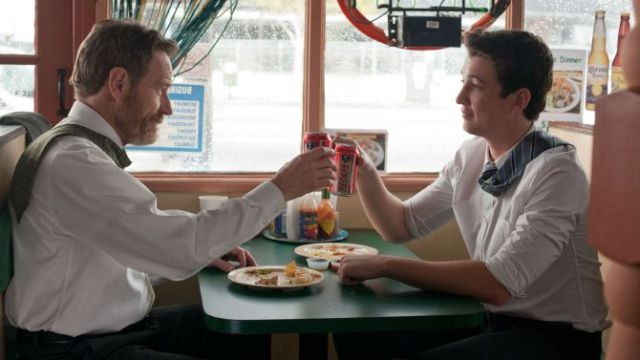
Wannabe online marketer Will (Miles Teller) has a fancy degree but no career prospects as he gets caught in a series of soul-crushing jobs to keep up his comfortable lifestyle. Meanwhile his housemates and his girlfriend Jillian (Anna Kendrick), not to mention his dad Roger (Bryan Cranston) find themselves struggling to stay in jobs that are anything more than a means to an end.

Will’s eye-rolling at his dad’s oft-told story of self-made success is cute enough. Roger’s heartfelt (and unbeknownst to him, recorded) confession that he just needs to get an interview, to allow a potential employer to see the real him, works. I really don’t know why aren’t seeing more characters in young adult comedies struggling to get paid work writing or creating content on the Internet, or films that follow the middle-aged unemployed desperate to start again, both prevalent and bittersweet issues in society today. In both cases these seldom-explored and potentially enlightening subject areas are wasted, and that’s a shame.

God this is lazy comedy. It’s all based around unlikable characters being unlikable hitting snags when they encounter people more unlikable than them. Will is a nasty, egotistical piece of work. Who honestly cares when he locks horns with his even more repulsive boss Katherine (Marcia Gay Harden)? You don’t want him to one-up her, you just want their encounters to end in Mutually Assured Destruction. Everyone we meet is a stereotype – jock, stoner, creeper, grafter, nympho, nerd – the script by Kyle Pennecamp and Scott Turpel lacks wit and awareness throughout and only raises a grimace when they crack out a gross-out set piece built around human and animal bodily fluids.

Miles Teller seems to alternate between making brave choices and proving his versatility (as in WHIPLASH) and taking easy roles where he gets by being insufferably smug (most comedies he does, including this one). The ever-reliable Anna Kendrick is completely wasted as Will’s careerist girlfriend Jillian and she doesn’t really get anything meaningful to do until the last 20 minutes of the movie. After a decade of really interesting and eclectic roles, Bryan Cranston has fallen back on playing (admittedly well) another mild-mannered working dad, another Hal. Someone else who doesn’t have to stretch himself is John C McGinley, who plays Doctor Cox again, remembering to change his shirt but not his behavioural tics.

This was probably good-intentioned to start with, it probably aimed to give well-educated young people at a loss in life a little bit of hope. Kendrick gets to make the final inspirational “I don’t know what to do with my life but that’s OK” speech before Teller nullifies it shortly after by summing everything up with a trite advertising slogan. The people involved probably didn’t intend for Get a Job to be so condescending either, but with such a lack of good jokes that’s pretty much the only feeling you’re left with, that you’re being relentlessly talked down to. Sometimes you struggle to understand why studios push back release dates or show such little faith in their products, but here they were completely right to give up hope, just as anyone watching Get a Job will. SSP

Posted in Film, Film Review | Tagged , , , , , , , , , , , , , | 1 Comment

Review: Pee-wee’s Big Holiday (2016)

peeweebigholiday

Pee-wee’s Big Holiday (2016): Pee-wee Pictures/Apatow Productions

Awww, now I feel really dispirited. Pee-wee Herman’s frivolous adventures may never have been high art, but they were at least always bouncy, fun and creative. After Paul Reubens appeared on stage as the character for years, in 1985 Pee-wee made his big screen debut in PEE-WEE’S BIG ADVENTURE. This was also the feature debut of a certain Tim Burton and proved to be a zany treat. Another movie, a TV show and over 20 years in the wilderness later, Pee-wee returns to Netflix in somewhat shambolic fashion and oddly lacking in energy for his BIG HOLIDAY.

Pee-wee Herman takes a break from his idyllic small-town life, job and toys to travel to meet newfound friend and kindred spirit Joe Manganiello in New York for his birthday party.

The first stretch of the film feels very Pee-wee and is an almost direct lift from his Big Adventure, a sequence colourful, playful and pleasingly complete with elaborate contraptions to get Pee-wee out of bed, dressed and (mostly wasted) breakfasted. Mark Mothersbaugh’s jolly score is clearly inspired by Danny Elfman too, and it makes you wonder why Mr Elfman didn’t want to return.

There’s the expected air of silliness about some of it, but sadly a lot of the jokes just don’t land. The plot also gave me major Big Adventure Déjà vu (minus the bike). To be picky, Pee-wee doesn’t even really go on holiday (this character going somewhere for leisure a-la Jacques Tati might have been amusing), he just meanders across the country to attend a party. I’ll admit that it’s a bizarre but amusing reference that the women who briefly kidnap Pee-wee en route (Jessica Pohly, Stephanie Beatriz and Alia Shawkat) resemble the gals from Russ Meyer’s FASTER, PUSSYCAT! KILL! KILL! but elsewhere the sense of imagination is sorely lacking. A scene midway through where a farmer’s numerous randy daughters try to seduce their bow-tied guest in particular just feels wrong. I see Pee-wee as an asexual being and his relationships should be kept platonic and innocent where possible.

There is more imagination and deranged wit in a single episode of PEE-WEE’S PLAYHOUSE than there is in the entire runtime of his latest big(ish) screen adventure. Where are all the surreal asides and the sense of unrestrained anarchy? As soon as Pee-wee sets off on his state-spanning trip the film just settles in and seems to go through the motions. It’s all just a bit lifeless and uninspired.

Don’t get me wrong, Reubens looks great for a man of 63, and he admirably tries to slip back into Pee-wee’s well-worn slip-ons. He’s still got the vitality, the energy of a toddler and the right jerky physical control for the character, but the voice has not aged well. Where’s the shrill honking laugh and stroppy whining when things don’t go his way? The reason Pee-wee makes such a strong connection with viewers is that he inherently sweet but also throws his toys out of the proverbial pram when he feels he’s been mistreated no matter what age he actually is. Here Pee-wee doesn’t exactly feel like he’s grown up but he’s certainly not as bouncy and irreverent as he used to be.

I feel that most long-running stories should evolve with the times. Pee-wee should not, and to be fair he still feels caught in his very particular time capsule. But if  you’re committed to bringing back your most successful and self-defining character after a long absence, you need to bring him back with pizazz, to make your audience realise what it was that they missed so much. As it is, Pee-wee’s Big Holiday reminds you all-too-infrequently of what makes the character so unique and what makes spending some more time with him worth it. SSP

Posted in Film, Film Review | Tagged , , , , , , , , , , , , , , , , | Leave a comment

Review: Captain America: Civil War (2016)

civil war

Show me your war faces!: Marvel Studios

Isn’t it nice when something lives up to expectations? CAPTAIN AMERICA: CIVIL WAR is not just as spectacular as we’ve come to expect from a Marvel movie, but it’s a grown-up, layered and very well-told story up there with the studio’s very best.

Following a costly mistake on their latest mission and the simultaneous resurfacing of brainwashed assassin Bucky Barnes/The Winter Soldier (Sebastian Stan), The Avengers are split down the middle as the UN pushes for regulation of the world’s superpowered guardians. Siding with Steve Rogers/Captain America (Chris Evans) for their freedom or Tony Stark/Iron Man (Robert Downey Jr) for the world’s safety, our heroes prepare to fight for what they believe just as new players entering the field complicate matters further…

Tony sure is making up for being a bit thick last time. While most might expect to side straight away with Steve/Cap and his quest for freedom from persecution and owning up to your mistakes, Stark makes a pretty good case too. Not only did he so recently create a murderbot (twice) but he and his superfriends have caused a lot of collateral damage during their of world-saving exploits. The difficult choice each hero makes rings true as well, all coming back to what made them who they are and what they have done, good and bad. Cap rebels just as he did in the last movie he headlined, and it’s pleasingly ironic that he’s the one essentially arguing for the very American right to bear arms and Stark, a weapons maker, wants greater regulation. This is just one example of how well the film explores the central argument being by no means cut-and-dry.

This is the best-balanced ensemble released by Marvel since the first AVENGERS. Evans and Downey head up each side of this war of ideology in fine fashion, but Stan remains to tortured heart of this story with his big sad eyes and Anthony Mackie’s Falcon does a lot of the dramatic heavy lifting as well. Elizabeth Olsen’s Scarlet Witch and Paul Bettany’s Vision have a lovely little blossoming relationship moment together before things escalate with superpowers shortly afterwards. Having Tom Holland’s new Spider-Man as an excitable nerd in middle of all the chaos works wonderfully, and Chadwick Boseman’s dignified and pained Black Panther bodes really well for his solo outing in a couple of years.

There’s lots of exciting bone-crunchy fight scenes throughout, the opening team excursion in Lagos making most comparable action scenes in movies (even some made by Marvel) look pretty amateurish and inconsequential. Every action sequence serves a purpose to the story, is endlessly creative (Spidey’s fight alone is more inventive and satisfying than most superhero movies in their entirety) and they’re well spread throughout the film. Here you’ll find the most polished fight choreography in any Marvel film so far here, and a lot of effort has gone into designing fun ways for our heroes to combine their powers as a team or  counter and nullify each other later on.

The obvious comparison point is BATMAN V SUPERMAN, and here Marvel really does get right pretty much everything DC got wrong. Big, meaty themes are debated eloquently (often midway through battle), every character’s actions have consequences and all the key players are given interesting things to do. One-liners fly as rapidly as repulsor blasts, psychic bolts and vibranium shields (the latter of which Spidey quips “doesn’t follow the laws of physics at all!). Even when they’re getting into the heavyier stuff, Marvel knows there is always room for some levity. My favourite comic moment of the whole film is the sight of Bucky and Falcon crammed in to a tiny car as they impatiently wait for Cap to plan their next move.

I was so pleased that the plot, for all its detours, didn’t rely on a massive conspiracy being revealed midway through as THE WINTER SOLDIER did. For much of the runtime it looks like it’s going that way, but cleverly when the twist comes screenwriters Christopher Markus and Stephen McFeely go big only to bring it back in again and keep it all very personal and far more hard-hitting than any amount of exploding cities could be. The way the film ties up and builds on loose plot threads of Winter Soldier and Ultron retroactively improves those entries too, which is nice.

We probably didn’t need both the return of “Thunderbolt” Ross (William Hurt) and the addition of a new politician played by Martin Freeman, Everett Ross (no relation to Thunderbolt) since they both serve essentially the same purpose to the plot. Also, while most gags are welcome, one that is delivered straight after a key moment of hard-hitting drama didn’t feel right.

Come to see the best juggling act in town (or the Russo Brothers as they’re also known) present an almighty scrap between Marvel’s most powerful players that they still own, a feud that actually makes sense. Stay and rewatch Civil War for the in-depth ideological debate, the sterling performances and the exciting, if uncertain possibilities it sets up for Marvel movies in the future. SSP

Posted in Film, Film Review | Tagged , , , , , , , , , , , , , , , , , , , , , , , | 7 Comments

Review: Midnight Special (2016)

midnight_special_wb_2.0

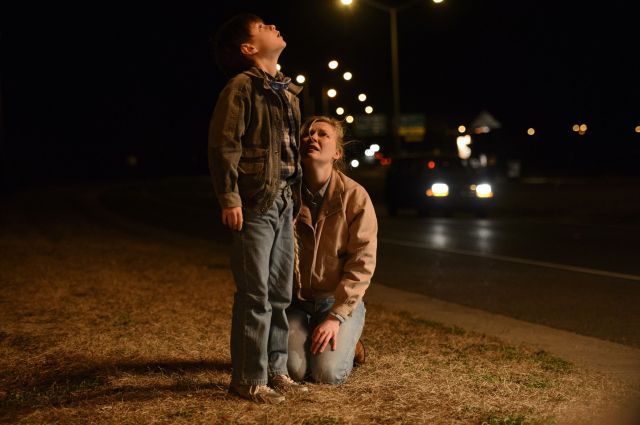
Honey, do you have to stargaze right now?: Faliro House Productions/Tri-State Pictures

Jeff Nichols has followed up doom-laden psychological horror TAKE SHELTER and big-hearted fable MUD with MIDNIGHT SPECIAL, his biggest film to date. While there’s plenty in it to talk about, it’s admittedly far wonkier than what has come before.

A father (Michael Shannon) and a son (Jaeden Lieberher) are on the run from the government and fanatic tag-alongs. They are not criminals, but young Alton is no ordinary young boy and the cult built around him and the relentless G-men driving the search have designs on his wondrous and destructive special powers. Alton, along with his father, mother (Kirsten Dunst) and protector (Joel Edgerton) embarks on a high-risk journey for his freedom.

I can’t really fault the honest intentions behind the film (Nichols is reflecting on a father’s need to protect), or the (mostly) sparing use of special effects and eerie sound design. What I will say is that the pacing in Midnight Special is way off. Whenever the story builds any momentum it is lost again almost immediately by Nichols’ tendency to cut to a serene landscape somewhere in the American South. These still moments have their place of course, helping a story not feel monotonous and providing the viewer with time for reflection. They also kill tension when placed midway through action scenes or immediately following plot advancement. Speaking of plot advancement, we learn a lot of key information through the central quartet of characters watching news reports on what is supposed to be going on, and this is an incredibly clumsy device.

The cast are pretty good across the board, particularly Dunst’s pained, instinctual mother, Driver’s inquisitive, decent NSA man and Jaeden Lieberher’s Alton, the otherworldly “special” of the title. Shannon and Edgerton are both intense but I really struggled to penetrate their Southern drawl and at times it seemed like they were in a war of escalation in mumbling. I don’t understand why you’d hire a character actor with such presence as Sam Shepard and only give him one scene at the beginning of your film though. Nichols clearly likes working with Shepard, casting him again after Mud so it seems odd he gave him such a nothing role here.

Said scene with Shepard kicks off a storyline involving a backwater cult (unfortunately resembling the one from UNBREAKABLE KIMMY SCHMIDT) that goes precisely nowhere. They send some goons after the family and are working with the government to no certain ends, but they are pretty much dumped by the wayside early on.

A lot of what transpires, what characters see and what is really real is left up to the viewer’s interpretation. What we see as an audience though, despite raising possibilities aplenty, tends to collapse under the weight of even the slightest intrusion of logic.

The emotions of Midnight Special are very real, and Jeff Nichols clearly isn’t quite ready to hand in his indie credentials yet, but is this destined to be anything beyond a curiosity? It provokes discussion points, feels oddball and moody and has a very distinctive aesthetic, but the way the plot hangs together and lack of commitment to a strong central idea makes the film less than the sum of its parts. People will talk about this one, but it might be more out of frustration than passion. SSP

Posted in Film, Film Review | Tagged , , , , , , , , , , , , , , | 1 Comment

Review: Hush (2016)

Hush_Trailer1

Hush (2016): Blumhouse Productions/Intrepid Pictures

Coming from Mike Flanagan, the director behind the striking, eerie, uneven OCULUS, HUSH tweaks existing horror movie formula to come up with an effective and tense little chiller.

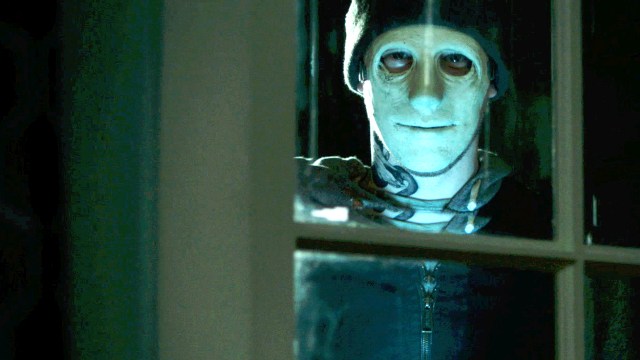
Deaf writer Maddie (Kate Siegel) can’t decide on an ending for her second novel. As she waits for inspiration to hit her and settles in for a long night, a masked man wielding a crossbow (John Gallagher Jr) tries to gain entry to her isolated house…

From the outset sound and silence are emphasised. Noiseless production company logos transition straight into the clattering and sizzling of cooking and back to the void the deaf protagonist hears. Sound editing is sometimes a devalued branch of filmmaking, but here it is key for the drama and this department deserve particular notice for this movie.

They throw down the gauntlet early by commenting that Maddie can keep her readers from guessing the ending of her stories and that’s the least that this film should achieve. For the most part it succeeds in being unpredictable and the screenplay by Flanagan and Kate Siegel is dialogue-light and compelling. The expected beats of a home invasion/slasher horror over the decades are all in there somewhere but not necessarily in the place you’d expect and there are some good plot curve-balls and shocks thrown in for good measure. A clever sequence where Maddie plays the various fatal scenarios of her trying to escape in her head with her internal commentary at how bad an idea each is reminded me a lot (in a good way) of the multiple-choice horror game UNTIL DAWN from last year.

There’s a slasher movie mask early in, but it’s ditched pretty quick. Maddie isn’t being stalked by the uncanny or the vaguely supernatural but by one very human and seriously disturbed guy who enjoys playing with his prey as much as Maddie’s cat does. Kate Siegel is dignified and raw as Maddie, John Gallagher Jr terrifyingly removed from his nice-guy support worker in SHORT TERM 12.

There’s some nice ideas built around how this isn’t the ordinary battle of wits. The killer works out quickly how handicapped his victim is and exploits her almost sole reliance on sight by hiding just out of her field of vision and Maddie in turn must survive by her wits alone, distracting her opponent and using her highly attuned other senses to her advantage (she feels the vibrations of him moving on the floorboards above her hiding place and knows he’s behind her from his breath on her neck later on). It’s a creepy movie and also an eye-opening movie about abusive sickos who get even more of a kick out praying on the vulnerable. The scariest thing the film does is exploring how liberating Ease of Access technology can be for the disabled, but equally how crippling it can be to an individual once it is suddenly taken away again.

It becomes a real battle of the senses in the film’s final act when Maddie decides her only chance is to fight and to improvise with an interesting array of household objects. The horror movie “final girl” cliché is turned on its head as Maddie really starts and ends the film as the final girl. For much of the movie it’s a two-hander between her and her tormentor. The only real thing that changes is that she decides not to be the victim.

It probably wasn’t necessary to have Maddie’s backstory explained on the dust jacket of one of her books. Couldn’t she just be a character born deaf? Her would-be killer didn’t need a backstory so why did she?

The way sound is played with throughout is interesting and it would have been even more so, not to mention braver and bolder to do the whole thing as a silent movie. Even considering these niggles, Hush cements Mike Flanagan’s position as a horror director to watch and makes me hopeful the next script he works on stands out from the crowd as proudly as this one. SSP

Posted in Film, Film Review | Tagged , , , , , , , , , , | 7 Comments

A Few Thoughts More: The Force Awakens

luke

Star Wars: The Force Awakens (2015): Lucasfilm Ltd/Bad Robot Productions

This piece contains spoilers for THE FORCE AWAKENS, but if you care and haven’t seen it yet then where have you been? There’s also a reference to the twist in IRON MAN 3, just FYI.

I’ve seen the seventh STAR WARS film four times now and, five months on, what I said in my original review from December for me still broadly holds true.

All the references to the previous entries in the saga and the love of the craft shown in every scene makes this an entertaining Star Wars movie. Despite annoyingly repeating the same flying-into-something-to-blow-it-up finale, it’s the chemistry between, and soul behind characters old and especially new makes this a good movie all-round.

What makes The Force Awakens such an interesting film is arguably as much the questions it doesn’t answer as those it does. JJ Abrams and Lawrence Kasdan sure know how to leave you dangling, but they also make you yearn to find out more over the course of another adventure.

The big questions from the fandom seem to be threefold: 1. Who is Rey? 2. Who is Snoke? 3. Why did Luke leave?

As to the first question a popular fan theory points to Rey being Obi-wan’s granddaughter. I think it would be too obvious for her to be another Skywalker, although Leia does seem to give her a subtext-heavy hug during the film’s finale. I could buy the Obi-wan theory as there are references to him throughout the film (notably Rey’s Force vision), their behaviour is similar and despite being a celibate Jedi, Kenobi was in exile on Tatooine for years. I do have to wonder if Rey really has to be related to any original series character. Couldn’t she just be Rey, who is who she is purely because she is strong off of her own back, abandoned in the wasteland by unloving, unready and unknown parents? The Force might be more likely to manifest in families strong with it, but as far as we can gather (just look at Anakin) things can just happen. The Force works in mysterious ways…

Next, who or what is Snoke? Fan theories have ranged from Palpatine’s supposedly murdered master Darth Plagueis (the top result on Google) to a resurrected Darth Vader (aparently they look like they share scars), but from what we’ve seen of him the answer may be far simpler. All we know is that he chooses to manifest as a giant hologram and can exert a lot of influence over others. Snoke may well be less than meets the eye. I think it would be a bold and interesting decision to reveal the new Emperor as a charlatan who’s just really good at manipulating his image. If this were the case it might annoy some viewers, but I loved the similar divisive twist in IRON MAN 3, so you can see the kind of brave plot turns I tend to appreciate.

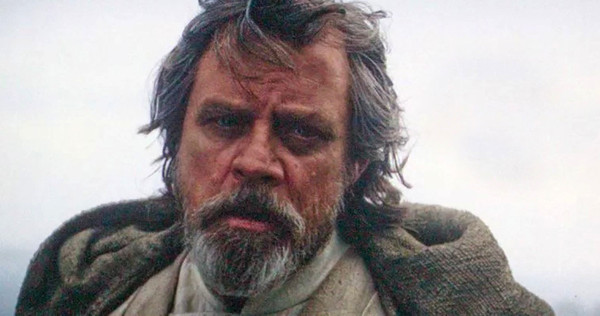
Finally, why did Luke leave? This one is brought up by Han Solo aboard the Millennium Falcon. He says that Luke began training the next generation of Jedi until his nephew Ben/Kylo Ren turned to the dark side and destroyed all his good work. Then he vanished, said to be searching for the first Jedi temple in the far reaches of the galaxy. Was he trying to find the source of the Force or a means to turn Ben back to the light or was he simply ashamed and in need of solitude. When we finally see him being confronted by Rey holding out his old lightsaber, I would imagine he is feeling conflicted. Optimists might say Luke was just waiting for the next promising student to prove themselves by finding him, but it might just be that he never wanted to be found, that he self-imposed his exile like Yoda and Obi-wan did before him.

In addition we never find out how Kylo Ren got Vader’s helmet or how Maz Kanata got Luke’s lightsaber, whether Han committed suicide or if Ben was always going to murder his father or what the New Galactic Republic is doing as The Resistance fights its war against the ambiguously powerful First Order. I’m sure we’ll find the answers to some of these questions in sequels and others will perhaps be left open to interpretation. I hope that when they do come, the answers we do get are at least interesting, or at least not the most obvious options available. SSP

Posted in Film, Film Feature, Film Review | Tagged , , , , , , , , , | Leave a comment

Review: The Jungle Book (2016)

jungle book

One of these is not like the other: Walt Disney Pictures

Last year I asked on this very blog what Disney were playing at in remaking their animated back catalogue. I might have to eat my words soon because I’ve really liked most of this production cycle. MALEFICENT was reprehensible but CINDERELLA was well-appointed and now THE JUNGLE BOOK is the latest roaring success.

In a re-telling midway between Rudyard and Walt, Man-cub Mowgli (Neel Sethi) reluctantly leaves his jungle home guided by Bagheera the panther (Ben Kingsley) to rejoin his own kind after a threat from ferocious tiger Shere Khan (Idris Elba). His journey will not be an easy one, his story will captivate generations to come.

What a cast director Jon Favreau has assembled. Newcomer Neel Sethi makes an intuitive and mischievous Mowgli and grounds the effects-heavy story well. The impressive voice talent includes a crooning Baloo (Bill Murray); Kingsley’s boarding school master Bagheera; Elba’s seething thug Shere Khan and King Louie by way of The Godfather (Christopher Walken). Kingsley’s honeyed and authoritative narration is the perfect glue for this story and both establishes the rules of this world and underlines the moral content in the most elegant manner possible.

The entirely CGI jungle (based on real-world photographic reference material) is photo-real, the animals and their interaction with Mowgli are totally convincing and always compelling. For all the fun, very real dangers are in evidence too – we witness first-hand how much destruction fire or the “red flower” as the animals call it causes and the fights between animals are about as brutal as you could get away with in a Disney film, cutting before you actually see mortal injuries even though you know exactly how much damage these teeth and claws are doing.

The classic songs are there at key moments, with Murray doing a fun rendition of “The Bare Necessities” as a lounge track and King Louie using “I wanna be like you” as an elaborate threat. Murray’s love of performing comes across, but Walken basically speak-sings his number (tweaked by Robert Sherman himself to somehow work Gigantopithecus into rhyme) allowing for little jazzy foot-tapping but ample opportunity for Walken to intimidate and impart some far more sinister implications. I would warn that the King Louie scene might be a little intense for your littlest ones, but elsewhere there are some decent jump scares to keep them lively. Stay through the credits for some nice musical surprises as well.

I like the idea of leaving the elephants as unknown elementals, respected and feared by most and appropriately deified for the story’s setting. I also liked that man remained an enigma and that when Mowgli finally finds his way back to his own kind he sees them just like the furrier inhabitants of the jungle do – horrific shapes silhouetted against fierce firelight. I never expected Baloo to come out with a politics joke for the parents and neither did I expect to find a reference to CASABLANCA here, but Baloo lying to Mowgli about his feelings to save him towards the end of the film is just what that key scene is.

It’s not perfect by any means. An innuendo-filled scene of Baloo and his jungle pals watching Mowgli do their dirty work feels a little cheap and I don’t really think Kaa (Scarlett Johansson) piling on exposition through “trust in me” hypnosis really works either – stylistically it doesn’t really match the rest of the film and it implies the serpent is a little too omnipotent.

The Jungle Book is a treat for all the family and should please fans of Disney’s iconic animation and Rudyard Kipling’s fables alike. Favreau’s film is visually splendorous, emotionally affecting and hugely entertaining throughout. If this is any indication of the quality of Disney’s future re-adaptations, their dominance of the film and entertainment industry will likely continue for a long while yet, and that might not be a bad thing. SSP

Posted in Film, Film Review | Tagged , , , , , , , , , , , , , , , | 3 Comments

Review: Victor Frankenstein (2015)

VictorFrankenstein

Victor Frankenstein (2015): Davis Entertainment Company/TSG Entertainment

I know you shouldn’t pre-judge, but I was preparing to get angry at VICTOR FRANKENSTEIN. I do try and avoid preconceptions, but Frankenstein feels very personal to me after dedicating an awful lot of time and effort to my MA dissertation on the numerous adaptations. Well now I’ve seen it – was I wrong to jump to conclusions? Not entirely.

The life of a hunchbacked clown (Daniel Radcliffe) is changed forever when he is rescued from the circus by Doctor Victor Frankenstein (James McAvoy). Given physiotherapy, a name and a purpose in life, Igor uses his considerable surgical skills to facilitate his master’s experiments to create life from death…

I am so sick of “you know this story” as the lead-in to a reimagining. At the very least it’s condescending and seems specifically designed to justify telling a tale for the umpteenth time and pre-emptively thwart anyone criticising deviations from the source material.

As with most Frankenstein movies there are more references to the pre-war Universal series of films than there are to Mary Shelley. The Monster is brought to life with electricity, he has a flat head (“Why? / Because I like it!”), Henry Frankenstein from James Whale’s 1931 film is name-checked and Igor was not a character in any form before Bela Lugosi requested his creation for SON OF FRANKENSTEIN. OK they do drop “The Modern Prometheus” into dialogue, but this nod to the novel’s subtitle is about all that’s going for Shelley.

I will say Victor Frankenstein has incredible production design. The sets, costumes, hair and makeup, gears and mechanisms fell lived-in, grimy and gothic. Speaking of hair, I would love to know Igor’s trick to get his locks so perfect and glossy using only a cutthroat razor and a bar of soap. Igor’s imagining Da Vinci-esque anatomy diagrams over living, breathing things is a neat and well-visualised idea and the scenes of what passed for surgery in the Victorian era are shudder-inducingly convincing as well. They didn’t have that many sophisticated methods in the 1800s, but the techniques available were at once brilliant, harsh and cruel.

James McAvoy is wonderful as Frankenstein, a raving, conniving charlatan who only succeeds because of the brilliance of his assistant. It may be an unfaithful depiction of Shelley’s layered and guilt-ridden dreamer but it’s certainly an entertaining character. I wouldn’t give up him shouting about “babies in vats” at a high society function for any amount of nuance. Elsewhere, Radcliffe is just OK as our mistreated genius and there really isn’t much of anything to Andrew Scott’s zealous policeman or  Igor’s would-be love interest Lorelei (Jessica Brown Findlay).

Scott’s Inspector Turpin is monumentally thick. Though he might not recognise the now straight-backed fugitive Igor just from a rough sketched wanted poster, he somehow still struggles to find Frankenstein, a well-known lecturer and surgeon with a daily routine even after he put on a very public demonstration that went awry. He just asks Igor again, “Get me Frankenstein” and duly he does. Another minor detail, he calls him “Mr Frankenstein” and I don’t think even the most inept and god-fearing cop would ignore a suspect’s title in the interview process.

The issue here is that the filmmakers claim to want to tell the story of Frankenstein’s under-appreciated assistant, a self-aware sideways glance on Shelley’s tale, but writer Max Landis can’t fight the temptation to tell the same old story. Victor Frankenstein is fine when it’s exploring new avenues (the colourful circus opener and Igor finding a new life for himself are the strongest elements) but when it returns to Shelley or Universal Horror it becomes quite tedious. Shelley’s themes aren’t explored in any great depth, it’s not compelling and The Monster (Spencer Wilding) itself only appears for the last set piece of the film and there only as a brute to throw his creators around for five minutes. I don’t have an issue with it not being Shelley’s verbose and conniving creature, (only Robert De Niro and Rory Kinnear have really played the character from the page so far) but if it’s going to be silent and animalistic it’s got to be in some way sympathetic as well – that’s why Boris Karloff’s pitiful child-monster worked.

A talented production design crew and McAvoy thoroughly enjoying putting the “mad” back in mad scientist are not enough to recommend Victor Frankenstein. At the very least it had to be different, but instead of focussing on the promised and potentially interesting growth of Igor as a character it gets stuck with flogging an inferior Shelley/Universal Horror homunculus. SSP

Posted in Film, Film Review | Tagged , , , , , , , , , , , , , , , , , , , , | Leave a comment

Review: Nina Forever (2015/16)

nina_forever_still

Nina Forever (2015): Charlie Productions/Jeva Films

Raise your hand if you remember how rubbish LIFE AFTER BETH was? NINA FOREVER excels in pretty much every way its totally wonky American cousin fails – it’s sincere, soulful and has something important to say about losing a loved one before their time.

When trainee paramedic and reluctant supermarket worker Holly (Abigail Hardingham) strikes up a fast romance with Rob (Cian Barry) it seems like her life is finally coming together. Rob finally begins to raise himself out of a black pit of depression too, but despite the new couple’s passion and their connection, there is a problem. That problem is Nina (Fiona O’Shaughnessy)  – Rob’s ex who has died horribly but won’t let that stop her from coming between them.

The film’s opening scene is a beautiful illustration of stillness and all its implications – a static camera, a motorcycle crash beside a placid lake, a failing flickering indicator light in time to a failing, flickering heartbeat. Then death becomes life once more as the pulse steadies and the prone body stirs and the circle of life keeps on spinning.

Holly is described as “vanilla” by a condescending colleague at one point, in stark contrast to the raw intensity of actress Abigail Hardingham’s heartfelt performance. Not everyone could manage to eat a pomegranate seductively, but Hardingham somehow manages it (just look at Rob’s face – he’s impressed too!). Cian Barry has the thousand-yard-stare of a man at war with himself and the sturdiest of three-handers is completed with Fiona O’Shaughnessy who gamely spends most of the film stark naked and caked in claret and impresses with her unsettling ruined body movements and by balancing playing Nina as heartbroken from beyond the grave and tossing out catty insults.

Nina Forever always walks a very difficult line, between life and death, love and regret, fun and danger. The first lovemaking scene between Rob and Holly starts off sexy and ends up pretty terrifying as the lovers hurriedly disentangle to get away from the bloody spectre of Nina rising out of their bed like a more talkative J-Horror ghoul. The scene really is one-of-a-kind, segwaying straight from abject horror to awkwardly introducing the ex (who just happens to be dead). The second lovemaking scene where Holly and Rob seem to embrace Nina’s supernatural intrusion almost as a fetish element in their relationship is even weirder and more striking. It really has got to be seen to believed.

As well as his new girlfriend, Rob has some perfectly lovely in-laws (David Troughton and Elizabeth Elvin) who invite him over every week for Sunday lunch and insist he needs to move on from, but never forget, their daughter Nina. The film’s take on loss and mourning is not a clear-cut one as a truly heartbreaking scene between Rob and Nina’s parents in a crowded restaurant makes clear. As the ghostly Nina points out to Rob “We never broke up”. Erm, she’s not wrong. Grief never really leaves you and will always be part of you, but you can’t let it rule you. There is always more out there for someone who has gone through the trauma of loss and once you find someone to share your grief with you can better overcome, or at the very least live with less pain. Later in the film when Rob and Holly commit to their relationship they also commit to Nina’s bloody apparition being part of their life and stock up on clean sheets accordingly, a pragmatic and progressive way to look at loss.

Anyone dismissing this film with a sneer as “emo” isn’t worth engaging in civilised conversation. It may be destined for cult status due to its genre-melding and plentiful gallows humour, but Nina Forever doesn’t seem to be gunning for this. Co-writer-directors Ben Blaine and Chris Blaine simply want to have an honest and insightful conversation about grief and people’s inability to cope with this most tragic and cruel fact of human existence. A scene towards the end seems ever so slightly too gruesome for the sake of it, but this doesn’t lessen the impact of the piece as a whole, and Nina Forever ends up being an emotionally fulfilling thesis on grief and one of the most unique British horrors for years. SSP

Posted in Film, Film Review | Tagged , , , , , , , , , , , , , | 4 Comments

Review: Steve Jobs (2015)

Film Title: Steve Jobs

Steve Jobs (2015): Legendary Pictures/Scott Rudin Productions/Mark Gordan Company

Let’s not sugarcoat it: Steve Jobs was an awful human being. A great marketer, a technology rock star, a man with a vision, but as a person he is rightly reviled. Danny Boyle’s Aaron Sorkin-scripted character study does not shy away from this, even having the man himself admit he is “poorly made” at one point. STEVE JOBS sees its subject at his ugliest and we witness all the pain and torment he causes others behind the scenes of his glossy tech demonstrations and shiny branding.

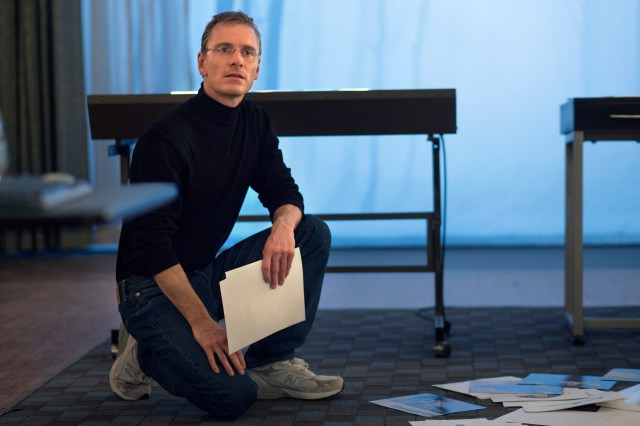
1984, 1988, 1998. Three product launches all fronted by, and obsessed over, by Steve Jobs (Michael Fassbender). This is the story of the buildup to the main event, to Jobs taking stage and selling to an enraptured audience, upsetting everybody and distancing himself from the rest of humanity all along the way.

Though a good chunk of the film’s appeal hangs on the performances of the cast, of their well-honed skills making Sorkin’s script sing, there is also ample room for Boyle to make things cinematic. Steve Jobs is constructed in such a way that it would work really well on stage and a future adaptation isn’t beyond the realms of possibility as Sorkin has written for broadway before. Fassbender’s Jobs is present in every scene with the rest of the ensemble constantly coming and going exactly as though they’re hanging around just off-stage.

Boyle loves the bend our concept of reality much in the same way Jobs was said to exploit a “reality distortion field”. Just look at how he justifies his actions – personal and professional – highlighting innovations of the past to confidant Joanna (Kate Winslet) as imagery illustrating his points is superimposed vividly on the corridor behind them like one of his Apple presentations to a captivated audience. He never drops his guard and we struggle to see where public Jobs ends and the real Jobs begins (if there even is a real Jobs) – he is always working, always with the next “great” thing for his company in sight and any real human connection at the very back of his mind.

It was pointed out when Michael Fassbender stepped in at a late stage to play the Apple maverick that he looks nothing like Steve Jobs. That’s true, he doesn’t. But that doesn’t matter because you believe Fassbender is Jobs. His performance, comfortably among the strongest in an impressive career, is completely magnetic and he counter-intuitively manages to make the man both a detestable figure and a tragic human being. Kate Winslet, Seth Rogan and Michael Stuhlbarg are all strong as respectively Jobs’ long-suffering marketing guru Joanna Hoffman; Apple co-founder and the real brains behind anything truly technical Steve Wozniak and underappreciated engineer Andy Hertzfeld. Their support sturdy as it is struggles to escape the all-consuming singularity that is the face of their company and the actor playing him. Oddly appropriate isn’t it?

Sorkin’s script is of course like a well-oiled machine for doling out wit – so layered, rhythmic and sharp that you’ll find yourself laughing out loud on reflex even if the joke didn’t quite register. It’s certainly worth multiple watches so you can pick out every gag and appreciate all the nuance.

The film has a lot of fun at Apple’s expense, emphasising that Jobs seemingly committed to a closed system (purpose-designed from the outset and uncompatable with everything without a fruit on it) just to be awkward, to have complete control over his market. Anyone who has ever owned an Apple anything (who hasn’t?) knows how tempting they are to buy and how frustrating they are to run. Jobs was apparently obsessed with the things that don’t matter. He was prepared to humiliate one of the geniuses behind his product just because he couldn’t get a computer to say hello. He wanted one of his products to be a slightly off cube to make it look more cube-like (something to do with a trick of the eye) before all the gubbins inside were finished, plus a transparent housing for the i-Mac so you could see the inner workings but still couldn’t open and repair it even if you knew how.

Steve Jobs is a perceptive and profound look at a divisive figure. Boyle, Sorkin and Fassbender have somehow managed to craft a richer and broader picture, a more human (though no less detail-obsessed) view than the man himself arguably ever had on his own world. SSP

Posted in Film, Film Review | Tagged , , , , , , , , , , | Leave a comment