Review: RoboCop (2014)

Robocop-2014-Header

Is it bad to be annoyed that I don’t hate José Padilha‘s ROBOCOP remake quite as much as I expected to? Don’t get me wrong, it’s bad, but not THE AMAZING SPIDER-MAN 2 bad.

In an updated take on the dystopian crime film, we once again follow Detective Alex Murphy (Joel Kinnaman) a good cop working in the crime-infested near-future Detroit. The US Senate has repeatedly blocked bills to allow for the ranks of the police to be bolstered by intelligent robot agents, and the OmniCorp technology conglomerate headed by Raymond Sellars (Michael Keaton) see a lucrative business opportunity when Murphy is mortally injured in an attack on his home. Murphy is transformed into RoboCop, the first successful fusion of man and machine, and rejoins the fight against crime while simultaneously trying to reconnect with his young family, and himself.

The film’s attitude to the justice system in the USA (including their policing of the world) is so cruel and cavalier that it’s difficult to tell whether the filmmakers are joking. This wouldn’t make for bad (if incredibly unsubtle) satire if they were kidding, but I don’t always get that sense. Samuel L. Jackson’s current affairs TV personality proclaims in the film’s opening sequence that without relying on robots to do the dirty work abroad, “it would be American soldiers pacifying these people”. “These people” in this case are the citizens of Tehran, who apparently require American pacification in this film’s universe (with no explanation given for why, beyond the US/Iran troubled relationship). Jackson’s character is a parody of a certain kind of political commentator, just not a particularly clever one.

Also in the opening sequence, we get Iranian suicide bombers laughably spelling out to each other, and to the audience, that “our goal is to die on television”. OmniCorp’s evil marketing team (headed by Jay Baruchel) rarely say anything that isn’t re-stating how nasty and money-obsessed they are (“we’re gonna make a lot of money” Baruchel’s character beams) and there’s even a scene that sets out their super-evil re-branding strategy before they casually mock their disabled potential RoboCop test subjects for not being white or muscular enough (just in case we were still in doubt about who the bad guys are). At least in Paul Verhoeven’s original, the OmniCorp baddies were just guys in suits who got on with the business of being evil rather than talking extensively about it. Jackie Earle Haley is entertaining as the army’s sneering robo-expert, but you don’t get extra points for Haley turning in a good performance any more because he’s great in everything.

In contrast to the pantomime villains and boring protagonists (Kinnaman is certainly no Peter Weller), we have Gary Oldman playing a jolly nice doctor who helps amputees get used to using their new prosthetic limbs, and setting up the film’s main story arc (“too much emotion will throw the system”) as well as providing general exposition throughout to make up for some bad storytelling.

I do understand why the filmmakers repeatedly reference the military drone concern – for a contemporary audience, it’s still a raw subject and gives the film a little added clout. I also appreciated the reprisal of the iconic theme tune from the original films, and I liked that an updated version of the original suit makes a brief appearance, if only they didn’t paint it a generic black to turn him into a poor imitation of Batman just because Michael Keaton (still seemingly obsessed with his most famous role) said so. The choice of song to play over Robo’s final training exercise also has an odd brilliance to it, and I’m amazed it hasn’t been used to punctuate and provide rhythm to an action sequence before. Elsewhere, the action is unremarkable. There’s a big shootout that is essentially a re-tread of the Verhoeven film’s finale, but without creativity and wit, in total darkness illuminated only by gun-flare and infra-red. It does perhaps provide a justification for Robo’s new “tactical” stealth bomber look, but then you have to ask why he has a glowing red Cylon visor to give his position away.

What I didn’t like about the film was that it took itself so damn seriously. RoboCop was always high-impact and ultraviolent (for good reason) but it was never gritty (again for good reason). The humour, gore and razor-sharp satire struck a perfect balance in ’87, but here we have something slick, grim and ultimately, really dull. I don’t honestly think you can make a good film about violence without showing violence. Violence is depicted here, sure, but it’s neutered violence, edited in such a way to achieve the desired certificate to boost profit margins. Here we can almost entirely blame the well-publicised studio interferance, but it’s still a problem that affects the film as a whole. Robo’s “birth” scene in the original film was horrifying and personal – he looked into his murderer’s eyes as they brutally tortured him and eventually took his life, and we were right there with him. Here, he’s blown up in wide shot by persons unknown, and we’re meant to be behind him again when he goes after the culprits, despite the fact we actually haven’t seen them commit crimes, but just have to trust what we’ve been assured happened off-screen.

The only real laughs come from the bizarre combination of Sam Jackson’s vocal warmup exercises coming out of the MGM lion, and from “If I Only Had a Brain” playing over one of Robo’s training simulations. A tweaked “I’d buy that for a dollar” is not funny.

The only even vaguely affecting scene is Murphy’s gradual waking from his coma dreams as his comfortable, vital suburban life morphs around him into a cold, dead laboratory around him (a decent metaphor for his character). In the other family-based scenes, Padilha and co need to learn that it takes more than a simplistic piano theme to elicit an emotional response from the viewer. We have to be made to care about the characters, but here Alex Murphy and his wife and son (Abbie Cornish and John Paul Ruttan) are just too bland.

Aside from the odd glimmer of potential and fan-pleasing references, the RoboCop remake is incredibly disappointing. It’s dour and polished and attempts to be political, but without someone skilled at balancing the atonal elements of violence, comedy and satirical commentary like Paul Verhoeven at the helm, the film lacks bite, and underwhelms as a whole. The studio put pressure on José Padilha to tone down the violence when his film’s budget escalated, which accounts for some of the film’s problems, but that still doesn’t excuse the protagonists not making a connection, the villains monologuing, and the general “tell, don’t show” attitude of the script as a whole. No-one will remember this one a year from now. SSP
 

Posted in Film, Film Review | Tagged , , , , , , , , , , , , , , , , | 1 Comment

Review: Edge of Tomorrow (2014)

edge-of-tomorrow-01

Sometimes a clever little tweak to formula is enough to make a film memorable. EDGE OF TOMORROW is a solid and entertaining sci-fi action film, with good performances, but it wouldn’t be particularly notable if you threw out the unconventional plot structure. It’s not necessarily a bad thing that it’s not complex, as it’s always engaging, and so well put together that you won’t mind.

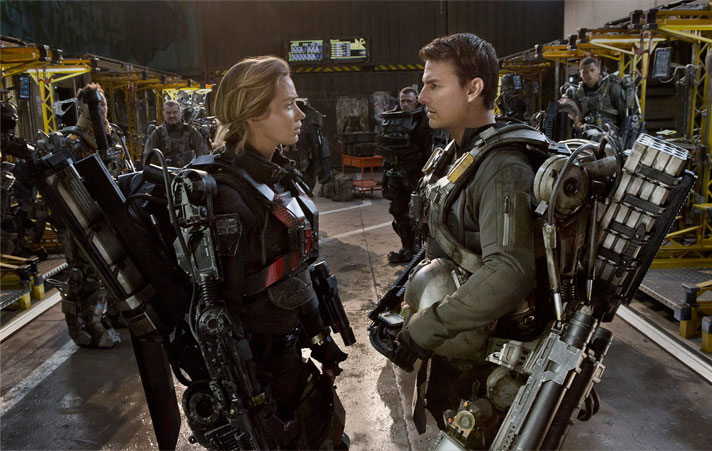
It’s the near-future and planet Earth is under attack. Try as the armies of the world might, they are fighting a losing battle against an alien foe who can seemingly anticipate every move they make. Armed forces publicist Major William Cage (Tom Cruise) lands in London just as a massive all-out offensive against the alien “Mimics” is being planned, and is forced to join the troops on the front line when he tries to blackmail the wrong general (Brendan Gleeson). His first day in battle does not go well, and Cage is killed by one of the creatures he is fighting. Miraculously, he wakes up again on the morning before battle, and gradually realises he is stuck in a time loop that allows him to predict and correct humanity’s tactical errors, and with the help of fearsome veteran Rita (Emily Blunt) they begin to concoct a plan to finally end the war.

Tom Cruise is the best he’s been since THE LAST SAMURAI, and refreshingly doesn’t seem to be playing Tom Cruise for the first half of the movie – Cage is cowardly, inept and awkward, and only grows into the Cruise action man role through practice, and out of necessity. Emily Blunt convinces as Rita, a formidable warrior woman, and it’s nice to see the relationship between the lead male and female not go quite the direction you’d expect. It’s great to see Bill Paxton in decent stuff again, and has all the best lines in the film as the philosophising Master Sergeant Farell. It must have been a bit odd for Paxton to be playing the veteran and watching a group of young actors playing a squad of kitted-out alien-fighting soldiers (and Cruise), inhabiting the very roles he occupied 30 years ago, but he seems to relish playing a figure of authority, the one who with the task of beating them into reasonable shape.

The battle scenes are intense and visceral, with a few of Doug Liman’s usual directorial flourishes to punctuate the action. The central premise, of Cage dying over and over as he works out how to win, also allows for a fair amount of black humour, particularly funny as he becomes more and more frustrated with his situation and what is expected of him. He’s shot, stabbed, crushed, exploded and run over throughout the film, so even if you’re not usually a Tom Cruise fan, you might get a cheap (if a bit wrong) thrill out of seeing him dying again and again.

The look of the film is somewhere between ALIENS, ELYSIUM and GEARS OF WAR, with power armour that augmenting a soldier’s movements and armaments (here called “exo-suits”), the general look of the military hardware on display, and the film being just about as violent as you can get away with at this certification. The Mimics are scary, glowing, biomachanical masses of tentacles and teeth, and present a real challenge for the unfortunate soldiers fighting them on the D-Day-esque beach battlefield.

The film’s final act has some added tension thanks to a late twist foreshadowed in an earlier scene, but as the story progresses, it only becomes more conventional. That’s not to say Edge of Tomorrow is ever dull – the pace keeps up throughout, and there’s a pleasing vitality to every scene, but Liman never quite manages to match the creativity and novel fun of the film’s first half on narrative and action terms. As criticisms go, this is a pretty minor one, and doesn’t take away from the fact that what is good is really good. I don’t even really mind that Edge of Tomorrow is a really boring movie title (better to stick with Hiroshi Sakurazaka’s novel title ALL YOU NEED IS KILL), I was just having too much fun to care.

I’m not sure if there’s any deeper message to the movie beyond warfare is an endless and pointless cycle, but as I’ve said, not every sci-fi has to be 2001 or BLADE RUNNER level of complexity, and sometimes there’s a pleasure in a simple (if tweaked) story well-told. The story also ends on an ambiguous note, that so few modern blockbusters have the courage to do (unless they’re shamelessly setting up a sequel). I’d highly recommend Edge of Tomorrow as an interesting enough, meticulously constructed thrill ride that makes you glad Tom Cruise is still in good enough shape to do what he does, and that doesn’t take himself all too seriously while doing it. SSP


Posted in Film, Film Review | Tagged , , , , , , , , , , , , , , , , | Leave a comment

The (Very Very Belated) Worst Films of 2013 List

original1

I tend to be pretty selective in the films I choose to watch. I’m not one of those guys who has to see absolutely everything, and would probably never pay to see something that’s been universally panned on release. Yeah I know, critics are sometimes wrong, and sometimes they miss something that, for whatever reason, strikes a chord with me, but I tend to wait until these movies appear in DVD bargain bins or crop up on Netflix. I’ve made a couple of ill-advised purchases recently, and some other celluloid disasters have now popped up for streaming, so I’ve now, six months into 2014, I’ve now seen enough terrible films to rank my worst of 2013. If you wanted to check back on my list of last year’s best films, you’ll find it here.

Worst Films of 2013

10. G.I. JOE: RETALIATION

The first G.I. JOE wasn’t great, but it was colourful and had a certain goofy charm about it. It was undemanding and fun. RETALIATION tries to take the story back-to-basics, but in doing so becomes downbeat, conventional, brown and worst of all, boring. Not even Bruce Willis’ scowl or The Rock’s biceps could make this one memorable.

9. OBLIVION

The problem with OBLIVION wasn’t the way it was executed – on the contrary, it’s really slick and glossy, with good action and some memorable sequences. What is the problem is the casual plagiarism in the film. I know modern sci-fi is rarely original, but Oblivion brazenly cherry-picks ideas from other better cerebral sci-fi movies, and mashes them together into a bit of a mess.

8. A GOOD DAY TO DIE HARD

The latest unnecessary DIE HARD instalment could just be called Angry Old Bruce Willis Shouts at Russians for 100 Minutes. There is carnage on a large scale, but the action is messy, confusing and ill-coordinated, Bruce Willis looks disinterested, Jai Courtney makes no impression whatsoever and there’s an appalling appropriation of Chernobyl for the plot.

7. THE COUNSELLOR

A good cast and good filmmakers a good film does not make. It’s been a while since I’ve seen something so misjudged on every level – tone, character, story, aesthetic, nothing works. It’s disheartening to see Ridley Scott, one of the most prolific and successful directors on the planet, fall short for the third time in a row following ROBIN HOOD and PROMETHEUS. My full review can be found here.

6. SHARKNADO

There are movies so bad that they’re good. SHARKNADO is not one of them. The truly ridiculous premise just isn’t taken far enough, with the titular angry fish storm only on screen for about a quarter of the film’s run-time. The rest is buildup, and time wasted with snore-inducingly boring characters. The script, as strange as it sounds, isn’t even bad enough for a movie like this.

5. JACK THE GIANT SLAYER

Bryan Singer clearly didn’t have his head in the game here. He can’t have actually tried, and produced something so lacklustre and scattershot. The designs either look cheap or have all been stolen from elsewhere, the story lurches around, all the performers are out-acted by the beanstalk. My full review can be found here.

4. THE FROZEN GROUND

Aside from the film sitting not-so-pretty at number one, this is probably the most morally insulting movie on the list. I still find it staggering how writer-director Scott Walker got everything so wrong with this movie. I don’t think it was intentional, but his ineptitude made this one of the most inappropriate, ill-judged and uncomfortable true-life murder-mysteries ever made. My full review can be found here.

3. MOVIE 43

MOVIE 43 is appalling in almost every way, but it’s horrifyingly hypnotic because of this, which is why it’s only the 3rd worst film of 2013. Every scene is offensive to some extent, the connective tissue between the sketches is tenuous at best, and the only laughter prompted is laughter of sheer embarrassment.

2. A HAUNTED HOUSE

A HAUNTED HOUSE is appalling in almost every way, and in addition, it’s really boring! Its a succession of scenes of absolutely nothing happening, and the only reward is a fart gag, and not even a good one. Maybe Marlon Wayans is trying to poke fun at the fact that most real found-footage films are snore-inducing, but that doesn’t make its perfect imitation of this dullness any less annoying.

1. WORLD WAR Z

Here we have it, the mother-load of everything wrong with the Hollywood film industry today. An actor-producer’s ego at the forefront. Extensive, narratively crippling re-writes by too many writers. Characters who disappear from the film for huge stretches to make more room for Brad Pitt’s mid-life crisis hair. A complete lack of suspense. A huge budget that still results in something boring to look at. A massively ignorant, borderline antisemitic statement used to justify the location of the film’s central action scene. A potentially interesting, low-key finale utterly wasted. My full review can be found here. SSP


Posted in Film, Film Feature | Tagged , , , , , , , , , , , , , , , , , , , , , , , , | Leave a comment

Review: How to Train Your Dragon (2010)

Toothless-how-to-train-your-dragon-11838754-1265-535

Not long now until DreamWorks’ much-anticipated animated sequel HOW TO TRAIN YOUR DRAGON 2 is released. The filmmakers have hinted that THE EMPIRE STRIKES BACK was an influence in how they approached expanding the story in the second instalment, which is an exciting prospect. I can hardly wait to dive back into this world, but as an apetiser, let’s have a look back at Hiccup and Toothless’ first encounter.

Hiccup (Jay Baruchel) isn’t particularly good at being a Viking. He’s timid, thoughtful, and completely lacks a thirst for conflict that drives his fellows. He’s also the son of the formidable clan leader Stoick (Gerard Butler) who is at a loss at how he has raised such an offspring. Reluctantly, Hiccup enters dragon training, designed to teach young wannabe warriors how to fight the formidable reptiles that share their islands.  When all hope of proving himself seems lost, Hiccup miraculously manages to cripple a fearsome and elusive night fury, and the two adrift creatures form an unlikely, and world-changing bond.

HOW TO TRAIN YOUR DRAGON puts shame to lesser animated films. It’s so lovingly crafted and well executed, from the beautiful animation to the honest and human script from co-directors Dean DeBlois and Chris Sanders with William Davies to the flawless performances of the vocal talent, to John Powell’s rich, Celtic-inspired score. Everything just works.

Of particular note in the enviable cast is Jay Baruchel, who makes our unlikely hero Hiccup relatable, as well as exuding a formidable intellect (but never smugly so). Hiccup has never fit in, and is fully aware of that fact, but he doesn’t blame the society he lives in for not understanding him (as perhaps he should). He more-or-less accepts he’s a little weird, or as other characters keep emploring him to be, less “this” (“you just gestured to all of me”).  America Ferrera packs so much attitude into teen battle-maiden Astrid’s every line that you can almost hear her daring you to underestimate her prowess on the battlefield on the grounds of her gender, and Craig Furguson is just plain fun as the grizzled, wise-cracking old trainer Gobber. It’s also nice to hear Gerard Butler knowingly parodying the he-man roles he usually plays, and seeing him slowly but surely re-build Stoick’s relationship with Hiccup is touching, but never schmaltzy.

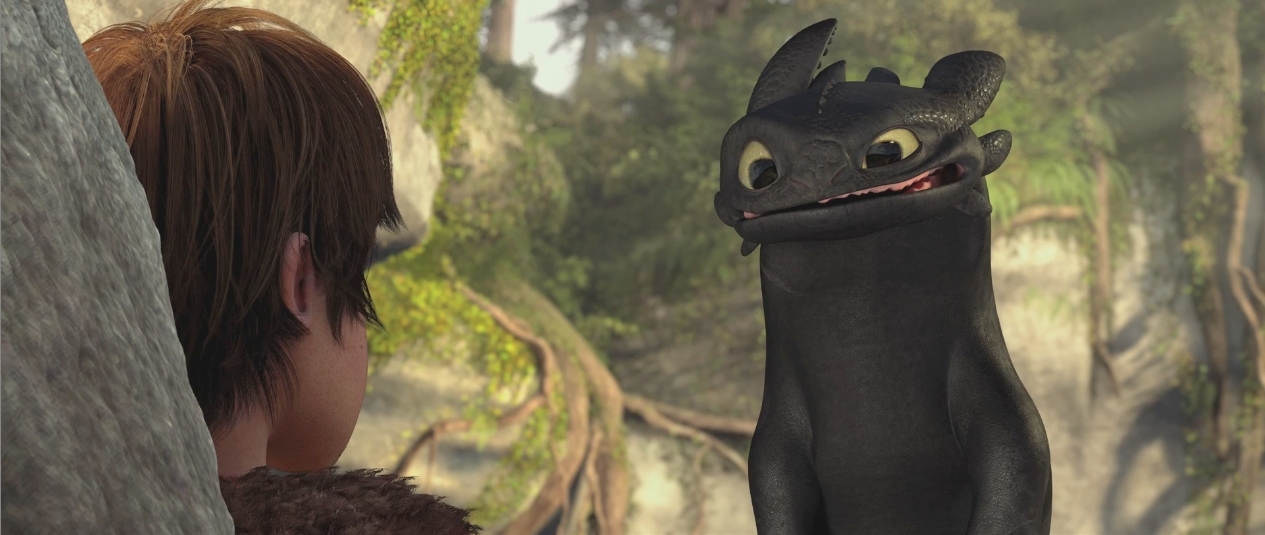
Despite the talent of the actors, the real star of the film isn’t a person at all, but an animated dragon. Toothless is a real triumph of animation – not since Wall-E has a mostly-silent computer-animated character been so easy to read, his every movement and slightest change in expression communicating to the audience exactly what he is feeling and thinking. If you’ve ever owned a cat you’ll be able to recognise a lot of this remarkable reptile’s behaviour – he’s a wonderful amalgamation of cat, bat and newt, and his movements puts one in mind of a big, scaly, territorial feline. The dragons in general are extremely well executed, and the designers and animators have managed to pull off a range of creatures that are familiar, but at the same time original, cartoony, yet still believable, a work of fantasy, but somehow grounded in some semblance of reality.

There’s a lot of passion, time and energy put into making Dragon’s world believable. The filmmakers allow for the appropriate amount of time for an audience to learn about and to understand a new culture. There are references to everything from other fantasy films and literature to RPG video games, making for a hugely appealing mix.

Even with all of these stunning elements, How to Train Your Dragon could have still fallen short, as in the end, it comes down to one thing, the story. Luckily, it succeeds on this front too. It’s just a good old-fashioned fable with a timeless moral – don’t judge a book by it’s cover. It’s also a coming-of-age story, a comment on father-son relationships and a warning against humanity’s tendency to destroy that which it does not understand. It’s always foremost a story about a boy and his endearing but dangerous pet, and how their relationship develops over time, which has an undeniable universal appeal.

How to Train Your Dragon is so much more than an animated family feature film. It’s engaging, original and expertly crafted in every aspect. It manages to comment on serious issues on quite a profound level without ever becoming preachy. It’s hugely critical of mankind’s destructive tendencies and of society’s pressure to hide your real self. And of course, it’s a feast for the eyes, ears and heart. With features like KUNG FU PANDA, MONSTERS VS. ALIENS and How to Train Your Dragon, DreamWorks Animation are fast becoming very serious contenders for Pixar’s crown, especially if this hit-rate continues, and Pixar continues to slip. SSP

Posted in Film, Film Review | Tagged , , , , , , , , , , , , , , , , , , | 1 Comment

Review: Blue Is the Warmest Colour (2013)

Lea Seydoux Adele Exarchopoulos

Love at first…: Quat’sous Films/Wild Bunch

BLUE IS THE WARMEST COLOUR stole the show at last year’s Cannes Film Festival, with critics showering it with praise for the sterling work of writer-director Abdellatif Kechiche, and particularly the film’s two leads Adèle Exarchopoulos and Léa Seydoux. With a film receiving such acclaim, perhaps I was always going to be disappointed, and I was slightly.

Adèle (Exarchopoulos) is a typical, if shy, French teenager – she goes to school, gossips with friends, fantasises about falling in love, has a comfortable home life with her parents. Adèle’s focus in life is shifted irreversibly when she falls in love with an older blue-haired art student, Emma (Seydoux) and consequently gets cruelly ostracised by her clique of school friends. We follow the ins and outs of their relationship over several years, and watch as their professional and personal lives begin to compete.

Let’s not avoid the obvious – there’s a lot of sex in the film, and film sex is almost never sexy. You can also tell that a man directed these scenes, and understand the two leads’ bad blood with him for their treatment.

Far sexier are the numerous scenes of eating (not like that). I don’t think I’ve ever seen so much food consumed on film, and it’s all shoveled in without airs and graces, in domestic settings while talking or watching TV. Supposedly, Adèle Exarchopoulos was cast because of the distinctive way she ate, and that certainly comes off on film. The most erotic part of the whole film is when the two leads are fully clothed, ungraceful and awkward in a cafe, and is far more involving and sexually charged than any of the seedy, over-choreographed male gaze-driven scenes of them in the buff.

Everything else is pretty solid. The film works as a heartfelt coming-of-age romance, as a mature exploration of sexuality and sense of self, as a fascinating snapshot of contemporary French society, all presented in a way, as Eddie Izzard would describe it that is “kinda French”. Not many would discuss philosophy at garden parties, but if anyone actually does, then it’s probably the French.

Adèle Exarchopoulos is a real find, effortlessly natural, warm and convincing as a nervy teenager on a voyage of passionate self-discovery. The physical tics she gives Adèle, from her bashful smile to her near-constant toying with her hair are endearing, and bring her to vivid life. Emma is outwardly strong one in their relationship, but no less flawed and fragile – she is progressively blinded by professional ambition, by her art and her need to express herself, even if it comes at the expense of affection for Adèle. While others in cast give good performances, the film is always about the core romance, and the narrative focus never really shifts from it. Adèle and Emma are all that matter, and you’re so close, so intimate with these two loved-up young women that by the end of the film you feel like you’ve been through exactly the same journey, growing and going through the same turmoil with them.

Though the extended sex scenes essentially function as the film’s set pieces, the film’s sequences of spectacle, you find yourself a little put out whenever one happens, getting in the way as they do of a tender love story. I’m not even particularly prudish, or against showing sex on film – sex scenes are fine when they serve and advance the story. SHORTBUS, for instance, is a film primarily about sex and how it offers enlightenment and the ability for us to connect on a meaningful level, so it makes sense to have a lot of sex scenes in it as they move the story on and advance the characters.

Blue is the Warmest Colour, though, is at its best when the characters keep their clothes on. When people are talking, debating, arguing or eating, it’s enthralling. When they’re making love (though the deliberate way the scenes are constructed hardly justify the use of that euphemism) it’s just uncomfortable, and let’s be clear here, the same would be the case if it was a heterosexual relationship being depicted. The scenes are just too long, too emotionally stilted. These extensively choreographed and carefully filmed, almost “porny” sex scenes also stylisically jar with the naturalistic cinematography and improvisation of the the rest of the film. Sex in Shortbus was messy and natural, a passionate pile-on of flesh, but Blue is the Warmest Colour’s sex is too calculated. It’s also received too much attention in the media purely for being a lesbian relationship being depicted, though perhaps what should have been focused on more is the fact that a heterosexual man was shaping the intimate scenes between two lesbian characters exactly how he wanted it to play out.

When the film’s central couple aren’t having it off, Blue is the Warmest Colour is a beautiful film. Well-acted, filmed and confidently natural, it allows you to experience the highs and lows of falling in love and becoming an adult along with Adèle, and despite a 180-minute running time, you will be swept up the story and hardly notice how quickly time passes. Critically, though, the prominent sex scenes get in the way, and it’s the one area of the film where you really don’t want to see Abdellatif Kechiche’s fingerprints. The implications of his involvement with these scenes in addition to their final appearance promotes deep discomfort, and according to the testimonies of the actresses, these were not the only scenes that were unbearable to film. Obviously, Exarchopoulos and Seydoux don’t need me defending them – they’re perfectly able to voice their own objections (and they have) and both have promising careers ahead, but I just can’t completely discount how the tales from behind the scenes made me feel while watching. We’ve seen difficult, even abusive directors before, and incredibly bad relationships with their actors, and often this has little or no impact on the final film. Here, though, a great film becomes a good film for being a little bit icky. SSP

Posted in Film, Film Review | Tagged , , , , , , , , | 2 Comments

Penny Dreadful’s Frankenstein: Faithful and Thoughtful

Episode 102

The following article contains spoilers for Episodes 1 and 2 of Showtime’s new television series PENNY DREADFUL, and for a 196-year-old novel.

I’ll admit I’m a sucker for slightly trashy pseudo-historical romps on TV – THE TUDORS, DRACULA and now Penny Dreadful, all float my boat. I’m not entirely convinced that this latest show, which comes to us from writer John Logan (GLADIATOR, THE LAST SAMURAI, SKYFALL) balances every element. We’re only two episodes in, but already there’s too many characters from Gothic fiction running around and some jarring tonal changes from scene-to-scene. Last week, we had Dorian Gray (Reeve Carney) rutting against an Irish lilting, blood-coughing Billie Piper as his personal photographer watched one moment, then Eva Green acting out THE EXORCIST the next.

What does work extremely well in my opinion is this story’s version of Mary Shelley’s most famous creation, Dr. Victor Frankenstein and his Creature. Its a story we’ve seen told and re-told, updated and reinterpreted umpteen times since the birth of cinema, and somehow John Logan has managed to do something different with it.

We’re introduced to the good doctor (Harry Treadaway) casually, without any build-up. He’s just a creepy surgeon’s assistant with an interest in macabre research who is consulted by Timothy Dalton’s Sir Malcolm in his investigation into vampires who have taken his daughter. It is only at the end of Episode 1 that Victor Frankenstein formally introduces himself, to his ungodly creation, no less. Frankenstein proclaims to Sir Malcolm (more than a little self-aggrandising) that his research into the blurred line between life and death is the only line of intellectual thought worth pursuing by mankind. His driving force, his obsession with gaining knowledge that his fellow scientists dismiss as impossible, is in-keeping with the Frankenstein of Shelley’s novel, who is also single-minded and determined to succeed, but is eventually undone and utterly broken by his creation.

What seems odd at first in this version of the tale is Frankenstein’s relationship with the Creature, or as he is here named, Proteus (Alex Price). Following his violent, lightning-assisted birth (a convention always present in Frankenstein adaptations since Universal), Proteus and Frankenstein become fast friends. Proteus learns hungrily like his creator, and takes great joy in the thriving, living world around him, and Victor just seems happy to have some company. Their friendship is healthy, tender, even faintly erotic (just kiss already!) – a first for the Frankenstein-Monster balance on camera.

Logan’s new take on Shelley’s words doesn’t stop there, either, and for the first time we are asked to consider who the Creature was before his unnatural formation and awakening. Though it was never explicitly stated in the novel, it has always been presumed in subsequent adaptations that the Creature was made up of corpses of several men, probably ne’er-do-wells, grafted together. Proteus, aside from his prominent scarring on the chest and head, looks like a single man, perhaps tampered with over the course of Frankenstein’s experiments, but a single person who used to have his own life, his own name, nonetheless. Proteus picks up most knowledge at the rate of a child, except when he is taken on a walk to the London docks by his creator and can instantaneously reel off the names of every part of a ship as it sails past. He then heartbreakingly asks Victor “what am I?” as he realises his unnatural nature, and appears to recall his former life as a sailor.

Frankenstein hurriedly takes his creation and friend for a heart-to-heart back home before, suddenly, and shockingly, Proteus is split clean in half down the abdomen. As his ruined form falls to the floor in a heap, Rory Kinnear announces himself, as Frankenstein’s “first-born” who has come home. Here it all finally falls into place, why Frankenstein’s relationship with his creation was so drastically different to every version of the story we’ve seen before. Proteus wasn’t the same Creature we know from Shelley’s novel, but rather a second attempt to create life, to correct his mistakes. In the novel, the Creature brings great destruction on the world as a result of his horrified creator’s rejection. Penny Dreadful’s Frankenstein has obviously made the same mistake, and was determined to right these wrongs to quiet his own conscience. Clearly Kinnear, as the original Creature (incidentally, with his long dark hair and yellow eyes looking for the first time exactly as Shelley described him) has not forgiven Frankenstein’s rejection, and his first act of revenge is to destroy one who has taken his place, much like he decided to brutally murder Frankenstein’s loved ones in the novel. This also implies we might be seeing a much less sympathetic, cruel Frankensein’s Monster as Shelley wrote him, rather than the helplessly destructive, child-monsters of the Universal and Hammer Horror films.  I’m also so pleased that the tradition of casting great actors as the Creature – Karloff, Lee, DeNiro and now Kinnear – is continuing.

Where the story goes from here on will be very interesting indeed, and you almost wish an entire series was dedicated to telling a new version of Mary Shelley’s timeless tale, but if we have to put up with more possession, vampires and out-of-place gunslingers if we are to see Victor and the Creature’s story continue, then so be it. Still, poor Proteus. SSP

Posted in Film, Film Feature, Television | Tagged , , , , , , , , , , , , , , , , , , , , , , , , , | 1 Comment

Playing Catchup

reanimator3d

I’ve loved films for a long time. All my life really. I try and see as many, and as varied movies as I possibly can. But you can only watch so much in a year, and there are still a few notable films that have passed me by. I’ve been trying my utmost to correct these oversights, so here are a few of my most recent first-time watches, along with my take on them.

POINT BREAK (1991)

Kathryn Bigelow doesn’t just make technically brilliant action movies, but beautiful action movies driven by character and human emotion. That was obvious to most in THE HURT LOCKER, but it’s also easy to see in POINT BREAK. You really don’t expect a film wish such a trashy premise as FBI agent going undercover as a surfer to catch a gang of bank robbers would be this nuanced. Keanu Reeves is allowed to go full-on “whoa dude” as newbie agent Johnny Utah tries to blend in, and he has great chemistry with Patrick Swayze’s Bodhi and Lori Petty’s Tyler – both, in their way, fascinating characters. The surfing scenes are great, the heist scenes are great, it features one of the all-time greatest foot chases on film (both in terms of flawless execution and the compelling stage in the characters’ development that drives it). W. Peter Iliff’s screenplay is zippy and funny, too, and allows for several unexpected, soulful punches in and amongst the action.

FACE/OFF (1997)

I know it’s one of the most ridiculous movies ever made, but I’ll be damned if it isn’t fun. Take two actors who at this stage of their careers had become parodies of themselves, and come up with a plot contrivance that allows them to impersonate each other. John Woo’s action direction is typically flamboyant and dove-filled, and both John Travolta and Nicolas Cage seem to enjoy having a filmmaker’s blessing to act full-on crazy. Travolta’s Cage impression is better than Cage’s Travolta, but that’s mostly because anyone trying to do Nicolas Cage has such an abundance of personality and performance peculiarities to work with (whereas Travolta tends to play more straight men when not in musicals or comedies). Both take turns to play the idealistic hero and the criminal mastermind, and manage to mask to script’s shortcomings through sheer commitment to their performances which come with a generous helping of the finest, dry-cured ham.

RE-ANIMATOR (1985)

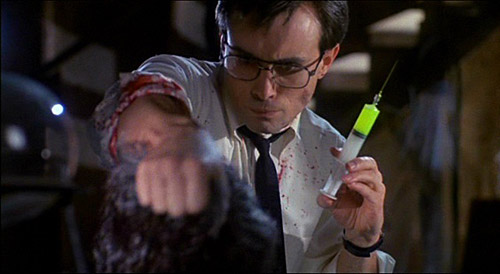
I’m a fan of a lot of movies that are considered “cult” – THE ROCKY HORROR PICTURE SHOW, THE CROW, ICHI THE KILLER – but this one had passed me by. How had I allowed this to happen? It’s amazing! An excessive, incredibly dark and smart horror packed full of energy with (still) great gore effects and a unique sense of humour. Inspired by H.P. Lovecraft, it shows more than a little of Mary Shelley’s influence as well. It’s packed full of so much casual depravity, blood, guts and nudity (the reason for the latter is due to several extended sequences set in a morgue and involving the return to life of its residents) that you can fully understand the captivation of 80s audiences, and even more understand why it is still popular today. Incredibly, it makes Peter Jackson and Sam Raimi’s efforts around the same period (as enjoyable as they are) seem quite tame in comparison.

Most pleased I’ve now seen: Re-animator (because it’s an unapologetic, yet sharp and aware trash-fest with a mesmeric OTT turn from Jeffrey Combs). SSP

Posted in Film, Film Review | Tagged , , , , , , , , , , , , , , , , , , , , , , , , | Leave a comment

Review: X-Men: Days of Future Past (2014)

????????????

X-Men: Days of Future Past (2014): Fox/Bad Hat Harry

It was a tall order for Bryan Singer – who returned to helm the film franchise he fathered after a decade’s absence – to bring together two ensemble movie casts in an ambitious (and perhaps foolhardy) time travel story that celebrates the past and the future of the longest-running continuous superhero film series. I’m pleased to report that X-MEN: DAYS OF FUTURE PAST is, for the most part, a sturdy, thoughtful, often exhilarating and well-performed mutant extravaganza.

In the near future, cities have been reduced to desolate wastelands by Sentinels, nigh-on unstoppable killing machines designed to track and exterminate human mutants, who are hunting for the final pocket of resistance, the few surviving members of the X-Men.  In order to avert the dark future they inhabit, Professor X (Patrick Stewart) and Magneto (Ian McKellen) decide to project Wolverine’s (Hugh Jackman) consciousness back in time to his younger body in 1973 in order to prevent a key event that catalysed anti-mutant feelings and lead to the creation of the Sentinels. Wolverine must find and convince the younger Professor X and Magneto (James McAvoy and Michael Fassbender) to work together and stop Mystique (Jennifer Lawrence) whose assassination of the Sentinel mastermind Bolivar Trask (Peter Dinklage) will ultimately seal their kind’s fate.

There are appearances from mutants old and new, but it is super-speedy Quicksilver’s (Evan Peters) brief but deliriously entertaining turn that steals the show. The key set piece built around his abilities, while being highly unconventional scene in its conception, rivals Nightcrawler’s stunning introduction in X2 as the best action sequence in the series. I fell completely in love with Peter Maximoff as a character to the extent that I want him to play a part in every one of the future X-movies, and Peters’ portrayal of a young man clearly enjoying having superpowers is so refreshingly different from the usual broken, troubled souls that usually inhabit the spandex. Aaron Taylor-Johnson has a veritable mountain to climb to best Peters when AVENGERS: AGE OF ULTRON comes around next year.

Quicksilver’s action scene follows on from busting Magneto out of his cell below the Pentagon (where somehow Erik has managed to stay clean-shaven in his ten-year, metal-free incarceration) and Fassbender is pleasingly bringing more McKellen out in his performance this time round, which somewhat makes up for the latter not having a whole lot to do. It’s nice to see most of both casts return, even in minor roles or surprise cameos, but it’s inevitable that some characters are under-served, and after all the series has always struggled to balance ensembles (apart from in X2).

The beating heart of the film smartly still comes from the strained sibling relationship between Charles and Raven, which is just as compelling as it was in FIRST CLASS, and also gets a certain amount of closure here. Lawrence’s Mystique drives much of the action, but also brings out a lot of the film’s pathos. Nicholas Hoult is reliable as usual, as is Jackman playing Wolverine for the seventh time, but McAvoy is the one who really has to work to sell the emotional and physical pain for his unique dilemma. Writer Simon Kinberg has come up with an interesting idea to give young Xavier more conflict, and a stronger character arc, which I won’t spoil here, but it results in one of the most important and powerful moments in the film, and in turn leads to the much-hyped telepathic conversation between past and future Professor X, which is brief, but absolutely perfect in terms of fitting with and developing on what we’ve learned about their characters over the series.

Out of the future X-Men, Ellen Page probably stands out the most, and Shadowcat’s place as facilitator and stabiliser of the time travel element of the plot adds a certain amount of jeopardy and need for her character to make it out unscathed. Iceman (Shawn Ashmore), Colossus (Daniel Cudmore) and Storm (Halle Berry) do a fair amount of fighting along with new additions of the portal creator Blink (Fan Bingbing), the agile Warpath (Booboo Stewart), fiery Sunspot (Adan Canto) and comic fan favourite and massive future gun wielder Bishop (Omar Sy) but don’t have much dialogue. It’s a shame that Storm, Iceman and Colossus, who have been part of the series since the first films weren’t given more of a chance to act, but the newcomers and their abilities are all too visually interesting to be wasted, and will doubtless be back in future instalments.

In terms of being a celebratory X-movie, lots of attention has been dedicated to referencing the franchise’s own history. I personally got a particular kick out of the reprisal of X2-esque title sequence and John Ottman’s main theme music. As well as having the highest stakes, and the gloomiest implications, it’s also the funniest X-Men film, with gags aplenty referencing the previous movies (and the characters’ chronological futures) and poking gentle fun at the comics they are based on. There’s a casual, almost throwaway line that acknowledges a certain mutant’s parentage in a manner similar to a conversation that took place in X2 that will raise a smile from those in the know. It’s also fun to see certain mundane aspects of 70s life and culture – the fashion (Xavier and Hank wear terrible shirts and flares), the gimmicks (Wolverine wakes up on a waterbed next to a lava lamp), the limited technology (Hank seems very proud to have linked up all three TV channels in his tech room), appropriated by this really out-there story for comic effect.

The film is well-served, but not over-stuffed in terms of action. Sadly, comic book movie audiences will now always be expecting another AVENGERS, and lightning likely won’t strike twice or thrice on these terms until Avengers 2 and 3. The film opens with an inventive sequence of the future X-Men working together and combining their powers to try and hold off a pack of Sentinels who have just discovered their sanctuary. As already mentioned, Quicksilver’s playful action scene is fantastic, Mystique kicks all kinds of ass and we get to see what Magneto can do with a freight train and later, an entire football stadium. The Sentinels, particularly in their ultimate dark future forms, are interestingly designed and convincingly adaptable and deadly, and Singer doesn’t shy from showing you just what they can do to our favourite mutant team. I usually hate the appropriation of real-world disasters in blockbusters where the events are trivialised for the sake of spectacle (as the Cuban Missile Crisis was in First Class), but the right balance is struck here with JFK’s assassination and the Vietnam War informing the plot in the background, but never used as the main focus of the story.

A question you have always have to ask with a time travel film is “does it make sense?” Or, if not exactly sense, “can you follow the logic?”. Days of Future Past follows the principal that actions in the past don’t change future events until the traveler returns to their point of origin (apparently this is related to String Theory). There is always a tension with Wolverine’s consciousness remaining in the past to achieve what he has to achieve, which becomes more difficult as he witnesses traumatic events in the past and experiences real physical trauma while his body is prone and helpless in the future. The act of changing past events also implies a different timeline for future X-Men films – like with JJ Abrams’ STAR TREK reboot, Singer and any other filmmakers who become involved with the series are no longer limited by what has come before. This, promisingly, could mean a prominent return of characters who were perhaps underused in the previous movies (Cyclops and Rogue in the sequels, for instance).

X-Men: Days of Future Past is a good time travel film, a great superhero sequel and a fascinating leap forward in the journeys of these iconic characters. It doesn’t quite mask the continuity errors that have cropped up in such a long-running franchise, and some characters aren’t given their dues, but the ones that matter are allowed to progress in their journeys, and to really evolve. It’s refreshing to see a major blockbuster not dominated by excessive action sequences too – what there is is original and unusual and inventive, and revolutionise superheroic set pieces to a large extent. But most satisfactorily of all, for once the final kick comes from character development rather than outright scale, which was a smart move from Singer and Kinberg, and promises much for the future of the X-Men. SSP


Posted in Film, Film Review | Tagged , , , , , , , , , , , , , , , , , , , , , , , , , , , , , , , , | 1 Comment

Superhero Movies Before They Were Cool

crow-post-1

Once upon a time, superhero movies were not the norm. They didn’t dominate. They certainly weren’t the most popular and profitable film genre on the planet. Hollywood had had dalliances with comic book adaptations, for sure – Christopher Reeve’s SUPERMAN movies of the 70s and 80s, and the Tim Burton/Michael Keaton BATMAN films of the 80s and 90s, but the capes and spandex had yet to take hold. What superheroes that did emerge beyond the Boy Scout and the Bat tended to be far darker and lesser-known, with a smaller box office, but no less interesting.  Here’s three of the most notable examples, what they meant then, and how they influenced the industry today.

DARKMAN (1990)

DARKMAN is a long-standing template for dark superhero movies (arguably even above Burton’s Batman). It’s the only original superhero (not adapted from a pre-existing comic) on the list, and that’s only because Sam Raimi couldn’t secure the rights to the superhero he wanted to use (The Shadow).

In his breakthrough role, Liam Neeson plays Peyton Westlake, a scientist horribly burned when he is the victim of a mobster’s shakedown in revenge for Westlake’s lawyer girlfriend’s rooting out of underworld corruption. Now immune to pain and highly mentally unstable, he shrouds himself in bandages and becomes Darkman, a good-hearted monster determined to finish his work and driven by regret, love and revenge.

In Darkman, you can see Sam Raimi’s career in microcosm – he still hasn’t abandoned his mischievous comedy-horror roots in the EVIL DEAD films, but he is just starting to move towards the more mainstream fare epitomised by SPIDER-MAN. He also pays affectionate tribute to the Universal Horror movies in the way the film looks, and what is driving it underneath. Darkman himself looks like the lovechild of antagonists of THE MUMMY and THE INVISIBLE MAN, and his motivations are somewhere between the doctor in FRANKENSTEIN and the eponymous PHANTOM OF THE OPERA.

Despite the horror and superhero elements, like a lot of Raimi films, you have to be able to stomach a certain amount of camp to really enjoy this one, and the action set pieces are looking more threadbare than other early 90s movies. The special makeup effects are still fantastic, though, and it’s entertaining to watch Neeson give a really over-the-top performance.

THE CROW (1994)

Still as thematically satisfying and character-driven as ever, Alex Proyas’ cult masterpiece THE CROW still packs a punch today, even without the unexpected real-life tragedy of Brandon Lee. It’s influenced everything from THE MATRIX to THE DARK KNIGHT in terms of aesthetics, and though it was never more than a sleeper hit on release (beyond morbid curiosity) it has had a lasting impact.

Eric Draven (Lee) lived a happy bohemian life with his girlfriend before they were both brutalised and killed by a gang looking for a kick on Devil’s Night. But Eric’s spirit isn’t letting go of his grip on the world of the living without a fight, at least not until justice is done…

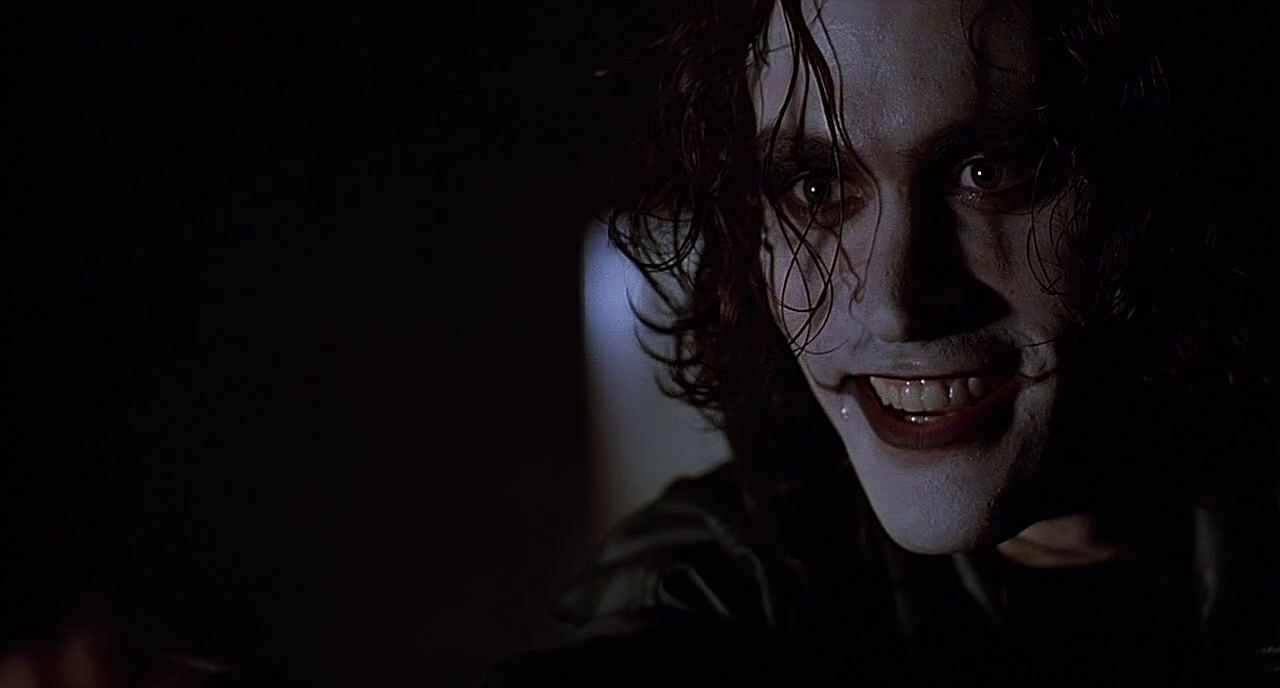
A film about a resurrected murder victim seeking violent revenge of course has to be dark, and The Crow is, very much so. But it’s also really funny. Brandon Lee relishes Eric’s gallows humour (just looks at his face when he asks his victim “is that gasoline I smell” before blowing up his pawn shop) and played captivating unhinged long before Heath Ledger. Michael Wincott’s foul fencing fanatic gang boss Top Dollar is a memorable antagonist, entertaining in the way film villains used to be – simply enjoying being nasty – in the days before every bad guy had to have a sympathetic streak. Add to this a killer goth rock soundtrack, and you’ve got the makings of an enduring cult classic.

I’m actually surprised the avenging angel as superhero movie hasn’t been attempted more since this. It’s the perfect excuse for your movie to be cool and moody, and allows for the exploration of grand, complex pseudo-religious themes and the unapologetic punishment of bad people. As influential on good films as it was, The Crow did also give birth to some truly terrible sequels that didn’t even have the dignity to be awful in their own right, but rather repeated the exact same beats of the Proyas/Lee original,  but badly. No-one could match Lee’s portrayal of course, but the villains were dull as well, and the sequels also lacked the beating heart in this film that chiefly came from Eric’s brotherly relationship with the waifish Sarah (Rochelle Davis).

SPAWN (1997)

SPAWN had brilliant production design, and the effects are still interesting enough to (mostly) still hold up, but the ambitious themes and scale makes the plot a mess and the performances and screenplay leave a lot to be desired. Being a comic book adaptation is not an excuse to completely lack nuance. Michael Jai White is OK, and John Leguizamo is irritatingly funny, but Martin Sheen is God-awful.

Like The Crow, Spawn tells the story of a murdered man returning to the world of the living for revenge against his killers. Unlike Eric Draven, Al Simmons (White) was not an innocent, always inhabiting a morally grey area as he employed his considerable skill as an assassin of high-profile targets. When he is betrayed and murdered, he makes a deal with the Devil to return to Earth to save his family and stop his killers from unleashing a new hell on the world.

I’m not saying there aren’t some great ideas on show, but few of them are executed well. You have to balance a lot of competing narrative, tonal and thematic elements to successfully pull off a story about the eternal battle between good and evil, and much of Spawn feels skewed in the wrong direction for one reason or another. The visual effects are undeniably influential on the good (HELLBOY), the bad (GHOST RIDER) and the interesting (NIGHT WATCH), and a superhero’s suit has rarely looked so awesome on film. Also as the first big screen live-action African American superhero, arguably without Spawn, you might never have had BLADE.

If Alex Proyas had directed this as originally planned, the whole thing might have ended up more coherent, but then we might have never seen DARK CITY, which would be a terrible loss for cinema. SSP

Posted in Film, Film Feature | Tagged , , , , , , , , , , , , , , , , , , , , , , , , , , , , , , , , , , , | Leave a comment

Review: Godzilla (2014)

godzilla-trailer-02

Godzilla (2016): Legendary/Warner Bros

60 years ago, film studio Toho burst onto the international stage with GODZILLA, an astonishing fantasy analogy for the Japanese nightmares of Hiroshima and Nagasaki. In 2014,  a new version of the tale has emerged from MONSTERS director Gareth Edwards. Tragically, Evans’ second feature is not very good, and not a patch on the original Godzilla.

The film opens in 1999, where two scientists (Ken Watanabe and Sally Hawkins) investigate the accidental excavation of some colossal animal remains in the Philippines. Along with a reptilian skeleton the size of a skyscraper, they discover something has hatched from a pair of strange eggs and is heading straight for the Japanese mainland. On the outskirts of Tokyo, nuclear physicist Joe Brody (Bryan Cranston) discovers some seismic anomalies and advises the immediate evacuation of the plant he oversees, but not in time to save his wife (Juliette Binoche) who was trying to repair the core. Driven by his guilt and obsession with finding the truth, Joe spends over a decade digging for answers, sweeping up his unwitting, estranged Naval officer son Ford (Aaron Taylor-Johnson) in the process,  just in time for monsters new and old to make their presence known to the world.

Edwards’ Godzilla nods to the original 1954 Toho film in a couple of sequences (a monorail train comes off quite badly from crossing paths with a monster, Watanabe shares a name and little else with a character from the earlier film), but the real lifeblood of the film comes not from Ishiro Honda, but from Steven Spielberg and JURASSIC PARK. There’s an obscene amount of references to the classic dino-disaster in terms of story structure, the look and tone of certain scenes and even specific individual shots. The Jurassic Park nods include, but are not limited to: a creature imprisoned in a cage of electrified wire, and before it escapes, it pings the wire with one of its claws; a humorous moment where a bus driver has to wipe away fog from his windscreen to adequately survey the carnage going on outside his vehicle; Godzilla striking a victory pose and roaring after a particularly tough fight. There’s also a nod to Edwards’ own previous film, and I swear that there’s even a reference to Roland Emmerich’s much-maligned 1998 blockbuster, but describing it would be too much of a spoiler.

Whereas Honda’s Godzilla had nuance, depth and something important to say, Edwards’ film feels annoyingly non-committal. It never dares to make the leap to blame any one source for the events of the film. The Toho Godzilla was unashamedly an anti-nuclear, anti-war piece, but this movie can’t seem to decide whether nuclear power, the destruction of nature, pollution, or mankind’s violent nature are to blame. It tries to suggest it was a combination of factors and ends up criticising none of them particularly harshly. It’s all just a bit wishy-washy. The same could be said for Max Borenstein’s screenplay in general really – it just lacks punch.

Godzilla’s adversaries in the film, the radiation-sustained monsters dubbed “MUTOs” are really dull in their inception, like a lazy amalgamation of the creatures from STARSHIP TROOPERS and CLOVERFIELD. They gave me a newfound appreciation of how much effort and creativity went into designing the vibrant and varied kaiju of PACIFIC RIM.

Aaron Taylor-Johnson makes for a serviceable but vanilla hero. His motivations – the protection of his young family (Elizabeth Olsen and Carson Bolde) and a general sense of duty – make sense, but the macho-reckless way he goes about fulfilling them defy logic, and undermine his character. It could have been really interesting having a young military father torn between his paternal instincts and his patriotic drive, but instead, half the time Ford seems to forget he has a family. The more talented cast members are either under-used (Cranston) or are good, but not good enough to support an entire film  (Watanable, Hawkins).

Alexandre Desplat’s score for the movie is admittedly gorgeous, a bright spot in a world of grey and brown. It’s grand and rich and sits perfectly between East and West composition styles.

It’s also nice to see a stylish title sequence (oh how I miss title sequences from modern filmmaking) that establishes the background to the plot in the form of a classified newsreel montage. The HALO jump that has been splashed all over the marketing is very impressively constructed too, but as I said, it was all over the marketing, and the sequence doesn’t last much longer than it did in the trailer.

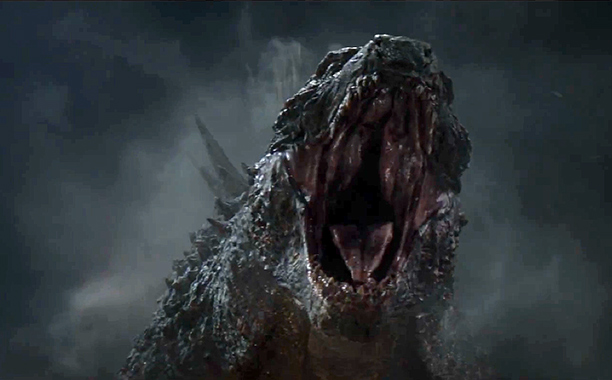
The idea that Godzilla essentially functions as nature’s factory reset button is pretty clever too, but the big scaly dude himself is hardly ever there. When he’s on-screen, either standing proud against devastated cityscapes, or swimming crocodile-like between aircraft carriers with his towering spines exposed, or unleashing his secret weapon (Godzilla fans – yes, they’ve brought it back) he looks and sounds amazing, but I didn’t feel like I’d really got my Godzilla fix, and as weird as it sounds, I didn’t feel that I got to know him, which isn’t good in a film about, and titled, Godzilla.

Gareth Edwards’ take on Godzilla had a lot of potential – a solid cast, an interesting up-and-coming director and a studio that only last year delivered some great giant monster carnage. But Edwards evidently isn’t Guillermo del Toro, at least not yet. He may have bitten off more than he could chew by going straight from independent creature sleeper hit to helming the latest revival of one of the biggest icons in creature feature history. If only the script, the performances and the plotting had been as impactful as the soundtrack and visuals. Warner Brothers have already announced that a sequel is on its way, so maybe that will be better. SSP

Posted in Film, Film Review | Tagged , , , , , , , , , , , , , , , , , , , , , , , , | 5 Comments