Review: Pan (2015)

Pan

The first stretch of PAN combines the orphans and workhouse of OLIVER TWIST with the WWII setting and fantasy bleeding into the real world of THE CHRONICLES OF NARNIA. . Then things go all Terry Gilliam but with less verve as a pirate ship swoops through the London Blitz and we’re off on a thoroughly uninspiring adventure.

The latest “so you think you know this story?” retelling of a classic follows orphaned Peter (Levi Miller) as he is scooped Roup by pirates and transported to an otherworldly island. There he finds the tyrannical Blackbeard (Hugh Jackman) who is forcing an enslaved workforce of children and outcasts to mine crystals imbued with fairy magic to maintain his unnatural eternal life. Peter soon finds destiny calling, and with the help of warrior princess Tiger Lily (Rooney Mara) and dashing rogue Hook (Garrett Hedlund) he sets out to unlock the power inside himself and free Neverland.

There are some terribly inventive visuals on show here – oceans suspended in bubbles in the clouds; the bark on a tree shifting to tell the story of a war between tribespeople and pirates. The crocodiles look great too for the very brief time they’re on screen. Other parts of the film’s aesthetic are decidedly less impressive, with fake-looking environments and “Neverbirds” that look like the animation software hasn’t finished rendering them yet.

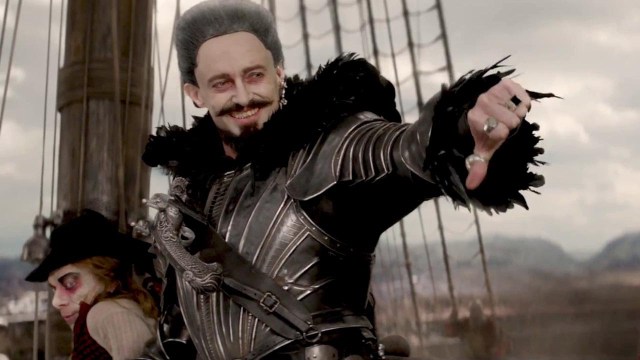
I was sold on Hugh Jackman’s Blackbeard from the moment he minced out to address the crowd chanting Nirvana’s Smells Like Teen Spirit (because why not?). He’s a firework display of high-camp and Child Catcher sinisterness. His powdered and bewigged look and playing-to-the -back-row performance is also entirely in-keeping with Peter Pan’s theatrical origins and continued popularity as a pantomime. There’s also zero reason why he couldn’t just be playing Captain Hook other than origin stories being all the range these days. Garrett Hedlund is awful as a young Hook. He plays him like Han Solo without a drop of charm, plus a nails-on-chalkboard voice that sounds like a British actor doing a bad American accent (despite Hedlund actually being American). He also tends to forget about his crocodyliphobia from scene to scene. Levi Miller is fine, but doesn’t make the biggest impact as Peter and Rooney Mara is given nothing to work with but her incongruous Doc Martens as Tiger Lily.

The film thinks it’s funny and endearing but it sadly isn’t either. Gags are either based on men and boys falling over or getting hit in the family jewels, clumsy references to the source material (“The boy is lost?” / “Yes he is a lost boy”) or non-jokes like Peter exclaiming on his arrival to Neverland “Is this…Canada?”

The action is by-the-numbers and every demise in battle inconsequential – I know this is a family film, but pirates falling out of shot or into holes and tribespeople becoming puffs of brightly-coloured dust when they’re shot or stabbed means nothing. You couldn’t really be graphic with the intended audience in mind, but you can acknowledge that people die when swords and guns are involved.

By the end of the film we’re not even finished with Peter Pan’s origin. The key characters still have some way to go before they reach the point in their arcs we find them in JM Barrie’s play/novel, so you find yourself thinking, what was the point? If you’re going to depart from your source material, there has to be a good reason for doing so, and it at the very least has to be memorable.

When we first heard that Blackbeard’s slave miners sang Nirvana and The Ramones and Peter, Hook and Tiger Lily would all come from different periods of history, I though Joe Wright was going to do some really interesting, distinctive stuff with the concept of time, with Neverland existing outside the traditional linear concept of its passing. Infuriatingly, nothing is done with this idea. There was controversy when Mara was cast as a character usually portrayed as Native American, but it didn’t bother me when I realised the tribe in the film was a patchwork hippie commune rather than anything culturally based. Nothing is done with this idea either – where do these mixture of people and fashions come from and how did they construct their society? Nobody making the film seemed to care so neither should we.

Pan wastes talent and potential throughout and continues straight on until morning. It’s dull, apes better films it wishes it could compare to and in the end feels entirely unnecessary. By all means come for Hugh Jackman’s hypnotic flamboyance, just don’t hang around for anything else. SSP
Posted in Film, Film Review | Tagged , , , , , , , , , , , , , , , , | Leave a comment

20 Years On: Trainspotting (1996)

Trainspotting

It’s that time again: enough sand has passed through the hourglass of eternity to discuss another classic in retrospective fashion. This week marks the 20th Anniversary of TRAINSPOTTING, Danny Boyle’s striking adaptation of Irvine Welsh’s game-changing novel about Edinburgh heroin addicts.

It’s Edinburgh in the late 80s, and Renton (Ewan McGregor) is trying to kick a bad habit. Try as he might to quit, the lure of one last hit with his mates always brings him back under the influence of his cruel and terrible mistress.  The world of heroin addiction fueled by petty crime is all he knows, and soon he must chose between being happily enslaved by his addiction or cleaning up and taking on whatever else life throws at him. 

Danny Boyle’s regular screenwriter John Hodge respectfully adapts Irvine Welsh’s story, lifting key scenes (“The Worst Toilet in Scotland”) and memorable dialogue (these remain the most articulate, swearily poetic addicts you could ever hope to meet) completely intact, but he isn’t afraid to streamline things elsewhere for the screen either by combining characters and omitting extraneous scenes. The result is zippy and to the point, perhaps missing a little of the detailed richness of the novel but always with what our protagonists are going through and how their world is changing for better or worse pushed to the forefront.

The casting could hardly be better, from Ewan McGregor’s would-be-moral compass Renton to Ewen Bremner’s affable moron Spud and Robert Carlyle’s volcanic and utterly terrifying Begbie. Renton has arguably had a few of his rough edges removed by casting the charming McGregor in the role, and I miss his benefit fraud scheme from the novel, but Bremner feels like spud lurched straight from page to screen and it was a stroke of genius to cast the diminutive, wiry Carlyle as a character envisioned as tall and broad – somehow Franco feels so much more chilling and unpredictable this way. Every cast member gets their moment to shine with hints at promising careers to come, and all convincingly covey humanity warts and all.

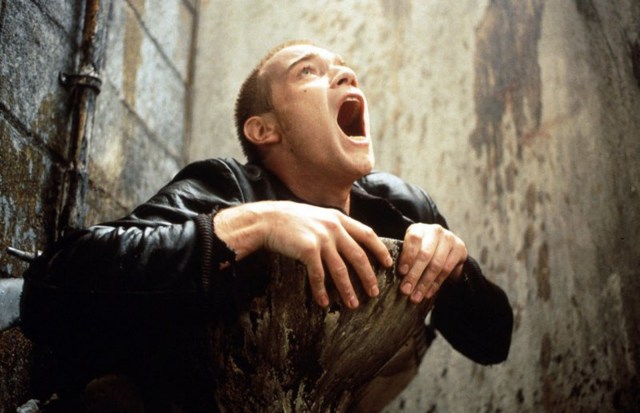
Boyle and editor Masahiro Hirakubo recognise the potential for surrealism in a story where its heroes are so often tripping. Renton’s dive into an ocean through a hellish, bottomless toilet to retrieve his recently ejected opium suppositories and his sink into the oblivion of a shag carpet following an overdose from a bad batch represent  two of his very lowest points juxtaposed with beautiful and bizarre imagery. The filmmakers don’t avoid the upsetting realities of drug addiction, and certainly don’t glamorise it as some commentators so wrongly claimed (you have to wonder if they even saw the film) but it can be a powerful tool indeed to marry horror with beauty, the real with the surreal.

Trainspotting is like a time capsule of pop culture and societal concerns in the late 80s/early 90s – the old guard of underground rock music (Iggy Pop, Lou Reed) giving way to electronica and rave culture (Leftfield, Underworld); unemployment, drug addiction and AIDS mere headlines for many and inescapable everyday life for others. It certainly looks like a film made two decades ago, but the energy, self-awareness and sheer style on show keeps it from feeling too dated. Grimy bedsit sets and the clever use of Glasgow as a cheaper stand-in for Edinburgh helps Trainspotting overcome its budgetary limitations, keeps our focus on the characters and steadfastly avoids a glamourous tourist’s view of “Embra” (the kind that poor Fringe-goer came looking for before our heroes follow him into a bathroom to ruin his day).

Much like with Welsh’s novel, the film is witty and very funny, alternating between being emotionally crushing and uplifting as Renton and co bounce between choosing heroin and choosing life. It’s left pretty ambiguous what the characters will make of the rest of their time on Earth – we’re apparently going to find out in a film sequel very soon – but you have to be optimistic for Renton as he leaves his old life and friends behind and begins a new one, reprising his opening monologue almost word-for-word, but with a decidedly different tone in his voice. SSP


Posted in Classic Film, Film, Film Feature, Film Review | Tagged , , , , , , , , , , , , , , , , | 3 Comments

Review: Slow West (2015)

la-et-mn-slow-west-review-20150515

SLOW WEST is a bit of a stunner. It’s been an interesting few years for the Western, with few traditional examples but plenty of sideways looks and genre hybrids making noise and proving there’s still life in this (very) old horse.

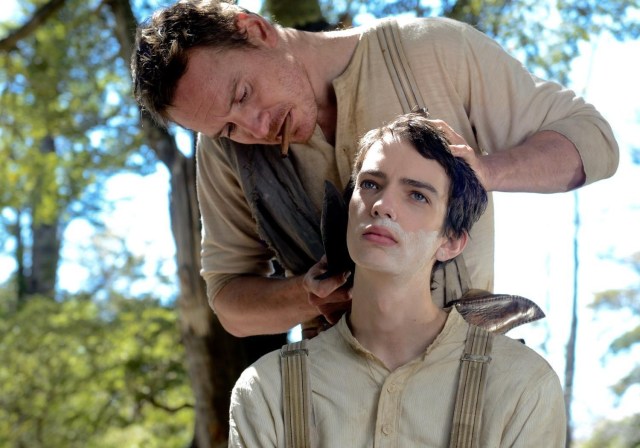
Jay Cavendish (Kodi Smit-McPhee) finds himself journeying from his native Scotland to the American frontier in search of his young love Rose (Karen Pistorius) whose family has fled across the Atlantic after an accident puts a mark on their heads. To help him across a strange land full of dangers, Jay employs the sardonic Silas (Michael Fassbender) to escort him to his intended in one piece.

This is a story that shows the mercilessness of frontier life, but also acknowledges the humour in some of these bleak situations. Jay and Silas have a tough journey into the unknown ahead and are always a mere moment away from certain death, but they still take a night to get sloshed on absinthe and awake staggering up and falling over themselves in the middle of a flash flood. They’re duped, shot at, robbed of their clothes in the wilderness and there’s a great throwaway tree-felling gag as well. It’s nice to see Fassbender getting to show off his comic chops (particularly following the bleakness of MACBETH) by bringing Silas’ pragmatic world view into conflict with that of his idealistic young charge, usually in the form of a withering comment or despairing look.

My favourite scene by far takes place early on and has the pair stopping at an unremarkable-looking shack for supplies. The inside of said construction has everything the weary traveler could possibly need to buy from guns and clothes with bloody bullet holes in them to hooch and green bacon. It’s a sequence that starts as a bit of light relief and gets dark real quick when some other travelers arrive.

It’s a beautiful film throughout. New Zealand makes both for a convincing idealistic rural Scotland and an imposing Colorado. The scenery is big and bold, the character moments detailed and intimate. One stylistic trick employed by first-time feature director John Maclean (one to watch) I loved was drawing your focus by placing key objects off-centre in the foreground as the action takes place in the background, like when Jay ditches his unwieldy boots and sprints to the back of shot to rescue his friends. The film also contains one of the most on-the-nose but thematically perfect visual representation of a metaphor in film.

This is the second recent Western after THE SALVATION to deal primarily with the experiences of European expats. For once Michael Fassbender’s accent-on-tour doesn’t matter – everyone’s from everywhere! This certainly helps mark it out from the crowd and provides a different, and arguably much more desperation-fueled motivation for these wanders wandering where they’re wandering.

Despite mixing things up and self-consciously twisting away from convention, Slow West still ends with a classic Western shootout with our heroes hold up in a cabin and a gang of bad guys coming at them from all directions. You expect some sort of last stand in a classic of this genre, but I’m sure there are other ways to cap off a Western than a quick-draw duel or wave after wave of baddies queuing up to get shot. I would have also liked a few more flashbacks to Scotland, more of a development of Jay and Rose to give the film’s final act even more emotional impact than it already has.

America’s favourite genre is becoming decidedly less American. That’s not a criticism, just an observation. The myth is starting to slip and lose its romance but the story and what it means to people is becoming no less interesting. If we have more Western reinventions like Slow West on the horizon, this genre could hang around in one form or another for a long old while yet. SSP

Posted in Film, Film Review | Tagged , , , , , , , , , , | 2 Comments

Review: Deadpool (2016)

Deadpool_Negasonic_Teenage_Warhead

Perfecting the walk in spandex: 20th Century Fox/Marvel

DEADPOOL is exactly what it should be. It’s not big (by superhero standards) and it’s not clever but it’s lewd, violent and supremely self-aware, just like its titular scarlet-clad antihero.

Wade Wilson (Ryan Reynolds) makes a dishonest living as a gun for hire, and is perfectly happy doing so until a terminal cancer diagnosis forces him to sign up for a shady medical experimentation programme designed to unlock latent mutant genes. Wade hopes his cancer will be cured so he can spend the rest of his life with Vanessa (Morena Baccarin) and the process does allow him to heal any wound, but it also leaves him scarred, angry and fully aware he’s in a superhero movie. Now Deadpool sets out to take revenge on his torturers and to tell a different kind of superhero story.

Reynolds is Deadpool. He can handle the physicality and motor-mouthed requirement of being a living adult cartoon character, but more unexpectedly he also makes Wade Wilson a vulnerable, passionate and tragic character. Much like Keira Knightley, who is name-checked in a gag, he has range. Deadpool the character may not be a fan of Reynolds the actor portraying him (they used a similar punchline in the video game he headlined a couple of years ago with regards to Nolan North) but this is the actor man who could conceivably bring this character to life in live-action. Hollywood rarely seems to know what to do with Reynolds and as such he has been stuck as the best thing in a long line of bad movies, but his passion and enthusiasm for projects like Deadpool and THE VOICES is obvious. Morena Baccarin gives as good as she gets as Vanessa, Wade’s sweary love of his life and TJ Miller deadpans with the best of them as sidekick Weasel. I really hope they give Negasonic Teenage Warhead (Briana Hildebrand) more to do in the X-Men universe as her surly teen attitude and explosive powers have interesting action potential.

Writers Rhett Reese and Paul Wernick have packed the screenplay to an inch of its life with great gags, usually at the expense of Hollywood heavyweights. In reference to Colossus (Stefan Kapicic) and Negasonic being the sole mutant heroes tasked with putting a leash on ‘Pool we have him quipping to camera “Almost like the studio couldn’t afford any more X-Men”; in another scene we find him glancing sorrowfully at a battered action figure of his previous insult of a screen incarnation in X-MEN ORIGINS:WOLVERINE. You have plenty of crude asides and rapid-fire cruel comebacks, but if there was one thing I wasn’t expecting from Deadpool it was Monty Python jokes. A skit that we come back to several times is essentially a re-jigged version of the iconic comedy troupe’s “Four Yorkshiremen” sketch with characters trying to one-up each other on bad life experiences and Deadpool’s insistence on carrying on fighting despite losing the use of his limbs reminds me of a certain Black Knight.

The film might eye-roll at most superhero movie conventions, Weasel commenting that Wade should go and talk to a shady guy in a bar simply because it might “advance the plot”; Deadpool gleefully spotting that Angel Dust (Gina Carano) is about to jump from a height and do a “superhero landing”. Despite this, the film still ends with a big scrap with the main baddie Ajax (Ed Skrein) in a monolithic scrapyard. The villains are probably the film’s weakest element, but Deadpool as a character doesn’t really need them – he’ll find someone to fight and annoy wherever he goes.

The film’s budgetary limitations are in many ways an advantage. It’s not peppered with excessive action, Deadpool admitting at one point “we didn’t have the budget for that” and he doesn’t sound sorry about this. The violent car chase seen in the trailer and test footage and a couple of smaller brawls are more than enough, and the no-frills plotting and pacing allows the movie to call it a day at a brisk 1 hr 48 minutes.

My biggest hope for Deadpool’s next outing is that he is allowed to be a bit more deranged. He’s entertainingly wacky and unconcerned about inappropriate behaviour in his solo debut, but you get very few indications of his schizophrenic nature. This is a balls-out and tonally fitting origin for Wade Wilson, but you can always make him madder and badder. SSP

Posted in Film, Film Review | Tagged , , , , , , , , , , , , , , , , , , , | 7 Comments

Review: The Martian (2015)

The-Martian-4

Almost Ridders, almost. This is undoubtedly the best thing Ridley Scott has produced in over a decade. For me though, THE MARTIAN doesn’t quite justify the plaudits it has received, but yeah it’s good. That’s pretty much it. You want a full review? Fiiine…

In the near future a manned research mission to Mars ends in disaster when an astronaut is lost in a freak storm and presumed dead. As his team leave for home, Mark Watney (Matt Damon) must try and make contact with Earth and survive alone on the Red Planet for however long it takes for help to arrive.  

Nobody makes technology look quite as good as Ridley Scott. Either it’s real mind-blowing space tech in action or it’s tactile and convincing enough for you to believe it’s real. Sooner or later he’s going to run out of ways to make space suits look like sexy fashion accessories, but these aren’t quite as egregious as the disco numbers we saw in PROMETHEUS. The film looks good in general as Scott’s films tend to, with the imposing landscapes of Jordan standing in for Mars and the action polished and convincingly realised throughout.

Matt Damon gets to play an egotistic tool with great elan, but it’s fortunate he’s such a charmer as well since we spend so much of the film’s runtime with Mark Watney talking straight at us either deploying gallows humour at his latest setback or getting increasingly livid at the awful music selection he’s been left with as his only company. I think the non-Watney scenes were intended to be an ensemble affair, but unless you’re Jeff Daniels, Jessica Chastain or Chiwetel Ejiofor then you’re not given a whole lot to do. You couldn’t accuse the cast or characters of being non-diverse, though you do have Ejiofor playing a man with an Indian surname that is clunkily explained away and Mackenzie Davis as a character with a Korean surname that weirdly isn’t discussed at all.

Drew Goddard’s screenplay is annoyingly a little inconsistent. Nothing’s badly written, but one moment we’re told exactly how Watney has solved an impossible problem in minute detail (particularly of note is how he waters his martian potato crop) and the next we skip past anything that was too difficult or boring to explain (where is NASA getting all its money from?). I think you either do one or the other – either every detail matters for the sake of immersion in your film’s world or none of it does for the sake of the fluid telling of your story. In its final form the film is a good-looking space adventure movie with tech-y asides but little else. There’s jeopardy sure, but it’s well signposted and romanticised threat to a large degree, and are we ever really in doubt that it’ll all be alright in the end?

The Martian was awarded the Golden Globe for Best Picture (Musical or Comedy) this year. I’m not going to deny the film has moments of levity, but classing it as a a comedy film is quite frankly ridiculous. Picking three genre pictures off the top of my head – JURASSIC PARK; JAWS; TOTAL RECALL – all have a roughly equal number of gags as The Martian, so are they all comedies? Basically, The Hollywood Foreign Press Association wanted to show an almost-back on form Ridley Scott some love, but felt that THE REVENANT was a worthier choice, so they bumped him down to the lighter runner-up prize.

If The Marian is an indication of things to come from Ridley Scott, especially where his sci-fi projects are concerned, then colour me optimistic. Prometheus got bogged down in mythology and delaying tactics to bring audiences back next time for the real revelations. If the next Prometheus/ALIEN movie remembers why we watch movies like this – memorable characters trying to survive whatever fresh hell the universe throws at them – as well as presenting everything with Scott’s superior level of craftsmanship, then we could be in for a much more satisfying affair. The Martian is nothing if not conventional, but it’s a solid and entertaining version of a story we know and love. SSP

Posted in Film, Film Review | Tagged , , , , , , , , , , , , , , , , , | Leave a comment

Review: Carol (2015)

carol-movie-review

When the awards come for CAROL, and come they will, it’ll be impossible (and unfair) to split Blanchett and Mara. One cannot exist without the other – the reason both actors work so well on screen how skillfully they play off of each other’s performances, how sensitively they covey Carol and Therese’s love. I doubt we’ll see joint Oscars, but you can hope.

When Therese (Rooney Mara), a shop assistant with artistic aspirations encounters elegant older socialite Carol (Cate Blanchett), the spark between them is instantaneous. Both have had disappointing relationships with men and live in an era where women are still shackled and homosexuals reviled and feared. How will they keep their love a secret as they embark on a romantic road trip and with the odds so stacked against them can such a relationship ever hope to survive?

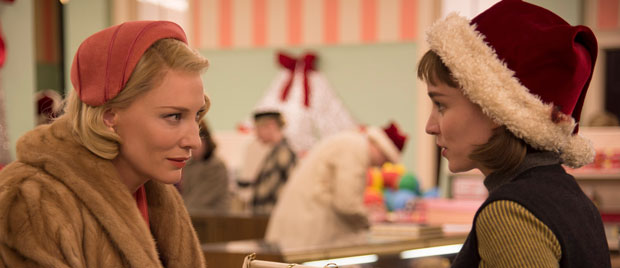
I don’t remember the last time I saw a more convincing romance on screen. As far as I could tell, that was real love in Mara’s eyes! The very deliberate ways our two leads are introduced makes the incredible contrast between their personalities, social class and background incredibly stark. Therese wakes in a moldy urban flat that is so cold she has to turn on the oven in the morning to keep from freezing. Carol breezes through the toy shop Therese (awkwardly wearing enforced Santa hat) works at all glamour – fur coat, controlled posture, seemingly complete confidence in who she is and the quality of life she is used to. You have the grounded, more rounded person and her otherworldly opposite who has far more life experience but many more issues as well. Opposites attract and all that. The pair’s relationship heats up quickly following their cute and seemingly innocent first encounter, and before you know it these women from different worlds are fully indulging in their passion for one another. Mara and Blanchett are perfect as our beleaguered lovers and you want their relationship to work despite knowing in our hearts that it this will be near-impossible living in the time and place that they do.

Tasteful as the love scenes in Carol are, there is so much fabric porn in this movie! It’s a touching romance between two people, sure, but lovers of fashion and the materials to make fashion are extremely well-served as well. You’re almost too distracted by indulgent fabrics at a key character moment when Therese paws  over her beloved’s elegant outfits while she is out of the room. Even when they are apart, they absolutely must have some form of connection through the senses to survive.

The heartfelt screenplay and gutsy performances envelop you with the help of Carter Burwell’s shamelessly romantic soaring score. The film has a very classical Golden Age of Hollywood feeling in general and this certainly feels like a novel that would have been adapted much earlier were it not for the sexuality of the lead characters. The pacing in measured, the plot upsets and heartbreak comes just about where you’d expect it, but when you’re spending time with such a lovely couple you don’t begrudge Carol’s old-fashioned construction.

The off-screen/page story behind Carol is almost as compelling as the script Phyllis Nagy adapted from the page. Semi-autobiographical and published as THE PRICE OF SALT by Patricia Highsmith (under an alias to avoid scandal), you can only imagine the artistic and moral quandary the author was under in getting this particular work out there. She wanted to tell the truth about how two women can feel for each other but feared being branded obscene, ruining her reputation and destroying her career if she put her own name to it.

I love stories of affairs of the heart that are left unresolved, just like they usually are in real life. Director Todd Haynes leaves our lovers on an ambiguous but positive note. At least I like to read the film’s final shot – Carol giving Therese a knowing look from across a crowded room – as positive. Considering the time of year it’s set and theme of love conquering all, this could become a festive staple, that is if you don’t mind not quite knowing whether you feel uplifted or downbeat when the credits roll and you’re about to tuck in to your Christmas lunch. SSP


Posted in Film, Film Review | Tagged , , , , , , , , , , , , | 2 Comments

Review: Turbo Kid (2015)

Turbo-Kid.png

Future cult classic alert! It takes an incredibly delicate touch to zip back and forth between a wholesome tale of friendship and the most exaggerated ultraviolence imaginable and have it work in harmony. TURBO KID is a bit of a marvel in that regard and is unquestionably the best BMX-based post-apocalypse movie you’re likely to see.

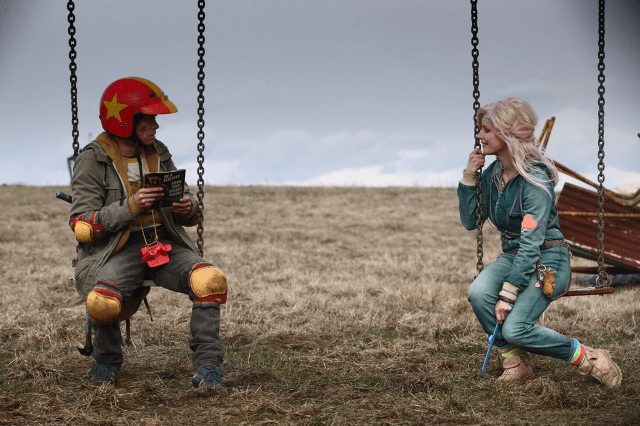
In the future, society has broken down and scavengers and raiders roam the wasteland on bikes (not the noisy kind). A kid (Munro Chambers) with a tragic past and a love of superheroes meets a strange girl (Laurence Leboeuf) in the wilderness and gets drawn into a battle against a tyrant (Michael Ironside). Only his super-suit and his trusted BMX can save him and free everyone else.

Apple is my joint-favourite movie character of 2015, tied with her (mild spoiler) fellow robot Ava from EX MACHINA. She’s the ultimate Manic Pixie Dream Girl, only more deranged and with dreams of her own and a real arc to her story. She conforms to that much-criticised archetype to begin with, then Laurence Leboeuf smashes through the limitations of the character with a raw and heartfelt performance. This, combined with the earnestness of Munro Chambers’ Turbo Kid and the chemistry they have together throughout their journey helps make this story an endearing and memorable one.

It’s nice to see Michael Ironside having fun again too. All too often in recent years has he been stuck with uninspired roles playing the general in everything. He seems to have remembered that he can do a whole lot more than look sternly at computer screens. Yes, he’s playing an authority figure again here, but he gets to be a proper maniacal bastard, and his glee (and an Ironside smile is terrifying) at watching the carnage he orders unfold in front of him is palpable.

The film is a great advert for transnational filmmaking: independent film studios from Canada and New Zealand, an international cast and some production design and effects wizards who clearly deserve more widespread recognition all working in unison to produce a very satisfying whole. We’ve seen Hollywood directors (Tarantino, Scorsese) offering their patronage to independent filmmakers and lesser-known foreign auteurs before, but it’s also good to see smaller studios banding together to get their products out their under their own esteem.

Too often with sci-fi movies the effects get in the way of the ideas. Sometimes even if the ideas remain the focus they aren’t enough to make up for an uninspiring plotting and characters. Gratifyingly, the makers of Turbo Kid (writer-directors François Simard, Anouk Whissell and Yoann-Karl Whissell) know that a compelling story starts with great characters. They don’t have to be especially complex, but they have to be well-defined and with clear motivations. It’s absolutely key that the characters here are strong and that it doesn’t take itself remotely seriously beyond making sure the central relationship works. If this aspect of Turbo Kid’s writing and performance fell flat there wouldn’t be a whole lot to fall back on because the budget is only one step removed from cardboard sets and shop-bought kids’ Halloween costumes and the filmmakers can only just afford to utilise a single quarry location.

If I’m honest, when I saw Turbo Kid advertised I expected passable schlock. Schlock is delivered in spades from the copious blood-splatter and dismemberment to the unashamedly B-movie dialogue and hammy performances. But gratifyingly overall it turns out to be a pulpy treat that overcomes its budgetary limitations and low-brow trappings with verve, intelligence and a can-do attitude. More like this please and the film landscape might become a better place. SSP

Posted in Film, Film Review | Tagged , , , , , , , , , , , , , | 1 Comment

Review: Creed (2015)

creed2

Astoundingly, CREED works equally well as a continuation of the ROCKY series and as a film in its own right. You might have expected one or the other, but it is an impressive balancing act to have it deliver as both. Sylvester Stallone has stepped back from his baby and allowed Ryan Coogler to tell the story he wants to tell much to the film’s benefit.

Adonis Johnson’s (Michael B. Jordan) life has not been easy. He never knew his parents and has always been a fighter so spent his early years between care homes and in and out of juvenile detention centres. When he learns he is the offspring of late boxing icon Apollo Creed, he seeks out Creed’s former rival and friend Rocky Balboa (Sylvester Stallone) for training. Will Adonis choose his own path or will he proudly adopt his father’s monicker and prove worthy of it?

The fights in Creed make those found in every previous Rocky movie look amateurish in comparison. They’re fast, frenetic and crisply edited to marry with the rhythm of Ludwig Göransson’s thumping score and you’re never in doubt for a moment that it is really the actors putting in the hard work. The shape Michael B. Jordan is in, his sheer physicality and the raw emotion he pumps into every punch and moment of anguish is truly enviable.

Creed works for many of the same reasons that the original Rocky did. It’s another grounded story about a nobody in a bad place in his life becoming a somebody. Whereas Rocky was a street kid stuck in a soul-destroying rut of amateur boxing with a sideline as a thug for hire, Donny comes from money by the virtue of being his famous father’s son, but is desperate to make his own name off his own back and become a contender. He has talent and puts his all into every bout, but without the name this matters not one not to boxing promoters (his opponent’s coach threatens to call off the final high-stakes fight if Donny doesn’t change his name to Creed). Despite addressing similar themes, these touches allow for an interesting class contrast between the two movies and for barbed criticism of the all-consuming publicity concerns of major sporting events.

Donny is a great character, trapped in the social care system as a child and by his father’s legacy as an adult, with an ever-present and unquenchable thirst to prove himself. Michael B. Jordan proves that FANTASTIC FOUR was an unfortunate fluke and he embodies likability and movie star charisma throughout. He and Coogler proved to be a winning combination in the harrowing FRUITVALE STATION and you certainly hope for further hard-hitting collaborations in the future. Tessa Thompson grows beyond the love interest role with dreams and life challenges of her own as Bianca and Stallone despite stepping back to an extent turns in one of the performances of his career – tender, mature and honest.

One of my pet peeves in Hollywood movies is incessant captions accompanying a location change. One Philadelphia, PA or Liverpool, England is fine, but we really don’t need it every time we fly across the Atlantic – I think most people will be able to tell the difference between the Philadelphia Museum of Art and the Liver Building. I also think the film could do with a slightly different ending to Rocky. There’s doing a nod to what has come before and then there’s producing an outright carbon copy.

Despite occasional flurries of repetition, Creed manages to jolt an outdated and outmoded franchise to life once more and succeeds in being its own thing. Much like Adonis, the film escapes the shadow of its forebear. Should it have received awards recognition for something other than Stallone’s showy and poignant turn? Absolutely it should. But there’s time aplenty yet for Ryan Coogler and Michael B. Jordan as their already vibrant careers are only just beginning. SSP

Posted in Film, Film Review | Tagged , , , , , , , , , , , | 1 Comment

Review: Until Dawn (2015)

until dawn

I haven’t done one of these in a while, but then again it’s been a while since I’ve played a video game with enough comparable elements to review it as I would a film. UNTIL DAWN is an absolute treat for horror fans. Who wouldn’t want the chance to influence the shape of a horror story as they take part in it?

The characters are all horror stock archetypes to an extent – the prom queen, the jock, the bitch – but all have a little something extra about them, and the decisions they make (and there are many multiple paths) all feel right for the characters. The motion-captured performances coming from among others HEROES’ Hayden Panettiere and bad guy extraordinaire Peter Stormare are pretty solid, and ever-so-slightly-uncanny eyes aside, the technology for realising convincing humans in video games is getting there. I don’t really think we needed their personalities to be summed up with three adjectives pinned to the screen when they are first introduced since we, ya’know, spend a lot of time with them to discover how they behave for ourselves, but it’s a minor misstep.

Even if you’re well-versed in horror enough to spot the many many references to specific examples of the genre, you should still be drawn in. There are nods to everything from SAW to HALLOWEEN and EVIL DEAD, but they’re not explicit steals, and a lot of these recognisable moments have been cleverly tweaked. The main story – following the aftermath of a tragic accident in a mountainside holiday lodge in Canada – borrows from tropes of teen slasher and asylum horror and later supernatural and folkloric horror as well, making for an entertaining scare concoction.

You can play Until Dawn in a meta and self-aware fashion to an extent, but the game does understandably make the characters go down certain paths as we wouldn’t have a plot without characters making stupid horror movie character decisions. So basically you’ve got the choice of making stupid horror movie character decisions or really stupid horror movie character decisions. It’s not always obvious which is which and you often have to choose fast. I was kicking myself after making my favourite character survive until the final act only to lose them after making them do something no sane person would do in their situation on my first playthrough. Second time round I managed to cut the death toll from five to three, so I must be doing something right!

There’s also plenty of SCOOBY DOO-style sleuthing and improbable (yet entertaining) dialogue to go with it. We don’t quite get “jinkies” but we do get a “holy cannoli” in response to a shocking revelation. It’s probably not advisable to dwell on the dialogue too much, but the characters are fit for purpose.

I can certainly see myself playing through the game (which amounts to seven or eight hours) again to get a few more of these guys through their waking nightmare. I can also see co-writers Larry Fessenden (who also stars) and Graham Reznick (who also worked in the sound department) do more of these. Whether they will continue this particular tale and make use of however many characters survived your actions (as they did with MASS EFFECT) or just apply similar mechanics to different horror sub-genres remains to be seen. I’d whole-heartedly recommend you experience Until Dawn yourself and see how much it compels and scares you. SSP


Posted in Film, Film Review, Video Games | Tagged , , , , , , , , , , , , , , | 1 Comment

Review: Room (2015)

room-brie-larson-2

It’s been a long time since a film affected me to quite this extent. ROOM got to me on a primal level, it cut into my soul and left me a blubbering wreck coming out of the cinema. It isn’t so much the dark subject matter – kidnapping, children born into captivity, the difficulty of readjusting to a “normal” life – it’s the way writer Emma Donoghue and director Lenny Abrahamson treat this story. No matter how bleak things get, their takeaway is relentlessly positive.

For seven years, a woman (Brie Larson) has only known a tiny room. She has the luxury and the curse of memories of her life before her imprisonment, but her five-year-old son Jack (Jacob Tremblay) only knows Room. Luckily, Ma is clever and iron-willed, and after seizing their chance mother and son find themselves outside and ready to meet a much larger world.

This story could easily have been a rather depressing ordeal. Yes, it’s tragic that this young woman was taken and imprisoned against her will and that she had a child as a result of her rape. It’s sickening that a man kept her as his property for so long and that the child he fathered never knew anything beyond Room, his entire world. But Ma and Jack have each other and always will, they make the best of it and they dream of the stars.

I’ve always loved films exploring reality and humanity’s often warped concept of it. Ma was once an everyday girl with an everyday life before she took pity on a stranger and found herself trapped in his shed. She knows how wonderful the world can be but does not overburden her young son, dividing things into the “real” (things he can touch within Room) and the “unreal” (things on TV and the glimpse of sky and space they can see through their tiny skylight). Ma is determined to give Jack the best quality of life she can with the limited resources available to her. Just because you’re trapped in a single room doesn’t mean you can’t keep active and play. Jack’s concept of reality is of course a narrow one, but once he finally experiences the outside world he has some massive conceptual adjustments to make.

The entire film is from Jack’s wide-eyed, ever-wondering perspective. The first half is his world of Room in microcosm – he gives every object he knows a name and lives a repetitive, if happy, existence with his mother who tries to stay strong for him. In the second half of the film Jack’s world explodes outwards and he has to come to terms with an infinitely more complex, bewildering and beautiful outside.

As he demonstrated with FRANK, Lenny Abrahamson doesn’t pull his punches when it comes to talking about mental illness. Discussing it in too much depth would spoil a lot of the film’s moments of high drama, but suffice to say Ma isn’t the same person who went into Room, and her close self-introspection and heavy press intrusion nearly destroys her. We don’t see very much of her captor (Sean Bridgers), and we don’t get a rationale for his monstrous actions, but he’s clearly a very disturbed individual and also clearly very human.

Stylistically, Abrahamson doesn’t over-embellish. If you’ve got a script this soulful, themes so vivid and performances so exquisite, you don’t need to do anything showy to elevate the material. Jacob Tremblay is a revelation as Jack – natural, fizzing with energy and capable of conveying far more than his years might suggest in an expression or with his steady and frequently funny narration. Sorry, Cate Blanchett, but I think Brie Larson might have pipped you to the post for Best Actress. Larson’s performance is tender, unglamorous and the purest representation of unshakeable willpower.

Room is an experience, pure and simple. It’s emotionally rending but will leave you feeling uplifted in the best possible sense and taking in every little wonder in our very big world. Abrahamson, Donoghue, Larson, Tremblay and everyone involved in making this remarkable film have produced a tribute to the resilience of love and the importance of physical and emotional freedom that is nothing short of transcendent. Now if you’ll excuse me I’m off to cry myself to sleep to Stephen Rennicks’ painfully beautiful score drained but very thankful for my world beyond this room.  SSP

Posted in Film, Film Review | Tagged , , , , , , , , , , , | 4 Comments