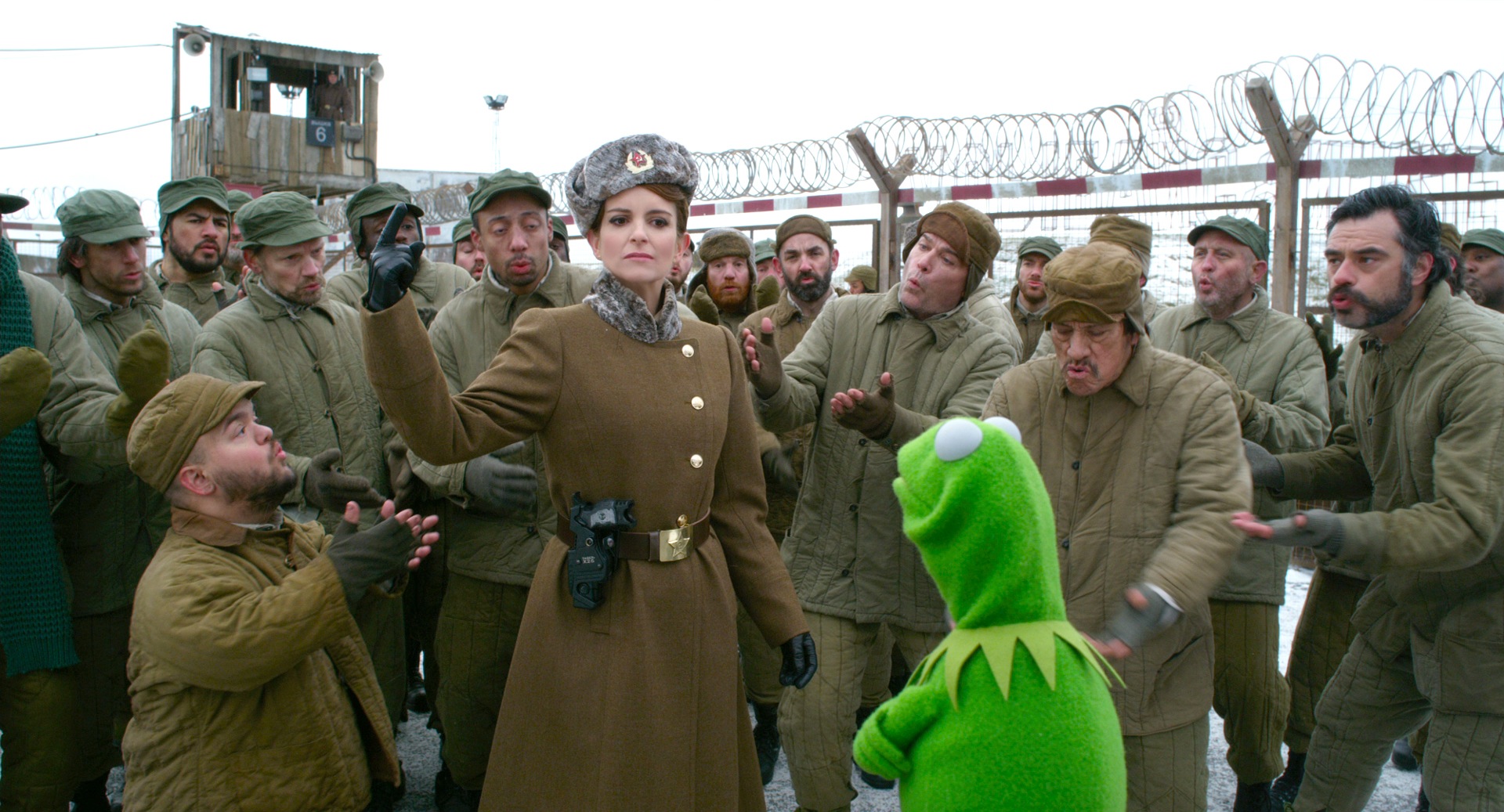
Review: Muppets Most Wanted (2014)

MUPPETS MOST WANTED

Like they say in the opening number, sequels are rarely as good as the first film – does it make it less so if it’s pointed out in song? After singing about dull and pointless sequels, MUPPETS MOST WANTED threatens to become one.

After their successful revival and last-minute rescue of their beloved theatre, the Muppets wonder what adventures and hijinks are in store for them next. They don’t have to wait for long before slimy talent agent Dominic Badguy (Ricky Gervais) offers his services to help them mount a world tour of their show. Meanwhile, Constantine, the world’s most dangerous frog, escapes from a Russian gulag and manages to switch places with Kermit, to the complete ignorance of his co-stars. What is Constantine’s plan, what will become of the Muppets without Kermit’s level green leadership, and how many celebrity cameos can you cram into one movie?

Narratively, the film is divided into three linked vignettes. The primary one is Kermit’s predicament – how will he escape prison and prove he’s the genuine article? The second is the Muppets’ world tour which acts as a smokescreen for Constantine and Dominic’s crime spree (not a spoiler – it’s in the trailer). The third involves Sam the Eagle and Ty Burrell playing an Interpol agent hunting Constantine and “The Lemur” across Europe. The gulag set stuff is great, and so is the buddy cop storyline. I’ve never seen a police interrogation or an introduction to life in a Russian prison in song before, but they’re both hilarious musical numbers brought to life by the comic genius of Burrell and Tina Fey, both wielding outrageous French and Russian accents respectively.

Most of the world tour storyline (in fact, any scene with Ricky Gervais) is uninspiring. They spent a good portion of 2011’s THE MUPPETS establishing how much of a superfan new Muppet addition Walter was of his idols. He spent his whole childhood and much of his adulthood obsessing over THE MUPPET SHOW, and was instrumental in reuniting the team. And yet it takes him two out of three acts of the film to work out that Kermit has been replaced by a doppelganger with a Russian accent. The other Muppets not noticing is funny, as it’s a running gag that he’s a bit of a buzzkill within the group, but Walter not noticing doesn’t really make sense within the context of the films.

The cameos are a pleasingly random assortment, but most of the famous faces and most of the film references bill be lost on the little ‘uns (how many kids will get a gag about THE SILENCE OF THE LAMBS or THE SEVENTH SEAL?) I’m not going to spoil the majority, because they work best if they surprise you, but Danny Trejo appears as an inmate in the gulag section, and hilariously, unlike his co-inmates Jermaine Clement and Ray Liotta, isn’t given a character name – he’s just Danny Trejo in a Russian prison. He also has the best line in the film, when the inmates are preparing for the end of the year prison show spectacular (don’t ask, it’s a Muppet movie) he claims to be “a triple threat – a singer, a dancer, a murderer!”. Tina Fey gets another great line, after foiling several of Kermit’s predictable escape attempts, she explains that she “has seen every prison movie, even the ones set in space”.

The songs are hit-and-miss. Flight of the Conchords’ Bret McKenzie once again brings a jolly knowing feel to the musical numbers, particular highlights being “We’re Doing a Sequel” which preemptively takes the wind out of most film critics’ sails, and “Interrogation Song” which stands among the greatest police questioning scenes and shows the very best of Ty Burrell’s comic timing. It definitely goes downhill when Gervais tries to sing, and none of the songs, even the good ones, come even close to the genius of “Life’s a Happy Song” or “Man or Muppet” from the previous film.

Unless you hold a grudge against fur and felt, or actively hate having fun, it’s impossible to completely dislike a Muppet movie, but this one does admittedly lose momentum. It’s slow to start, there’s too much going on in the middle, and the finale (discounting the final musical number) leaves a lot to be desired. It’s got highlights for sure, and the celeb contributions are more amusing and over-the-top than they ever have been in the history of big screen muppetry, but overall, Most Wanted ends up firmly in the middle of the Muppet pack.

Muppets Most Wanted has some funny lines, a couple of good tunes and the comedy double-whammy of Tina Fey and Ty Burrell playing entertaining caricatures, but it lacks the sweetness, earnesty and good intentions of its predecessor. It’s a decent enough sequel, but this is a Muppet movie, and that’s something special. The Muppets are cultural icons, and they should encourage you produce something that’s a little more than just decent. SSP


 

Posted in Film, Film Review | Tagged , , , , , , , , , , , , , , , , | Leave a comment

My Favourite…Superhero Movie

X-Men-2

X-Men 2 (2003): Fox/Bad Hat Harry

My favourite superhero movie is X-MEN 2. It’s a bit of a tired analogy to use concerning a sequel, but it really is the EMPIRE STRIKES BACK of comic book films in that it’s bleaker (though still with welcome light moments) and infinitely more complex than its predecessor. The first X-MEN was perfectly serviceable, a good introduction to the Marvel mutants’ world, but wasn’t remarkable. X2 improves on every level, building on what worked in the previous instalment and it’s a riveting ensemble thriller with something to say to boot.

With metal-manipulating mutant terrorist/freedom fighter Magneto (Ian McKellen) incarcerated, a new threat emerges in the form of Colonel William Stryker (Brian Cox), an anti-mutant fanatic who aims to engineer a war between homo-sapiens and homo-superior. The very real threat of all-out war comes to a head when demonic teleporter Nightcrawler (Alan Cumming) infiltrates the White House and apparently attempts to assassinate the American President (Cotter Smith) giving Striker an excuse to lead an assault on Xavier’s School for Gifted Youngsters and kidnap Professor X (Patrick Stewart) and some of his students. With their mentor and their sanctuary taken from them, the remaining X-Men lead by Wolverine (Hugh Jackman) who is still seeking to unlock his mysterious past, must foil Stryker’s sinister master-plan and band together with an unlikely ally…

If the synopsis makes it sound like there’s a lot going on in this super-sequel, it’s because there is. And miraculously, Bryan Singer manages to juggle a huge ensemble cast, a complex plot and impressive blockbuster spectacle to produce something quite spectacular. It’s why I’m so excited he’s returning to the X-fold in X-MEN: DAYS OF FUTURE PAST – this is the kind of material he excels at putting on film! I’m sometimes surprised at how little recognition the X-Men series has received in terms of how it has helped shape the modern blockbuster landscape. Sam Raimi’s SPIDER-MAN might have given the big screen superhero craze real traction, but Singer’s first X-MEN, with its lengthy production and scepticism from many at its parent studio Fox, that was the major risk. The risk thankfully paid off, allowing for a far superior sequel to be made.

The film incorporates a plotline that is now quite commonplace, with our heroes hesitantly joining forces with their adversaries to stop a much greater threat. As good a villain as Magneto is, he’s even more entertaining in an uneasy alliance with the X-Men, quipping about Wolverine not being the sharpest tool in the box (adamantium notwithstanding) and loving what Rogue (Anna Paquin) has “done with her hair”.

The colourful new character additions include Brian Cox’s zealous, genocidal human nutjob antagonist, the hot-headed (sorry) Pyro (Aaron Stanford), a silent but lethal henchwoman with the same powers as one of our heroes (Kelly Hu) and my personal favourite, the gentle, devoutly Catholic blue acrobat Nightcrawler.

Speaking of Nightcrawler, he’s the focus of my favourite movie action scene of all time. The film opens on this indigo devil showing the White House security services just how deadly homo superior can be. It’s a beautiful ballet of violence, of teleportation, smoke, slow-motion and Mozart. It’s effects-driven, but grounded in something more tangible, with real performers executing the meticulous choreography with the help of wirework and crisp editing. Other action highlights made possible by huge advances in special effects include Magneto’s ingenious escape from his plastic prison and the X-Jet being pursued by a pair of military jets through a minefield of twisters created by Storm (Halle Berry).

Though it’s undeniably a big-budget blockbuster, Bryan Singer never forgets to move his characters on, to meaningfully develop them and give them room to breathe. The returning characters from the first film all evolve (pardon the pun), with Wolverine delving into his dark, forgotten past, Rogue and Iceman (Shawn Ashmore) exploring the unique challenges of a mutant relationship, Jean Grey (Famke Janssen) trying to control her rapidly increasing powers, and Magneto and the deadly shapeshifter Mystique (Rebecca Romijn) assisting the X-Men while furthering their own sinister ends behind the scenes. Perhaps Cyclops (James Marsden) is underserved, but in all honesty none of the X-Men movies seemed to get the character, or give him enough to do.

What I also love that Singer brings to the film (despite admitting to not being an avid comic reader) is respect for the source material. He takes it seriously without ever making it a glum viewing experience. He, and co-writers Michael Dougherty, Dan Harris and David Hayter scatter references to the comics throughout, but don’t go overboard. The character and plot shoutouts are there for those looking, but you’re not going to miss out if you don’t spot them.

What every viewer will be able to appreciate is what this collage of mutant characters can symbolically represent. The X-Men, when they first emerged in comics in the 1960s, were there to stand in for the Civil Rights Movement. Today, they can represent anything from homosexuality (Bobby’s mutant “coming out” to his parents) to society’s attitudes to disability or deformity (Stryker’s monstrous treatment of his son). The mutant terrorist storyline might have had a raw impact when the film was released so soon after 9/11, but ten years on, the impression it leaves is no less powerful with what is still going on in the world today.

Days of Future Past is one of my most eagerly anticipated movies of 2014. I dare to hope it’ll be as punchy, well-balanced and thrilling as Bryan Singer’s last visit to the X-Men universe. I pray that the new ensemble cast which has about double the number of characters to dedicate screen-time to won’t be too much. It might very well be an awesome superhero extraveganza, but however good or bad Days of Future Past is, X-Men 2 will remain my favourite superhero movie of all time. What’s your favourite example of celluloid superheroics? SSP

Posted in Film, Film Feature, Film Review | Tagged , , , , , , , , , , , , , , , , , , , , , , , , , , , , | 2 Comments

Review: About Time (2013)

RichardCurtisAboutTime

I know it’s not a cool thing to admit, but I really like Richard Curtis. I love BLACKADDER, THE VICAR OF DIBLEY, FOUR WEDDINGS & A FUNERAL and even LOVE ACTUALLY. Not so keen on NOTTING HILL because it’s too soppy even for me, but generally I’d say he’s a pretty consistently pleasing comic writer-director. Being a Richard Curtis film, ABOUT TIME doesn’t have the slightest edge, but what it does have is a great big throbbing heart and a late emotional surge that leaves a lasting impression.

In this fantastical rom-com, Tim (Domhnall Gleeson) lives a comfortable, sheltered life with his loving family, but has had next to no luck with the opposite sex. Following his 21st birthday, his dad (Bill Nighy) reveals an astonishing secret, that all the men in their family have the innate ability to travel backwards in time. At first he uses his newfound power to tweak his life, to have a second (or third, or fourth) try at mistakes he’s made, particularly in terms of missed romantic opportunities. By chance, he meets the love of his life Amy (Rachel McAdams) but has to meet her all over again when his playing around with timelines erases their initial encounter. The film then focuses on their developing relationship, family life and the weight and implications of the ability to travel back in time at will.

The time travel mechanic of About Time doesn’t really work if you give it more than a second thought. If they can only travel backwards in time, how can they seemingly ping back to the present at will rather than living out their lives again? Ill thought-through as it is, what Curtis does with time travel, and the humanity he brings out of the concept later in the story is impressively soulful.

In terms of stand-out performances, Curtis manages to get the best out of every member of his cast, but Tom Hollander in particular stands out as the wonderfully foul fame-hungry theatre scribe Harry. Rachel McAdams still has the loveliest smile in Hollywood, and though Mary essentially starts out as a plot device, a reason for Tim to keep time-jumping to tweak their relationship, she’s allowed to develop into a much more rounded and real character by the end. Domhnall Gleeson as Tim isn’t – like a lot of reviews have suggested – playing Hugh Grant. In fact he seems to be playing a young Richard Curtis (gangly, ginger and upper-middle-class enough to almost get away with terrible fashion sense) and makes for a likeable, if kind of creepy (but in a harmless rom-com way) leading man. And who in their right mind wouldn’t want Bill Nighy and Lindsay Duncan as their parents?

There was surely more to be teased out of the concept of living every day multiple times (apart from the message about how we should all ideally live our lives, what happens in terms of biological aging?). There’s a line in the film which posits that once you’re bringing up a family, the ability to time travel seems unnecessary. At that point in the film (just over halfway through) I completely agreed. The relationship stuff, as always with a Curtis film was all very lovely, but the time travel element seemed a pointless distraction – a nice idea, and ultimate wish-fulfilment for sure, but not essential to the plot. That all changes in the final act, and a disarmingly brilliant (and tragic) revelation about the rules of time travel provides a powerful gut-punch. It’s Richard Curtis demonstrating he still has unused creative juices, and it’s a wonderful surprise. Beyond this though, the rest of the dramatic elements of the story feel too soapy.

Though the time travel element better serves the film in the final act, before that we have to endure Tim indulging in some superheroics, and this doesn’t work in the slightest. It’s like Hiro trying out his powers in the first season of HEROES, only Tim never gets to wield a katana. That’s where the film falls down, in not consistently delivering on of one of its core concepts. Curtis gets a lot of dramatic potential out of it, but tries to use it to turn the film into something it isn’t. Richard Curtis doesn’t do thrilling, he doesn’t do tense, and he shouldn’t ever try to . I’m also a little disappointed that there was never any attempt to explain why it’s only men who can time travel. Even a throwaway line could have worked, something like “oh, women can time travel too, but they’re not stupid enough to actually do it”.

About Time doesn’t pull off everything it attempts, but it’s probably the only Richard Curtis film that makes you think. It’s funny in his trademark posh, sweary way, and it’s got all the usual heart and syrup, so if you’re not already a fan of Curtis then you won’t be converted.  It’s also got a brain to go with all the chuckles and the awws, and joins GROUNDHOG DAY (though it’s not an instant classic like Ramis’ masterpiece) in the relatively small group of films that approach time travel in a really interesting, intimate, non-sci-fi way. SSP


Posted in Film, Film Review | Tagged , , , , , , , , , , , , , , , , , , | 2 Comments

Review: Saving Mr. Banks (2013)

saving-mr-banks

SAVING MR. BANKS isn’t like many other biopics, and it’s like next to no films about filmmaking. Movies that retell notoriously troubled productions have a tendency to exaggerate and oversimplify for the sake of smooth storytelling, yet often turn out to be much duller than the real events being depicted (see: HITCHCOCK). Saving Mr. Banks has depth, and as a Disney-endorsed feature it surprises as well, never pulling punches in terms of the really dark places the plot goes (though the House of Mouse has always dabbled in the upsetting) and also in that even good old Walt doesn’t quite emerge unscathed.

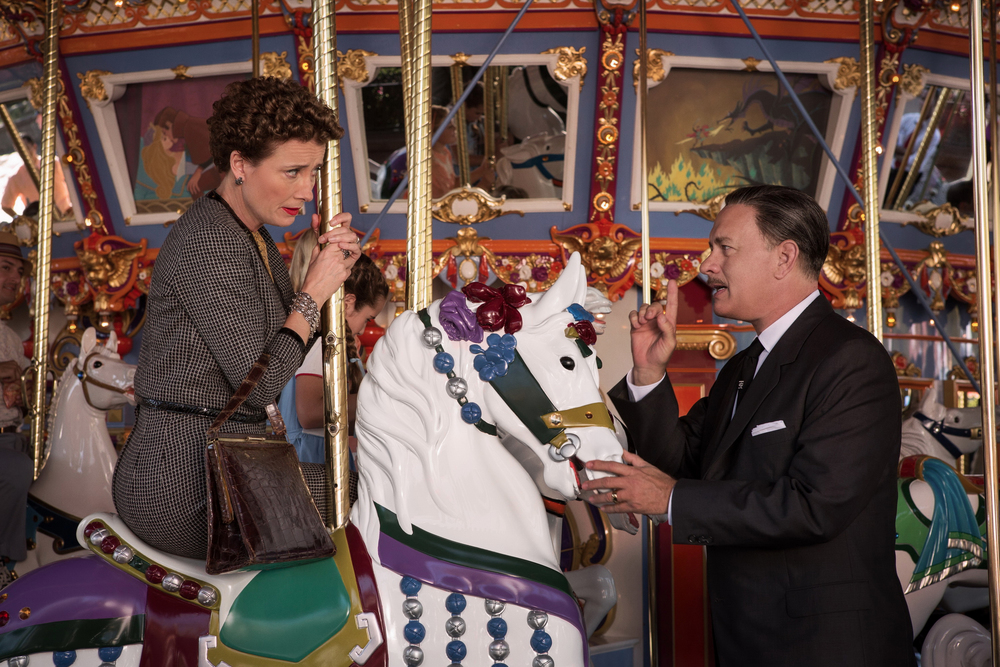
Following a 20-year back-and-forth of pleading, bribery and emotional blackmail, in 1961 P L Travers (Emma Thompson) finally agreed to travel to California to meet Walt Disney (Tom Hanks) and hear his plans for her beloved and precious literary creation, the magic moral nanny Mary Poppins. Travers does not take well to her American hosts, who are ever friendly and accommodating, but far too forward, informal, and, well…cheerful for her liking. Walt, screenwriter Don DaGradi (Bradley Whitford), songwriting prodigies the Sherman Brothers (Jason Schwartzman and B.J. Novak) and her chipper Hollywood driver Ralph (Paul Giamatti) all try and thaw the frosty Travers to little avail, and one of the greatest and most fascinating off-screen cinematic battles in history begins…

Neither Walt Disney, nor the story’s main focus Travers are presented outright as the baddie, but both are shown to be hugely creative forces of nature very used to getting their own way. They both have their reasons for loving the character of Mary Poppins, and their driving force, their main motivation in life, can be traced back to the beginning in both their cases. They’re presented as polar opposites in some respects (manner, public persona, loves and hates) but very similar in others (imagination, near-obsessive attachment and deeply-rooted childhood issues). Whether or not much of the story is true to life, and no matter how much dramatic embellishment was involved, Saving Mr. Banks makes for a great story to tell, and is a wonderful, moving and tender way to spend a couple of hours.

As the celluloid MARY POPPINS we all recognise begins to emerge (much to the horror of Travers) the film shifts tone from gentle biog-comedy-drama and threatens to become a full-blown musical. As the Shermans belt out tune after tune, and their catchy numbers blend into Travers’ emotionally scarring memories of her father (Colin Farrell), the considerable double-whammy of heart and soul is disarming, and will reduce all but the stoniest hearted to lip-quivering wrecks. The flashbacks themselves, and how they fit within the main narrative feels organic and elegant, seamlessly reinforcing key character developments rather than feeling like gimmicky, unnecessary distractions. We’re there with Travers as a wide-eyed and imaginative young girl (the enchanting Annie Rose Buckley) playing with her father in the sun-drenched Australian countryside one moment, then we’re whipped back to the older, more cynical author grimacing at jolly showtunes.

Often with biopics, with big stars playing another iconic persona, there isn’t much room for subtlety, and the script often leaves a lot to be desired – “it’s not what you say, but how you say it” as the saying goes, and audiences are often distracted from weaknesses in the words on the page by a chameleon on the screen. This is not the case in Saving Mr. Banks. It has subtlety, nuance and wit. It’s one of the strongest all-round screenplays of last year, and credit should go to the intelligent writing of Kelly Marcel as well as the impressive performances of Thompson and Hanks (and Farrell also deserves recognition). She gives Disney and Travers (father and daughter) – whatever faults they had in life – a real humanity, an utterly compelling empathy. She plays with the real events, streamlining them and always tying what happens back to what made these two remarkable people who they were. It makes for a fascinating character study. The parallels between Travers’ formative years and the characters she created (and Disney and co. tried to warp) are clever and affecting, from the author using the names of people she knew as a child in her books, to her incorporating a idealistic “what if” of her father’s fate in the character of Mr. Banks. Again, much of it might have been made up, but it works really well for the story, and everything serves a purpose.

Director John Lee Hancock and Marcel do get some key details right – the Sherman Brothers’ mannerisms and performance style, Travers’ distaste for animation (and Dick Van Dyke), Disney employees’ behaviour towards their formidable leader  (using “man is in the woods” after BAMBI as code to announce Walt’s arrival) and we even nearly get to see Walt smoking (those in charge of Disney’s public image wouldn’t quite allow that to be depicted, but we do get his booming smoker’s cough and him hurriedly stubbing out a cigarette).

It might not be revolutionary, in fact it’s proudly old-fashioned, but Saving Mr. Banks is an extremely well-rounded, sturdy and thoughtful piece of filmmaking. A documentary might reveal more about what actually happened (especially if someone miraculously managed to silence the Disney lawyers) but the story embellishments, musings about what might have happened, and two thoughtfully layered lead performances with able support from fellow cast members always emphasise one thing above all – character. The film works as a biopic, as a comedy-drama-musical about an infamously troubled film production, but where it really excels is as a character study, a film about what made two giants of imagination who they were. SSP


Posted in Film, Film Review | Tagged , , , , , , , , , , , , , , , , , , , , , | Leave a comment

Review: Captain America: The Winter Soldier (2014)

captain-america-winter-soldier-trailer

This isn’t a hug of friendship!: Marvel Studios

You’ve got to hand it to Marvel, they haven’t played it safe for a while. For me though, the risky elements of CAPTAIN AMERICA: THE WINTER SOLDIER don’t quite pay off as they should.

Following the events of THE AVENGERS, Steve Rogers/Captain America (Chris Evans) is living in Washington, D.C. and gradually getting used to life in the 21st Century. He still works for espionage agency SHIELD with Natasha Romanoff/Black Widow (Scarlett Johansson) and follows Nick Fury’s (Samuel L. Jackson) orders, but is becoming uneasy with being “the world’s janitor”. Following a morally questionable mission to reacquire a ship taken over by pirates, Cap, Fury and Black Widow are betrayed by Alexander Pierce (Robert Redford) who wields the full might and resources of SHIELD, in addition to the services of a mysterious asset, The Winter Soldier (Sebastian Stan). Cap is on the run, his past is coming back to haunt him, and he wants answers.

The quality of the action is astounding. The massively-scaled stuff sometimes just becomes a blur of CGI, but there’s a lot of bone-crunching, visceral fisticuffs in the film too. If you thought Cap was limited to just throwing, catching and rebounding his iconic shield, you were wrong. He uses it as a tool, a finely tuned weapon, and it’s blended seamlessly into the  exciting fight choreography, all captured in crisp cinematography and striking, BOURNE-style fast-cuts. Black widow still elegantly spins and flips round her opponents before delivering the lethal final blow (at one point with a bit of metal piping). Even Nick Fury gets in on the action this time round, in what must be one of the most destructive and hilariously over-the-top car chases outside a FAST & FURIOUS movie.

Most of the cast bring their A-game. Evans is still charming, and sells Cap’s earnest, natural born goodness and his need to fight for the little man. The plot also allows for Evans to bring more complexity to his character, who in THE FIRST AVENGER often came across as a vanilla hero. Johansson again hints at much more going on below the surface of Natasha Romanoff’s sexy/deadly outer image, and is an appealing character pairing with Cap. The always excellent Anthony Mackie, playing Sam Wilson/Falcon, a veteran-turned-counsellor is definitely the most believable character in the film despite wearing a high-tech “wing suit” for much of the run-time.  Samuel L. Jackson does what he does. Sebastian Stan does well as a pained, complex villain, though there is certainly more tragedy to the character that could have been capitalised on. Sadly, the addition of acting muscle in the form of Robert Redford doesn’t benefit the film. He coasts, doing the bare minimum, and it turns out that he plays a really dull character once it reveals what Pierce’s ultimate game is.

The film is funny. I liked a gag about how Cap is slowly coming to terms with his new time period (it involves a notepad of things to catch up on from his 60-year absence, including Marvin Gaye and STAR WARS). Black Widow at one point uploads some incriminating evidence to the internet before commenting seconds later that “it’s trending”. There’s also some nice back-and-forth banter between Cap and his two buddies Widow and Falcon, and another great Stan Lee cameo.

Let’s get on to what I didn’t like. Most films, especially something as mainstream as a superhero movie, would try and disguise its political message (if it had one) and certainly never explicitly advertise it. The Winter Soldier batters you around the head with its politics from the very first shot. It tackles the concept of the USA’s questionable role as a police force of the world in conflicts over the last couple of decades in a couple of catchy soundbites about pre-emptive military action (“I thought the punishment came after the crime”) but then falls back on the laziest possible paranoid justification for the evils of the world. It’s a left-wing argument on the one hand, and a more right-wing wish-fulfilment on the other. It just can’t make up its mind, so both sides of the argument are undermined.

There are some irritating breaks in logic throughout the film that pull you out. Being a superhero film is not an excuse to not make sense – the logic can be bizarre, but it has to be consistent within its own film universe. Why, with all their resources and near-sci-fi-level technology (there’s even a line that establishes they can tap into any security camera’s feed) can’t SHIELD track their targets with facial recognition software? Rogers wears dark glasses to go undercover, Romanoff puts on a hoodie – surely that shouldn’t fool an all-powerful intelligence agency? And why does Cap still defend Nick Fury’s integrity after discovering he approved crafting WMDs from alien technology behind his back in The Avengers?

The way the plot is constructed could also be tighter. I know there’s a lot going on, a lot of ground to cover, but scenes rarely feel like they’re following in sequence, and tend to feel too loose, and sometimes the cause-and-effect is incomprehensible. All too often I was asking “why?” even when the revelations started coming. Another sign of bad mystery screenwriting is not revealing anything right up until the final act when you dump every reveal in a big, unappetising pile in front of the audience. You need to drip-feed, give the viewer something to mull over on their journey. It’s lucky the central characters are so much fun to be around, or the connecting tissue between set pieces might seem pretty pointless, only there to delay us finding out anything concrete.

The film doesn’t have the living comic book pleasures of The Avengers or the perfectly judged twists of IRON MAN 3 (there are twists, but they’re either overblown or too easy to guess). I know it’s an increasingly common thing to compare Marvel’s output to what has come before, and The Winter Soldier perhaps hints at the studio moving on to pastures new, but I’m not sold yet.

It’s much better than Cap’s debut, which was a good satire of wartime jingoism but a dull superhero movie, and there’s certainly a lot going on, but The Winter Soldier, for me, has as many drawbacks as things to recommend. It’s thrilling, it’s funny, it’s ambitious, but it’s overly-simplistic in what it has to say about the world, unsubtle (being a superhero movie isn’t a ready-made excuse for that) and despite lengthy dialogue scenes discussing what is happening, the plotting feels disconnected and hurried. I can understand why a lot of people have taken to it – it is unlike any film Marvel have released before – but personally I can’t get past the inconsistency. SSP

Posted in Film, Film Review | Tagged , , , , , , , , , , , , , , , , , , , , | 6 Comments

Review: The Lego Movie (2014)

the-lego-movie-movie-wallpaper-19

THE LEGO MOVIE could so easily have been awful. Many, including myself, expected nothing more than a cash-in, an extended advert for pricey plastic blocks. Thankfully, it’s so much more. It’s sweet, funny, bouncy and clever, an animated adventure for our age, and proof of what is possible in terms of adapting an intellectual property.

Our hero is Emmet (Chris Pratt) a completely unremarkable drone, content with his place in a consumerist world built around strict rules (and built from literal instruction books). While finishing his day’s work at a building site, Emmet runs into Wyldstyle (Elizabeth Banks) a sexy rebel who seems convinced Emmet is destined to save their world from the Tyranny of Lord Business (Will Ferrell), who has a master plan to secure his place at the top forever more. Wyldstyle’s mentor, the blind wizard Vitruvius (Morgan Freeman) promises to teach Emmet to confront his destiny as the fabled “Special” and the heroes (including Will Arnett’s Batman and Charlie Day’s 1980-something Space Guy) prepare for war against Lord Business, his lieutenant Bad Cop (Liam Neeson) and their army of evil robots. And with all that, a 1 hour 40 minutes endorphin rush begins.

Under the stewardship of co-writer-directors Phil Lord and Christopher Miller (CLOUDY WITH A CHANCE OF MEATBALLS, 21 JUMP STREET) The Lego Movie strikes just the right tone. It’s knowing without being smug, it references other films but isn’t overcompensating for a lack of substance like the less successful DreamWorks films, it’s sweet and heartfelt without feeling overly sentimental. In short, Lord and Miller walk a fine line but pull it off in fine fashion.

The casting is faultless. Chris Pratt is effortlessly likeable, and has the range to bring across the ultimate tragedy of Emmet as a character, that he was purpose-made to belong, but has still never quite fit in. Elizabeth Banks has the right badass attitude as Wyldstyle, and revels in the complexities of her character, revealing her motivations layer by layer. Morgan Freeman makes you marvel that he’s never been in an animated film before, but the fight for show-stealing performance is undoubtedly between Liam Neeson’s schizophrenic blunt instrument of the law and Will Arnett’s gruff (but thankfully not too serious) Caped Crusader, sharing as they do all the best lines: “Do you see the quotations I’m making with my claw-hands?”/ “I only work in black…and sometimes, very, very dark grey”. Will Ferrell is brilliant as well, but I’m not going to go into precisely why – it’s better to watch the film and find out for yourself. These are all characters in an animated film, a film aimed at kids, and they’re so much more nuanced than they have to be.

The film’s visual style is also very endearing. Though it’s all big-budget CG animation like its market competitors, the animators have intentionally made everything look handmade, jerky, almost like traditional stop-motion, along with simulating environmental effects with Lego pieces. The effort and love put into building a Lego kit should always shine through, and that goes double for the brand’s big screen debut.

The Lego Movie can be enjoyed by a lot of people, but it’ll be the most affecting for those whose childhood would have been the poorer without those little plastic bricks. It’s a film for anyone who’s ever let their imagination run wild, anyone who smashes ideas together to create something odd and wonderful. It’s for anyone who’s obsessively searched for an essential piece on the carpet, and anyone who’s then collapsed in agony after standing barefoot on said essential piece. I challenge anyone who’s grown up with Denmark’s most fun export to not tear up a little in the film’s final act, where our perception of the whole film so far is irrevocably and meaningfully shifted.

I don’t know why Warner Brothers don’t just stick to animation full-time for their blockbuster material. They can’t do a live-action superhero movie without making it glum as hell, but their animated features all have a real energy and gusto to them, and more often than not have more going on in the grey matter than their more “real” counterparts.

Watching The Lego Movie is a joyous experience, and you’d be hard-pressed to find another film this year as smart and as fun as this. It’s a great animated film with compelling characters and gags aplenty, as well as exhilarating set pieces and tongue-in-cheek references to the titanic toy brand’s identity. It’ll please children and adults alike, but it’ll be something truly special for anyone who’s ever fallen in love with Lego. As Lego lovers know all too well, it’s not an obsession you ever really grow out of. SSP

Posted in Film, Film Review | Tagged , , , , , , , , , , , , , , , , , , | Leave a comment

Top 4: Guillermo del Toro

hellboy2

A mine of originality and a committed visualist, Guillermo del Toro is one of the most talented and distinctive filmmakers working today. His career has spanned over two decades so far, and he’d surely been even more prolific were it not for a couple of career setbacks (most notably abandoning the major commitment of THE HOBBIT out of sheer frustration). He’s made some remarkable films, but what is his best work?

Here’s my pick of Guillermo del Toro’s Top 4 films. Why Top 4? Because shut up, that’s why!

THE DEVIL’S BACKBONE (2001)

Far more than a run-of the mill ghost story, THE DEVIL’S BACKBONE is a nerve-wracking viewing experience with real human drama at its core.

When young Carlos (Fernando Tielve) arrives at a remote orphanage during the final stages of the Spanish Civil War, it is immediately apparent that all is not well. There is an unexploded bomb stuck in the ground outside, sinister relationships between the orphanage’s staff and children, and the ghost of a boy wandering the corridors.

You have all the standard jump scares you’d expect in any horror film, but also drawn out scenes of tension, and the ghost itself, Santi (Junio Valverde) is brilliantly realised, managing to evoke the right mix of fear and sympathy from the audience.

“What is a ghost? A tragedy condemned to repeat itself time and again? An instant of pain, perhaps. Something dead which still seems to be alive. An emotion suspended in time. Like a blurred photograph. Like an insect trapped in amber.” This opening question from the philosophical Dr Casares (Federico Luppi) urges us to look past what scares us, and conquer our fears. This fits in with del Toro’s usual ethos, that his monsters are mostly sympathetic creatures, and should not be taken at face value, as simply evil. This was his first truly great film, and remains among his best today.

BLADE II (2002)

The second outing of the half-vampire “Day Walker” Blade (Wesley Snipes) is a thrilling superhero sequel that tweaks vampire lore just enough to make it feel fresh and exciting. Guillermo del Toro’s first experience of Hollywood (MIMIC) might well have put him off for life, but he bounced back here stronger than ever.

A new and lethal kind of vampire is stalking New York, one that hunts its own kind as well as humans. Blade bands together with a crack team of vampire mercenaries (including Ron Perlman and Danny John-Jules) to wipe out the Reaper genus and halt its path of destruction once and for all.

BLADE II is more aesthetically embellished (it is a del Toro film, after all) and slick than Stephen Norrington’s previous effort, and comes with more of a sense of humour in addition to darker themes. There’s some great seething banter between Blade and the love-to-hate brute Reinhardt (Perlman), in addition to plenty of stylishly brutal action to savour. The film also sees the continuation of one brilliant partnership, and the birth of another. Ron Perlman returned to the del Toroverse after an absence of almost a decade (he was in the flawed but interesting CRONOS) and has been in every English-language film the director has made since. Then there’s Luke Goss, who made for a leftfield choice of villain, but proved he’s really good at complex, sympathetic antagonists, which he again proved in HELLBOY II.

PAN’S LABYRINTH (2006)

PAN’S LABYRINTH is a masterpiece of fairytale storytelling, effortlessly blending the real world with fantasy. Del Toro returned to his roots after a few years in Hollywood, crafting a Spanish-set fable full to the brim with soul, and like the film’s companion piece The Devil’s Backbone, a certain amount of bitterness towards Spain’s past.

Set in fascist Spain in 1944, a young girl, Ofelia (Ivana Baquero), is sent with her pregnant mother (Ariadna Gil) to live in the care of her stepfather Vidal (Sergi López), a ruthless captain in General Franco’s military who is fighting guerrilla rebels. Ofelia loves to read and has a vivid imagination, frequently escapinh the clutches of her brutal stepfather to explore her new surroundings. One such escapade leads to the discovery an ancient labyrinth within which she meets a mysterious faun who promises her eternal life if she completes three tasks for him.

Pan’s Labyrinth is a film of affecting and fascinating contrasts. We are shown the horrific brutalities of war one moment and fantastical beauty the next. One minute we’re watching guerrilla rebels being brutally tortured by Vidal, the next Ofelia is being guided on a quest by delicate fairies. We see these worlds through the eyes of Ofelia, through the eyes of an imaginative 12-year-old, and therefore the distinctions between fantasy and reality are not clearly defined, but blur into each other. Everything in the film is meticulously designed, from the labyrinth itself to the ancient faun, the fairies and the horrifying array of creatures Ofelia has to face.

Ivana Baquero is a real find, and makes Ofelia a compelling heroine, full of wonder and a real moral drive. Sergi López also makes his mark as Vidal, a detestable but captivating, almost (disturbingly) understandable villain, and we should of course not overlook Doug Jones, an often unsung hero of film who memorably plays both the Faun and the Pale Man.

With Pan’s Labyrinth, Guillermo del Toro continued to prove that not only is he a master of visuals, but of character as well.

HELLBOY II: THE GOLDEN ARMY (2008)

HELLBOY II represents Guillermo del Toro finding a happy medium between the two stages of his career. It’s got the mix of high concept action and easy humour of his more successful Hollywood movies, and it’s got the beauty and heart of his Spanish-Language films.

A few years on from preventing the apocalypse, and all is not well in the life of our favourite big red ape (Ron Perlman). His pyrokinetic girlfriend Liz (Selma Blair) is prone to mood swings and is finding life living with Red difficult to say the least. Meanwhile, the BPRD must also contend with a renegade elf prince (Luke Goss) hell-bent on destroying the world of men to restore the Earth to its unspoilt glory.

While Pan’s Labyrinth is undoubtedly del Toro’s best film, Hellboy II is my favourite. It’s the perfect balance between the two del Toros – entertaining and heartfelt, poetic and  action-packed, funny and emotional. You might well play del Toro trademark bingo while watching – you’ve got folkloric influences, fantastic creatures, clockwork and contraptions and a strong environmentalist message all contained within a very engaging comic book movie sequel. Perlman, Blair and Doug Jones (again playing multiple characters under makeup) are all strong, as are Goss and relative unknown Anna Walton playing the ideologically opposite elf twins. You also get the added bonus of Seth MacFarlane voicing a German spirit contained in a diver’s suit. They set up a third instalment brilliantly in the film’s final act, but if it never actually comes to fruition, then this is stunning final bow for the Right Hand of Doom.

Also, as much as people (quite rightly) harp on about the magic quality of Ofelia’s adventures in Pan’s Labyrinth, it is Hellboy II that contains the best scene of any del Toro film. It’s such a simple, hilarious and warm idea – Hellboy and Abe, two creatures set adrift from their respective worlds, working through the pains of love by getting drunk on Mexican beer and singing rambunctiously along to “Can’t Smile Without You”. It’s a unique, truly glorious sight to behold. SSP

Posted in Film, Film Feature | Tagged , , , , , , , , , , , , , , , , , , , , , , , , , , , | Leave a comment

Review: Ironclad (2011)

Ironclad-02

There have been a lot of historical epics in the past couple of decades – next to the superhero movie, it has become a favourite blockbuster genre, and tends to be more favoured come awards season. Though it flew somewhat under the radar on release, IRONCLAD is much better than the majority of its Medieval-set peers. It’s slightly better than BRAVEHEART, it’s much better than KINGDOM OF HEAVEN, and it’s a whole lot better than Ridley Scott’s ROBIN HOOD.

Loosely based on events in the First Baron’s War (1215-17) where (in brief) an alliance of English noblemen supported by the French monarchy attempted to depose King John after he failed to uphold political reforms brought about by the Magna Carter.  History lesson over, Ironclad follows a lone Knight Templar (James Purefoy) desperately trying to hold Rochester Castle against the Danish mercenary army of King John (Paul Giamatti) with a small band of warriors and misfits, until French reinforcements can arrive.

James Purefoy takes the lead as conflicted Templar Knight Thomas Marshall, which makes sense since Purefoy sits right next to Russell Crowe and Sean Bean as the most prolific historical action hero. Purefoy is great at glowery seriousness, and comes into his own twirling around a longsword in the heat of battle. The cast is full of British character actors doing their thing – Brian Cox as a grizzled nobleman, Jason Flemyng as a loveable rogue, Charles Dance as the official (in this case, a bishop) pulling the strings. The whole cast are clubbed into submission though, by the sheer snarly brilliance of Paul Giamatti as a terrifying, wrathful King John.

Ironclad is a film that’s made in the details. Most filmmakers wouldn’t bother with the details, but they make the film world work, and give it weight. From Marshall sharpening his sword with a scrap of chainmail, as he would while on a lengthy campaign in the Holy Land, to acknowledging how much power the written word, and the Latin written word especially, gave the nobility and the church in Medieval England.

The other thing Ironclad gets right is the absolute brutality of Medieval warfare. The blood, the dirt, the dismemberment; it was ugly, brutal, personal and inelegant. The carnage wrought by a Medieval take on THE MAGNIFICENT SEVEN on waves of attackers is shocking – we get to see the result of boiling oil in the face, axes in the face and a broadsword cleaving someone clean in half down the middle. All the action is captured in an immediate, visceral hand-held style, and along with the grey camera filters and the liberal spraying of blood and lethal showers of dust and masonry, the battle scenes feel more akin to SAVING PRIVATE RYAN than any castle siege film. The warfare isn’t glamorised, it’s hard-hitting, gruesome and well-directed by Jonathan English, and makes you appreciate the horror of fighting in the 13th Century.

What I didn’t like is a really irritating film cliché raising its ugly head, that of the celibate hero breaking his vow of religious devotion for the first pretty lady (Kate Mara) he meets, and seemingly without much persuasion. Just once I’d like to see a priest, or a nun, or any pious character sticking to their pledge and brushing aside the temptation of flesh. It always weakens and undermines the character, and it always invokes a sigh of annoyance from me. But if characters taking a vow of chastity didn’t give in, then we wouldn’t have sex scenes in these films, and as we all know, sex sells.

As engaging and pulse-pounding as the film is for much of its run-time, Ironclad does run out of steam in the final act. Once (spoiler) the siege is broken, we’re given some uninspired scrapping inside Rochester keep, complete with self-sacrifice and a pointless plot device used to artificially inject some much-needed tension when the film has been utterly drained of it. The filmmakers reduced the historically documented Rochester garrison size to make the odds more dire and our heroes mission all the more impossible, but once the enemy forces get over the castle walls it’s frankly ridiculous that the defenders still manage to put up a fight. Plus there’s the obligatory final “boss fight” between Marshall and an imposing opponent who’s only appeared on camera so far to make you want to see what he can do with the business end of a battleaxe. Their fight is brief, lumbering and a little dull, but it’s the only real low-point in the film’s otherwise excellent action.

Ironclad is a surprisingly fulfilling historical action film that manages to rise above its contemporaries through uncompromising battle scenes, refreshing attention to detail, and a frothing madcap villain turn from Giamatti. It’s a film that deserves to be seen more, and may become a bit of a cult classic in the future. A sequel is about to be released, which will surely prove again that lightning can’t strike twice. None of Ironclad’s cast is returning, but at least Jonathan English is back to direct, so the action should still pack a punch. SSP

Posted in Film, Film Review | Tagged , , , , , , , , , , , , , , , , , , | Leave a comment

Review: Mansome (2012)

1335544145371

MANSOME, from documentary filmmaker Morgan Spurlock (SUPER SIZE ME) aims to answer the question of what does being a man mean in the age of the “metrosexual”. Despite featuring entertaining, engaging interviewees giving their opinion on the subject, the debate is never really arrives at a satisfying conclusion. That’s a shame, because the film ends up being an enjoyable, tantalising journey that leaves you ultimately feeling a little hollow and intellectually unfulfilled.

Never above using himself as a guinea pig for his studies, Spurlock here shaves off his distinctive moustache, much to the distress of his young son, who isn’t sure he “looks like daddy” anymore. Following taking the plunge and picking up a razor, we have an amusing scene with Spurlock walking down the street with his son on his shoulders and a massive, bright orange stick-on moustache adorning his face to keep his kid happy. That’s one of the key aspects of the subject that the film keeps coming back to – every man’s “look” is part of who he is, and he becomes very attached to it over time.

The documentary is divided into chapters each focussing on an aspect of masculinity. Moustaches, beards, hair and extensive personal grooming are all covered, with a focus case-study, “experts” and usually a celebrity endorser to add a bit more colour (for example, John Waters champions the moustache, Zach Galifianakis the beard).

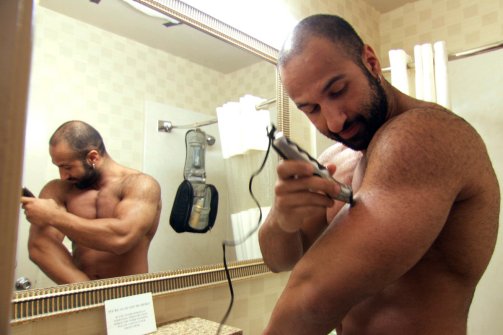
The filmed discussions do go into interesting territories. For instance, a champion beard-grower sees someone tugging on his facial hair as equivalent to groping a woman’s breasts (hardly, but I can kind of see what he’s getting at). We also get a discussion of the culture of self-image and grooming in professional wrestling (articulated well by a naturally hirsute wrestler of Middle Eastern stock who battles body hair daily to match his audience’s expectations of how someone in the ring should look).

The film is, disappointingly, limited to a predominantly heterosexual, American perspective. This makes sense because this is Spurlock’s background, and he’s sticking to what he knows, but it would have been enlightening and would have added much-needed depth to the debate to hear perspectives from outside of the USA, or even one interviewee acknowledging that some men go out to pick up other men in bars. The only times the film promises another stance is a brief comment from one of the talking heads who finds the term “metrosexual” homophobic and deeply offensive, as he sees it as heterosexual men trying to distance themselves from being seen as gay while adopting gay stereotypes. They admit that they groom, but have to make it abundantly clear that they are attracted to women just in case anyone’s perceptions are coloured. There’s also a brief mention of the concept that straight men want to look a particular way primarily to impress other men rather than women, but why this is the case is never really explored. No sooner than these promising lines of questioning are brought up, they’re dropped again as the film wraps up. If only this topics had been brought up earlier and allowed to be adequately explored, it would have made for much more of a thought-provoking hour and a half.

I also found the pre-scripted interludes featuring Will Arnett and Jason Bateman incredibly grating, and a little smug. No matter how self-aware and likeable they both are as personalities, you don’t need to see them getting massages and sharing a hot tub, and it just feels like the producers wanted to give themselves something fun to do. These vignettes might have looked like a fun little idea on paper, but ultimately they’re distracting and unnecessary.

Mansome makes for a very watchable documentary for the most part, and sheds some light on a subject that has become a favourite topic of discussion in the media in recent years. The age-old concept of what it means to be a man is now much more malleable and open to debate, but the debate isn’t presented in the most satisfying way here. It’s fun, and funny to watch, and the content is presented breezily, but we’re still due a really clever, provocative and balanced documentary about how masculinity is no longer so simply defined. I do now know what “bat wings” are when referring to the male anatomy. I really wish I didn’t. SSP

Posted in Film, Film Review | Tagged , , , , , , , , , | Leave a comment

Review: Inside Llewyn Davis (2013)

scene-11

Some critics have compared the Coen Brothers’ latest film, INSIDE LLEWYN DAVIS to their previous downbeat allegory for life and its essential rubbishness, A SERIOUS MAN. There are similarities, but in some ways I see it as more akin to NO COUNTRY FOR OLD MEN in that one of its primary concerns is consistently evoking a particular mood. There’s also similarities with O BROTHER, WHERE ART THOU? in that both films are musicals…only not really. In fact, you can spot references to most of the Coens’ previous work in Llewyn Davis, references that usually refine and mature the original idea. That’s what this film is about in the end, not just following a struggling musician failing at life, but it’s also about the Coen Brothers showing how far they’ve come stylistically, how grown-up they are, even if they still refuse to give definitive answers in their films, perhaps even more stubbornly in their middle age.

Llewyn Davis (Oscar Isaac) is an immensely talented folk musician who has hit an all-time low in his career and his personal wellbeing since the sudden suicide of his musical partner. Broke, depressed, and desperate, Llewyn couch-surfs any friend or causal associate who will have him while he tries to revitalise his career and move on with his life. Along the way, he loses a friend’s cat, discovers his friend Jean (Carey Mulligan) is pregnant, likely with his child, tries to exploit another friend’s (Justin Timberlake) musical success, and hitches a ride to Chicago with an obnoxious, drug-addled jazz musician (John Goodman) and his beat poet driver (Garrett Hedlund). Will Llewyn find success and put his life back together, or will he end up exactly where he started? If you know the Coen Brothers’ work at all, you should be able to guess the answer.

The soundtrack, meticulously constructed by regular Coen collaborator T-Bone Burnett, and mostly intoned and strummed by the ludicrously talented Isaac, is a real humdinger. A film that’s about music has to have a great soundtrack, and Inside Llewyn Davis has among the very best. The songs semi-parody the self-imposed misery and occasional cheesiness of stereotypical folk music, but they’re expertly constructed, catchy songs regardless. The film opens on Llewyn belting out his latest ode to depression in the dingy confines of the Gaslight Café as his scruffy audience watches, seemingly caught in a contemplative trance, bohemian cigarettes and European coffee close at hand. Isaac, as Davis, sings and plays a lot in the film, and proves to be a formidable musical talent. Mulligan and Timberlake get to work their pipes as well, and JT’s folky facial adornment is extremely impressive, as is Mulligan’s range of knitwear.

Davis is the absolute centre of his grey little universe, and the film’s story never shifts focus far from his misery. From forcing whoever he meets to give him somewhere dry to sleep for the night out of sheer pity, to being on the receiving end of a ferocious (and somewhat justified) verbal attack from Mulligan’s Jean, Isaac is always captivating despite Llewyn never even coming close to becoming likable. He’s talented, but he’s difficult in social situations, and he’s self-centred, and he absolutely believes his own hype. You suspect that his abrasive personality has limited his career prospects, as when Timberlake’s Jim generously invites Llewyn to play for him as a session musician and is repaid with surliness and unwelcome criticism of his music’s content (I mean, it is gimmicky and annoying, but Llewyn should be grateful of the work!).

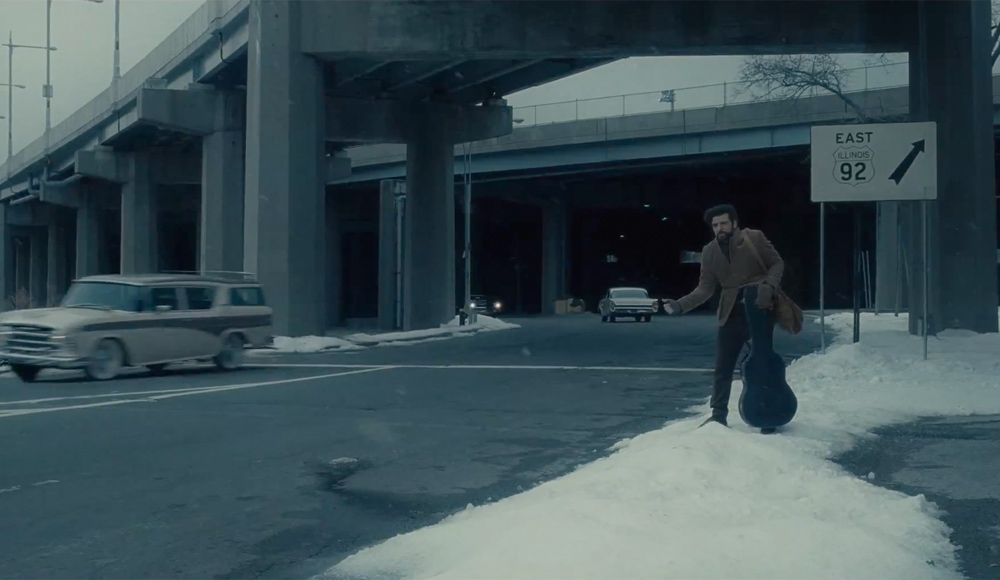
Capturing the Coen world in glum beauty is cinematographer Bruno Delbonnel. Delbonnel’s aesthetic is appropriately bleak for Llewyn’s going-nowhere story, framing the desolate  highways and unforgiving, bitterly cold city streets in as imposing tableaus offering no comfort to our protagonist, and no hope of anything better.

Thankfully, it’s not all doom and gloom. There are a few laughs to be had with character actors (Goodman, F. Murray Abraham, Adam Driver) turning up as the usual Coen oddballs, each given a scene to demonstrate what they do best (Goodman spits insults, Abraham is grouchy, Driver is a human sound effects machine). There’s even a hint of political commentary, a rarity among the Coens’ work, with appearances from young lost souls who have joined the American armed forces not because they want to serve their country, but simply because they don’t see their life as a civilian heading anywhere very fast. Perhaps this is a broader comment on anti-establishment attitudes to the Cold War (particularly with the escalation of the Vietnam conflict imminent), that taking an active part in them was an act of desperation rather than a demonstration of pride.

As much as Inside Llewyn Davis is a road movie, and by definition more about the journey than the conclusion, the finale does leave an indelible impression on the mind. Llewyn stated out a failure and (spoiler alert) ends up still a failure, but more content with his place in the world, and with a (slightly) more positive outlook on life. He may not have yet made it, but he’ll keep trying and one day, through sheer determination, he might succeed (though he’ll have strong competition from a fellow performer at the Gaslight who makes a brief appearance in the film’s final scene).

Apart from the memorable, sterling folk soundtrack and striking cinematography, Inside Llewyn Davis doesn’t quite feel like it’s reached the instant classic status of some of the Coen Brothers’ earlier work, but it’s no less rewarding for being a bit of a slow-burner. It’s a film that I’m sure will be appreciated even more over time, and will be worth repeated viewing as there’s a lot to dissect, and much to enjoy in this rich mood piece. You might even leave with a strange little smile on your face, which is an incredible result of watching a film about a loser looking for a cat and a career in the grey American winter. SSP

Posted in Film, Film Review | Tagged , , , , , , , , , , , , , , , , , , | 2 Comments